Download my Whitepaper here:
By clicking submit, you agree to receive promotional emails and weekly content from Company.

Owner Dependent Business? How to Fix It in 4 Steps
Thursday, November 26, 2026
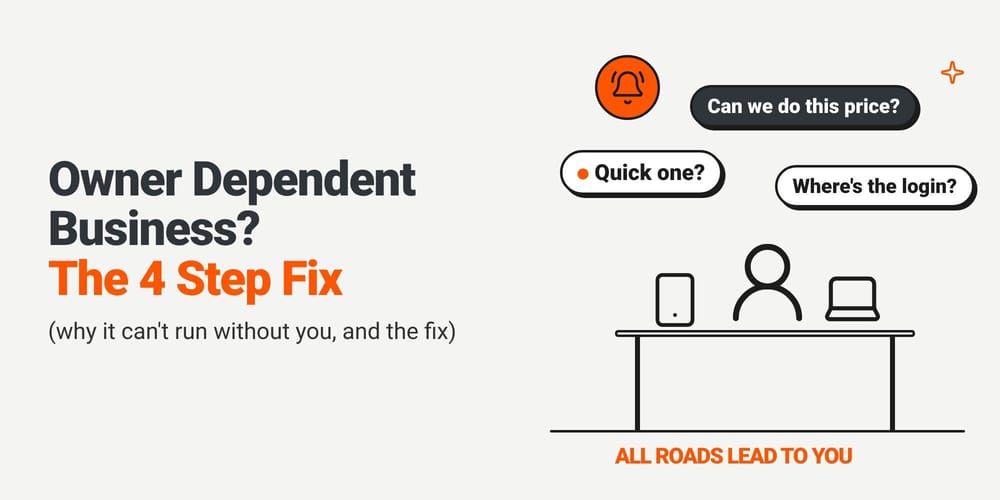
If you were stuck in a hospital bed for two weeks from tomorrow, what would happen to your business? If the honest answer is "it would fall over", you have an owner dependent business. Here is why it happens and the four steps I use to fix it.
Be honest with that hospital question. Because if the business falls over without you, you don't own a business. You own a very stressful job. And you can't even hand your notice in.
In this blog I'll show you why an owner dependent business gets stuck, the three places yours is quietly running through you right now, and the four step fix I've used across the two businesses I run plus the one I've just bought. Stick around for step four. It's the one most owners skip, and it's the one that finally made my phone go quiet.
Prefer to watch? Here's the video this post is built from. It's about eight minutes.
What is an owner dependent business?
An owner dependent business is one where the work only moves when the owner touches it. Sales, replies, prices, decisions. All of it waits for one person.
Here's the picture I want in your head. Your business is a motorway and you're the only toll booth. Every car, which means every lead, every quote and every decision, has to stop at your booth before it goes anywhere. On a quiet day that's fine. On a busy day there's a 20 mile tailback, and you're the one sat in the little box wondering why the business isn't growing.
It isn't growing because the road only moves as fast as you can wave people through.
My phone is the proof. "Can we do this price?" "The client wants to speak to you." "Quick one." It's never a quick one, is it?
Why an owner dependent business costs you more than your evenings
I see this from both sides. When I bought my latest business, the old owner was the business. Every client went through him. Every quote went through him. Every problem landed on his desk. Then he walked out of the door, and guess whose desk it all landed on? Mine.
Here's the bit nobody tells you. I've spent a lot of this year looking at businesses to buy, and when a buyer looks at one that can't run without its owner, they don't see a great business. They see risk. Analysis from Exit Factor, reported by London Loves Business, found that owner dependent businesses that do sell typically go for 20 to 40% less than comparable companies. Plenty don't sell at all.
You're not on your own either. We surveyed 186 UK business owners for The Growth Engine, and 77% said the founder still personally wins most of the new work. And a MoneySuperMarket survey covered by Workplace Journal found two in five small business owners felt burnt out, rising to nearly six in 10 for owners with 10 to 49 staff.
The three places your business runs through you
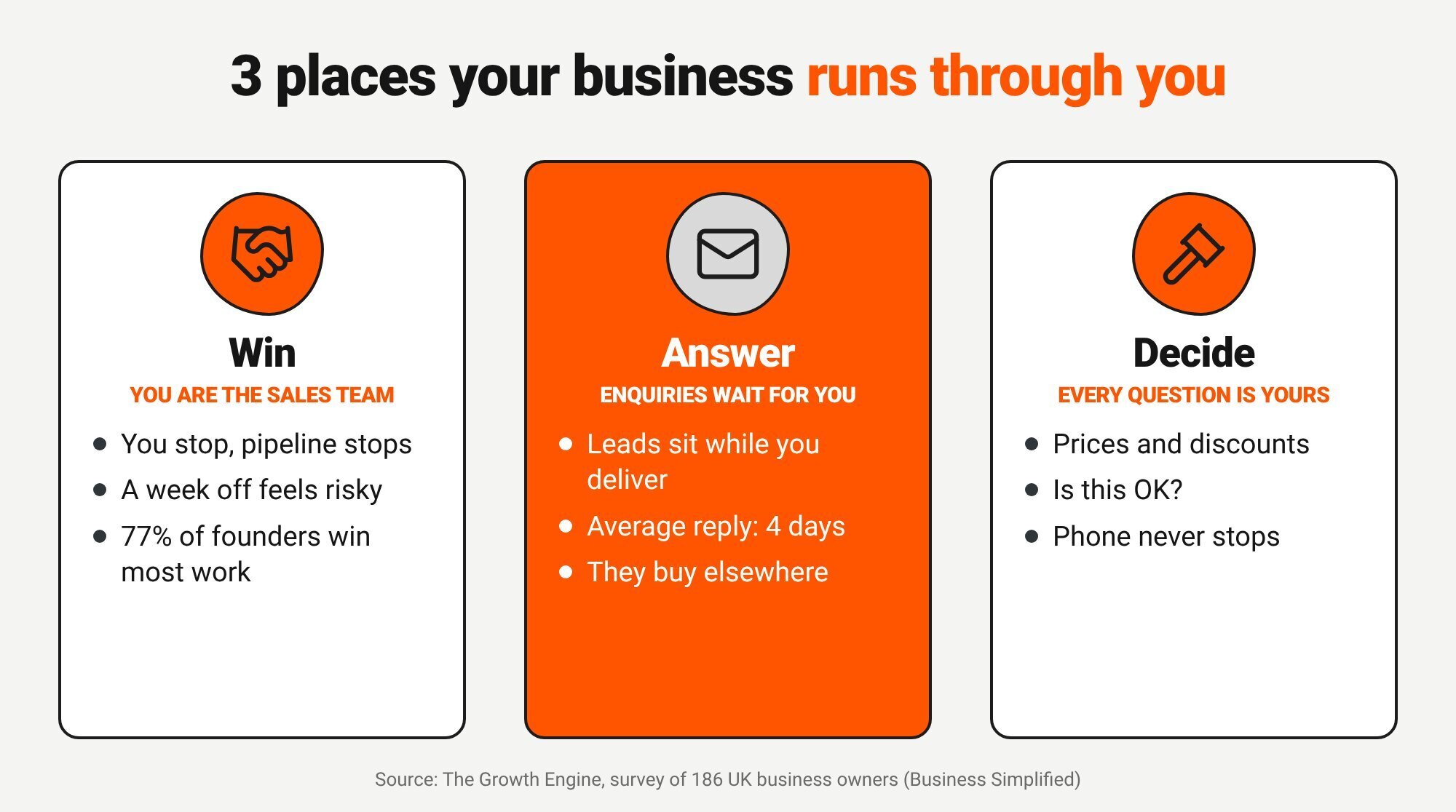
In my experience there are three, and most owners have all of them.
1. You win the work
You're the sales team. If you stop selling, the pipeline stops. So a week off feels like a massive risk and you just don't take it. This is also what causes feast and famine: when you're busy delivering, nobody is selling.
2. You answer the work
Enquiries come in while you're busy delivering, and they sit there. In our survey the average time to reply to a new lead was four days. Four days. By then they've bought from somebody else and forgotten who you are.
3. You decide the work
Every question, every price, every "is this OK?" comes back to you. Which is why your phone never shuts up.
Most owners know all of this already. The trap is how they try to fix it: by working harder. Earlier starts, more hours, emails at 2am. That's like fixing the tailback by telling the toll booth operator to work faster. You'll last a little while and then you'll fall over.
You don't need to run faster. You need more lanes.
Not sure which of the three is your weak link?
The Growth Engine Scorecard takes about three minutes. It scores you on your ideal customer, message, lead channels, follow up and how dependent the business is on you, and puts a £ figure on what your current setup is costing you each year. It's free.
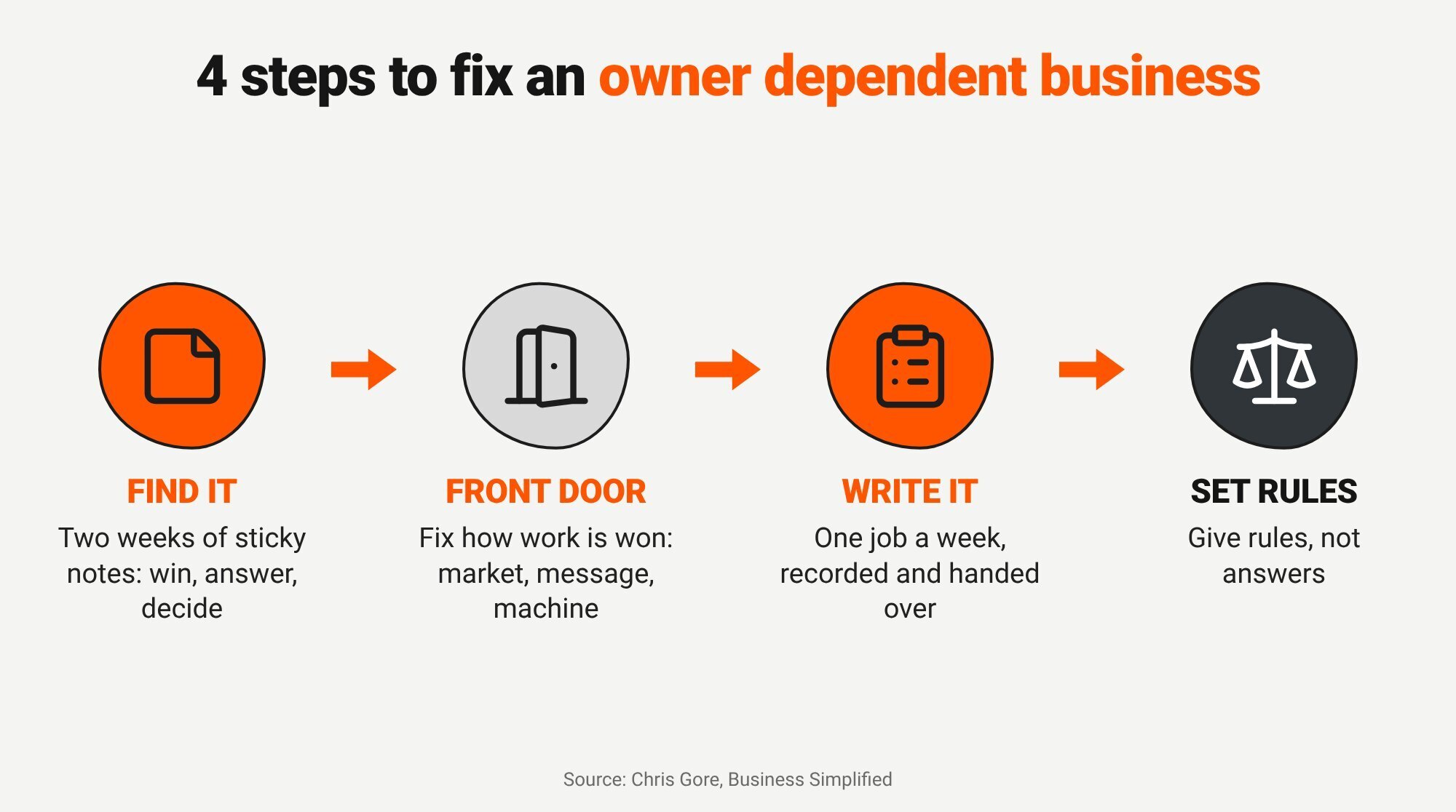
How to fix an owner dependent business in four steps
None of these involve you working harder.
Step 1: Find out where it runs through you
Get a pad of sticky notes. For the next two weeks, every time something needs you, write it on a note. One note, one thing. What was it, could somebody else have done it, and is the answer written down anywhere?
Don't fix anything yet. Just write it all down. At the end of two weeks, stick the lot on a wall. Quite frankly, it's terrifying.
Then sort them into three piles: win, answer, decide. I promise one pile will be far bigger than you expect.
Step 2: Fix the front door first
This is where most people get it wrong. They start by delegating the admin and the operations. It feels productive. But if new work only comes in through you, growth is still capped by your diary. All you've done is free up Tuesday afternoon to spend on sales calls.
So start with how the business wins work. Three things:
- Your market. Can you describe your ideal customer in one sentence? Only 11% of the owners we surveyed could. If you can't describe them, your team can't find them and neither can your marketing.
- Your message. Say what you do in your customer's words, not yours. When the message is right, your website and your content do the selling. When it's wrong, you have to do it in person every single time.
- Your machine. The system that finds, answers and follows up leads without you in the room. First rule: every enquiry gets a reply within an hour from somebody or something that isn't you. A team member with a written script, a template, an AI assistant. Anything but four days.
At Squaredot we built exactly this. Turnover went from £800k to £1.2m in three months, and work from cold leads went from 6% to 59%. That's new business that didn't come through me or my phone. I've written up the full build in how to build a lead generation machine that runs without you.
One warning. Without the market and the message nailed, a lead generation agency will usually fail you, and a senior sales hire is a big bet too (I've done the sums in fractional sales director vs full time).
Step 3: Write it down and hand it off
Go back to your wall. Every week, pick one note. Just one. The next time you do that job, record yourself on your phone talking it through. Turn that into a simple checklist and hand it to somebody.
I was in the military for a long time, and there's a simple rule there: if it isn't written down, it doesn't exist. Same in your business. If the only copy of how you quote a job lives in your head, you're the quoting department for ever.
One note a week. In 90 days that's 12 jobs that no longer need you.
Step 4: Give rules, not answers
This is the one that quietened my phone. When somebody asks you a question, don't just answer it. Give them the rule behind it. For example:
- Any discount under 5% is your call. Over that, come to me.
- Any complaint under £200, sort it and tell me afterwards.
You stop being the answer to every question and start being the person who sets the rules. That's the difference between an owner and an employee with a nicer car.
Then run the test
Take a week off. A proper one. Phone in the drawer. Whatever breaks while you're away is your next sticky note. Come back, fix that one, and go again. If the idea of that makes you feel a bit sick, read how to take a holiday as a business owner first.
When this fix is not for you
Honest bit. If you're a one person business and you like it that way, you don't have to build any of this. Being the business is a perfectly good choice, as long as you've made it on purpose and you know it caps what you can earn and what the business would sell for.
And if you're just starting out, don't spend a month writing procedures. Win some customers first. This fix is for owners with a team who are the reason things are slow. If that's you, there's more on the same problem in how to stop being the bottleneck in your business and in the rest of Honest Truths.
Frequently asked questions
What is an owner dependent business?
It's a business that can't win work, answer enquiries or make decisions without the owner involved. If two weeks away would cause real damage, yours is owner dependent.
Does being owner dependent affect what my business is worth?
Yes. Buyers see it as risk. Analysis from Exit Factor found owner dependent businesses that sell typically achieve 20 to 40% lower valuations than comparable companies, and many don't sell at all.
Where should I start if my business can't run without me?
Start by tracking every time something needs you for two weeks, then fix how the business wins work before you delegate admin. If sales still depend on you, growth is still capped by your diary.
How long does it take to fix an owner dependent business?
It's gradual. At one documented job a week you'll have handed over 12 jobs in 90 days.
How do I stop my team asking me everything?
Give rules instead of answers. Set clear limits, such as a discount or complaint value they can decide on alone, and ask them to tell you afterwards.
Find your weak link in three minutes
Is it the market, the message or the machine? The free Growth Engine Scorecard tells you which of five growth profiles you are and what to fix first in your owner dependent business.

Hi, we are Business Simplified
Growth shouldn’t depend on you chasing every lead. Business Simplified uses real data to fix your pipeline, increase leads and improve sales, so you can lead your business instead of being trapped running it.
Get Our Growth Engine White Paper
We surveyed 186 UK businesses to find out what growth strategies actually work
We published those findings in our "Growth Engine" whitepaper. You can get a copy here.