Download my Whitepaper here:
By clicking submit, you agree to receive promotional emails and weekly content from Company.

Feast and Famine in Business: Why It Happens and the Fix
Friday, November 20, 2026
Feast and famine in business is not bad luck. It happens because you are doing every job in the company, and the one job you can put off is selling. Here is why it keeps happening and the three step fix.
You're the boss. You're also the salesperson, the IT person, the HR director, the marketing person and the one who delivers the work. You are everything to every single part of your business.
And that is exactly why it isn't growing.
In this blog I'll walk you through why feast and famine in business happens, why sales is always the first thing to break, and the system we put together to generate leads so that I could step away from that side of things and grow. It's the written version of a short video, so watch that first if you'd rather listen.
You've become the single point of failure
Here's the biggest challenge companies have when they start to grow. The owner becomes the single point of failure on every single thing.
You hire someone, so you become the HR director. That hire needs login details, so now you're the IT person. You still need to sell, so you're the salesperson. The projects still need delivering, so you're operations as well.
None of those jobs is unreasonable on its own. Together they are a full diary before you've had a brew.
It's not just you either. In our survey of 186 UK business owners, 77% told us they still personally win most of their new business. So most owners are the sales team on top of everything else.
I've written about why so few UK businesses ever reach £1m, and this is a big part of the answer. The business can only grow as fast as one person can juggle.
Why feast and famine in business always starts with sales
When you're that busy, something has to give. So what gives?
It's not delivery. You can't leave operational delivery on a client who has already bought from you. You just can't. They've paid, they're waiting and they'll tell you about it.
It's not the hiring, the logins or the hundred other things that shout at you every day.
What gets left is the one thing that can be left. Selling.
Nobody rings up to complain that you didn't prospect this week. There's no deadline on it. So it slides, quietly, while you keep the rest of the business running. You end up breaking the very thing that feeds everything else.
The feast and famine cycle, step by step
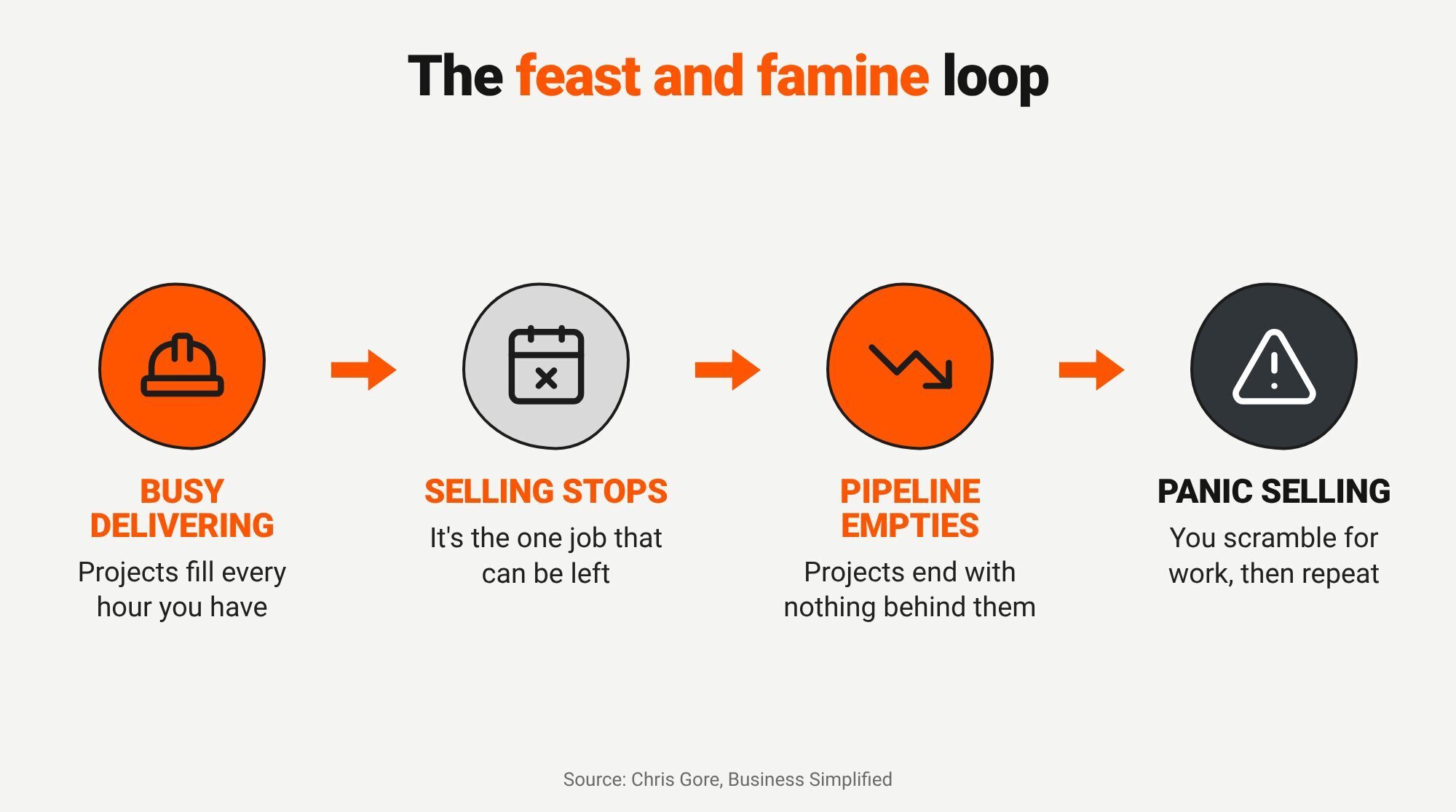
This is how the feast and famine cycle plays out.
- Feast. You're busy delivering projects. Good news, in theory.
- The seeds stop. While you deliver and deal with everything else, you're not planting anything for the pipeline.
- Famine. The projects finish. There's a lull. Everyone panics because no sales are coming in.
- Scramble. You throw yourself back into selling to try and feast again.
Then the work lands, you get busy, and round you go.
I liken it to a farmer planting seeds and waiting for the harvest. If you don't keep planting, the harvest is never coming. You can't plant once, eat for two months and then act surprised when the field is empty.
If you recognise this, you're in good company. 86% of the owners in our research had stalled at one of three growth ceilings, and a pipeline that depends on the owner having a quiet week is one of the main reasons.
Is feast and famine costing you more than you think?
The Growth Engine Scorecard is 17 quick questions. You get a score out of 100, your growth profile and an estimate of what your current setup is costing you.
The fix: turn lead generation into a machine
The biggest thing I advise people to do is make a machine out of lead generation. As soon as you possibly can.
Make it a machine. Turn it on. Keep it running. Don't switch it off.
The point isn't to work harder at sales. The point is that the seeds keep getting planted whether you're busy or not. That gives you the room to concentrate on everything else, because the pipeline isn't waiting for you to have a spare afternoon.
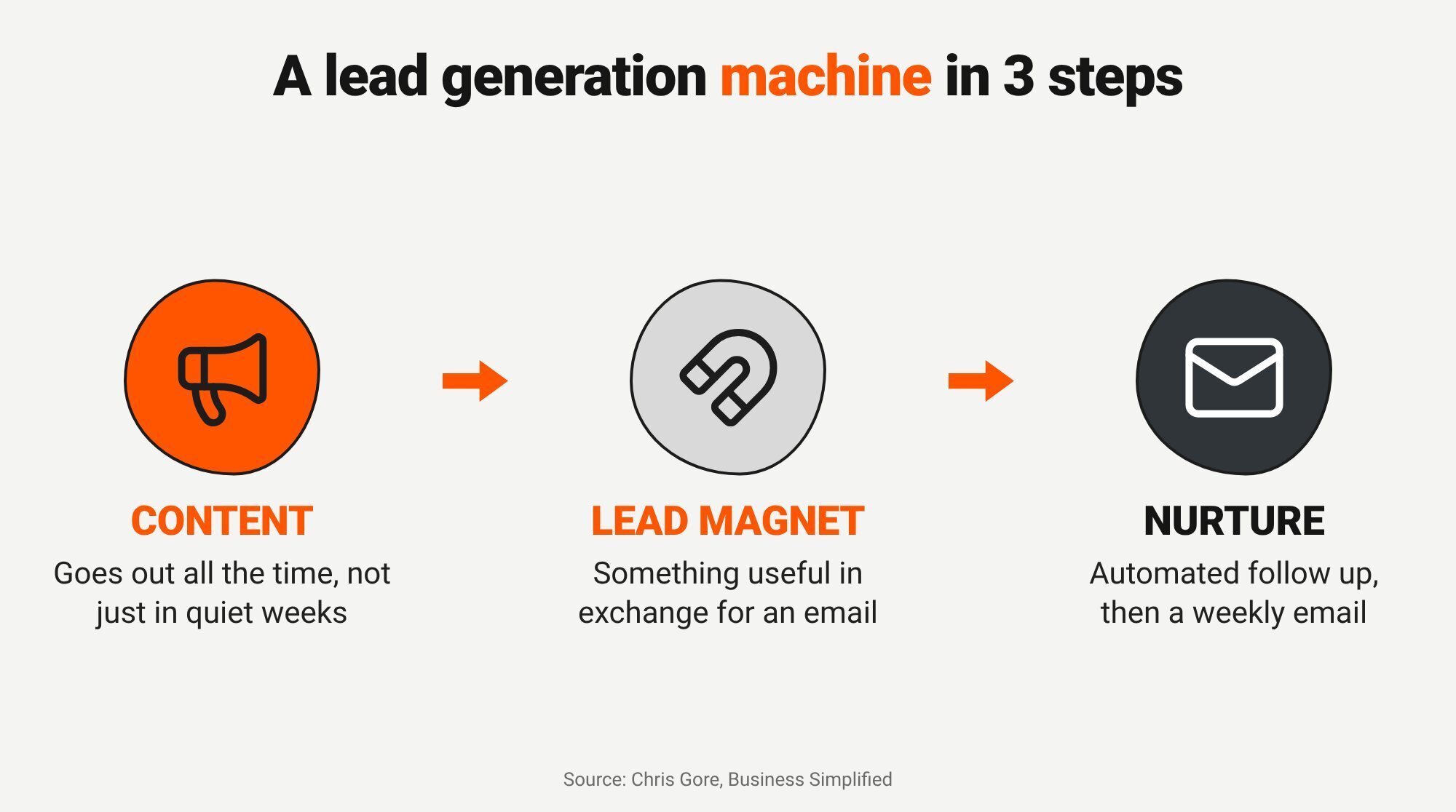
There are a number of ways to do it. This is the three step version we use.
Step one: put content out all the time
Content is what drives people towards you without you picking up the phone. The catch is that it has to go out all of the time, not just in the quiet weeks when you remember.
That doesn't mean it becomes your full time job. You've got a business to run. It means setting it up so it keeps going out. I cover the two main routes in inbound vs outbound lead generation.
Step two: send people to a lead magnet
Your content should drive people to some kind of value add. A lead magnet. Something useful they get in return for putting their hand up.
Say you own a roofing company. Your lead magnet could be a white paper showing how much heat gets lost through a roof when the tiles haven't been sorted. Or it could be a questionnaire: when was the last time you had your roof serviced, and here's what happens if you leave it.
It could be anything. There are loads of options, and I've ranked the best lead magnet ideas for UK service businesses if you need a starting point.
Step three: nurture them until they're ready
Once somebody has asked for the lead magnet, the nurturing starts. They've given you permission to use their email address, so use it properly.
First, an automated follow up sequence that gives them a bit more value. After that, a continuous nurture. Email them every week, basically, over a period of time.
Why does that matter? Because people might see your lead magnet today and not be ready to buy.
I might see something about winter tyres in August. I'm not buying winter tyres in August. I'm buying them when it gets cold. So you need to keep talking to me in between, so that when I am ready, you're the person I go to.
That's the whole thing. Drive the leads automatically. Get them to download something of value. Nurture them with constant communication.
Does it work?
Building this on the sales side is what allowed me to step away from it and grow my business.
When we built the system at Squaredot, the business went from £800k to £1.2m in three months, and the share of work coming from cold leads rose from 6% to 59%.
And for transparency, we do this ourselves. Our lead magnet is a white paper called The Growth Engine. We surveyed businesses doing between £100,000 and £5m in revenue about what business development looks like, and put the findings in one place. It explains, with data, exactly what I've covered here.
If you want the longer version, read how to build a lead generation machine that runs without you.
The honest bit: what this won't fix
A machine like this is not magic, and I'd be lying if I said otherwise.
- It's not instant. Nurturing takes time by design. If you need work by Friday, this won't deliver it by Friday.
- It doesn't fix delivery. If the famine is caused by clients leaving, sort that first.
- It still needs you to set it up. Somebody has to decide what the content says and what the lead magnet is.
- If you switch it off every time you get busy, you've just rebuilt the same cycle with nicer software.
There's more straight talk like this in the Honest Truths section of the blog.
How to stop feast and famine in business this month
Start small. You don't need the whole machine by Monday.
- Write down every job you do in a week. Circle the ones only you can do. It's a shorter list than you think.
- Pick one lead magnet your ideal customer would swap an email address for.
- Set up one automated follow up email, then a weekly one after that.
- Point your content at the lead magnet. Every post, every time.
- Leave it running when you get busy. That's the bit that breaks the cycle.
Keep planting the seeds and the harvest looks after itself.
Frequently asked questions
What does feast and famine mean in business?
It's the cycle where you are flat out delivering work for a while, then have a quiet spell with little or nothing coming in. It happens when selling stops during the busy periods, so there is no pipeline waiting when the projects finish.
Why do small businesses get stuck in the feast and famine cycle?
Usually because the owner does every job. Delivery for paying clients can't be put off, so selling is what gets dropped. When the work ends, there is nothing lined up behind it.
How do you break the feast and famine cycle?
Turn lead generation into a system that runs whether you're busy or not. Put content out consistently, send people to a lead magnet, and follow up by email until they're ready to buy.
How often should I email people who download my lead magnet?
Start with a short automated follow up sequence, then keep in touch about once a week. People are rarely ready to buy on the day they first find you.
Do I need to hire a salesperson to stop feast and famine?
Not necessarily. A salesperson still needs leads to work on. Build the system that produces enquiries first, then decide whether you need someone to handle them.
Find the weak link in your Growth Engine
Seventeen questions, about three minutes. The Growth Engine Scorecard gives you a score out of 100, your growth profile (Feast and Famine is one of them) and an estimate of the revenue your setup is leaving on the table. It's ours, and it's free.

Hi, we are Business Simplified
Growth shouldn’t depend on you chasing every lead. Business Simplified uses real data to fix your pipeline, increase leads and improve sales, so you can lead your business instead of being trapped running it.
Get Our Growth Engine White Paper
We surveyed 186 UK businesses to find out what growth strategies actually work
We published those findings in our "Growth Engine" whitepaper. You can get a copy here.