Download my Whitepaper here:
By clicking submit, you agree to receive promotional emails and weekly content from Company.

How to Build a Lead Generation Machine That Runs Without You
Wednesday, October 28, 2026

The 3-step system that got us past the £5m ceiling, backed by a survey of 186 UK business owners.
Getting a business to £5m is the easy bit.
I know how that sounds. Stick with me. Build a product, find a market, sell the thing. We did exactly that and hit about £5m in three years without breaking much of a sweat.
Then we tried to get to £7.5m, and everything ground to a halt.
Up to £5m, the business was me. I ran sales, HR, legal, the landlord, the leases, the client complaints and the staff complaints. If something needed doing, I was the one doing it. So I did what every founder does next. I hired a sales team to take the load off.
It didn't take the load off. It added to it. Instead of selling, I was managing: sick days, missed targets, and people who were never going to care about the business as much as I do. Let's be honest, as long as the salary and commission land, they don't. We went round in circles for two years, taking two steps back for every step forward.
So I stopped guessing. We surveyed 186 UK businesses turning over between £100k and £5m and asked them one question: what did you actually do to grow without being the bottleneck?
The answer was almost annoyingly simple.
In this blog I'll break down exactly how we run that system across our own two B2B businesses: what we post, where, and how often, the 4-part post framework, the tools we use, and the five-email "soap opera" sequence that books the calls. By the end, you'll have the blueprint for a machine that brings in leads while you're on holiday.
Why hiring a sales team won't fix founder-led sales
Here's the trap. You think, "When I hire, I'll take things off my plate." You won't. You'll swap selling for managing. HR issues, people calling in sick, targets that were perfectly reasonable going unhit. Your eye comes off growth and the numbers slide.
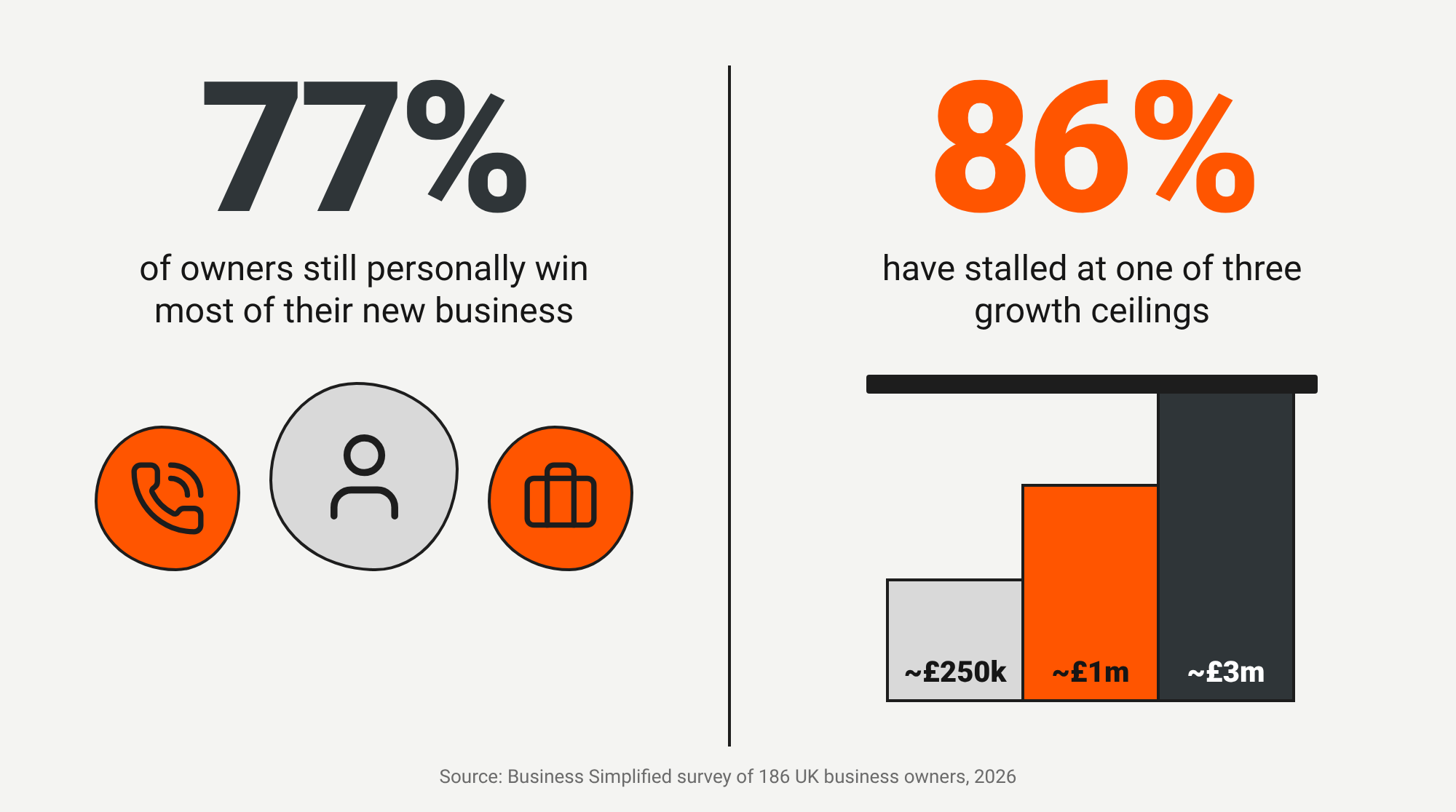
I'm not alone in this. In our survey, 77% of business owners said the founder still personally wins most of their new business, and 86% had stalled at one of three growth ceilings (Business Simplified survey of 186 UK business owners, 2026).
A sales team isn't the answer on its own. A sales team needs a process behind it. Something that fills the pipeline whether you're in the room or not. We've written about why 98% of UK businesses never reach £1m and the Market, Message and Machine framework before. This blog is the practical bit: how we actually run the machine, day to day.
I own two B2B businesses. SPOR designs, deploys and supports video conferencing and meeting room technology. Squaredot is a workplace design consultancy that works out how corporate offices are really being used, then designs around the data. Neither of them sells to Instagram influencers. This works for proper, boring, long-sales-cycle B2B.
Step 1: Build an audience in your sector
The first job is to become the key person of influence in your sector. If you run an HVAC company, you want to be the go-to name in HVAC. The person who pops up every time somebody searches for HVAC services. That's not luck. That's what happens when you show up, every day, with something useful to say.
Which platforms we use, and why
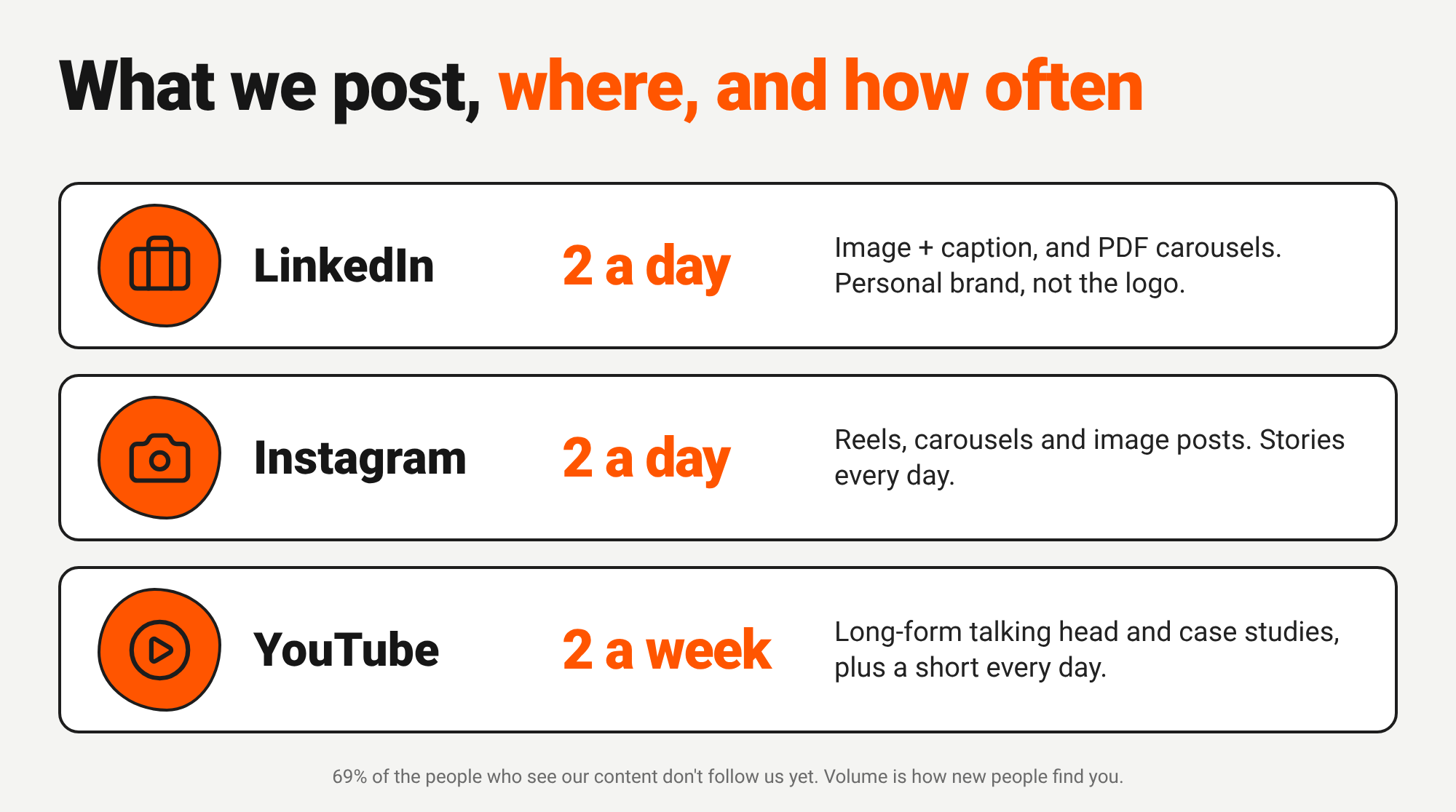
We're active on three: LinkedIn, YouTube and Instagram. Each has a different job.
- LinkedIn is all about personal brand. I post every single day. We use two formats: an image with a caption, and a PDF carousel. Video doesn't get pushed much by LinkedIn's algorithm, so we don't lean on it there.
- YouTube is the biggest lever you can pull. Two long-form videos a week, talking head and case study content. We talk about what a good office looks like, tour client spaces, and explain how one client cut their desks from 200 down to 96. You're not spending 60 seconds with someone. You're spending 10 or 15 minutes.
- Instagram is newer for us. It's short form, so its job is the hook.
Remember this one line: short form gets the hook, long form builds rapport. Someone sees a 60-second reel, clicks through to a YouTube video, gets to know you, then takes the lead magnet. That's the route.
How often should you post?
As often as you possibly can. Gary Vaynerchuk does hundreds of posts a day across different handles. We don't. We post twice a day on each platform, every day, and we keep it consistent.
The question I always get: "Won't people get sick of seeing me?" No. Across our platforms, 69% of the people who see our content don't follow us. They're brand new. The audience you're worried about annoying mostly hasn't met you yet.
Volume also trains the algorithm. Keep putting out the same sort of message and the platforms work out what you're about, then show it to people who care about that thing.
The 4-part post framework: Hook, Setup, Payoff, CTA
This is the most important bit of the whole blog. Every post on every platform follows the same four parts.
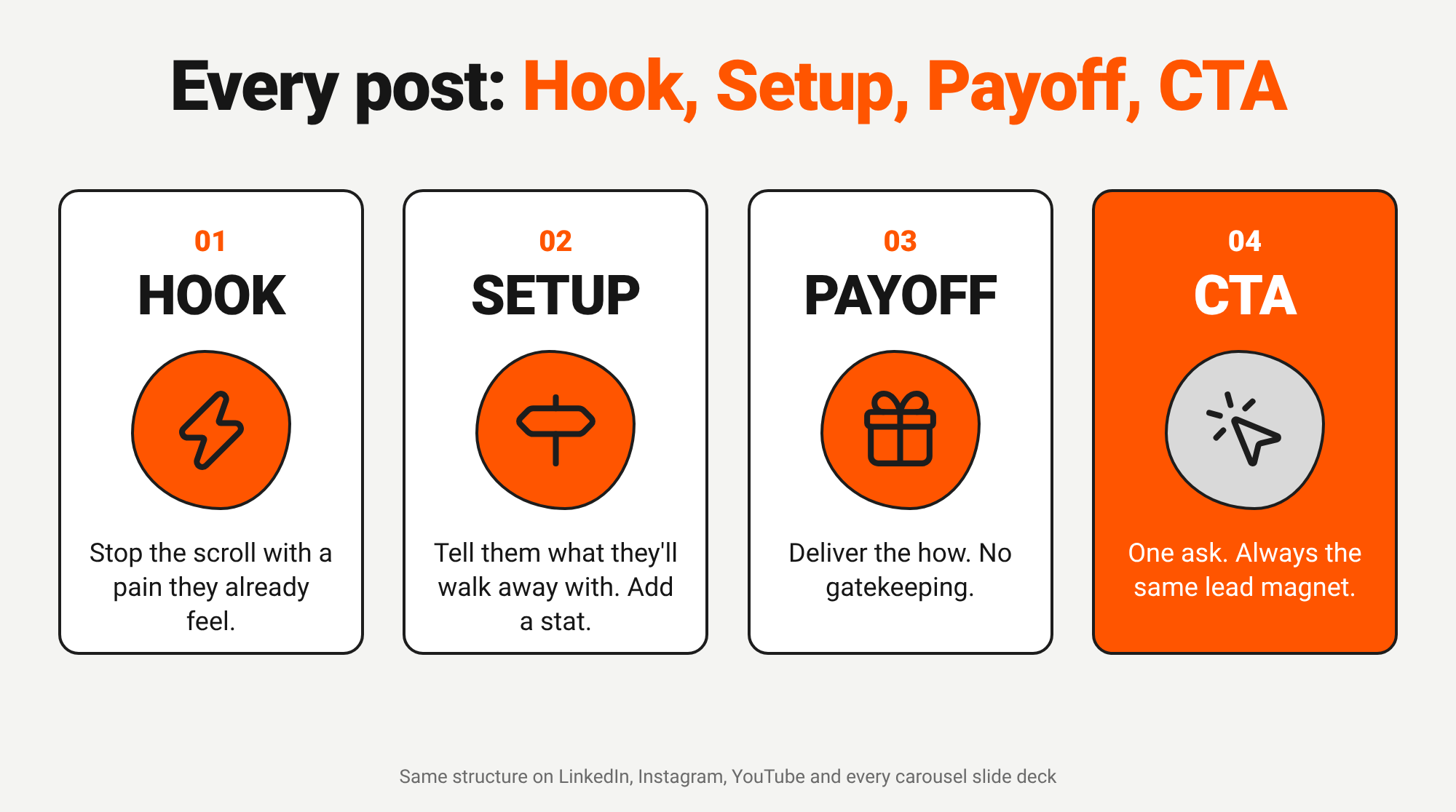
- Hook. Grab attention. A curiosity hook, a question, or a pain. Pain hooks work best. "Do you want to keep working from home?" gets someone's attention fast.
- Setup. Tell them what they'll get by the end, and add a bit of authority. A stat, a result, a reason to keep reading.
- Payoff. Deliver it. Show them exactly how. No gatekeeping.
- Call to action. Always points to one lead magnet. Ours is The Growth Engine.
Here's a business version. Hook: "Do you want leads coming in while you're on holiday?" Setup: "Building an audience came out as the number one growth lever when we surveyed 186 business owners. Let me show you how." Payoff: "We run three channels, every channel gets a post every day, and every post follows hook, setup, payoff, CTA." CTA: "The full findings are in our Growth Engine white paper. Download it here."
Here's one for a trade. Say you sell roofing. Hook: "Is your heating bill going straight out through the roof?" Setup: a stat on how much heat businesses lose through their roofs. Payoff: how your insulated tiles cut that loss. CTA: download the research on the installation method. (The roofing example is illustrative. Use your own real numbers.)
The same framework works for carousels too. Nine slides on Instagram or nine pages of a LinkedIn PDF are still hook, setup, payoff, CTA. It's a story, not a wall of text.
Real example: "Microsoft Teams is watching you"
One of my best performing videos on my YouTube channel, The Future Workplace, has 2.7 million views. The hook? "Microsoft Teams is watching you." Everyone uses Teams. Everyone was working from home. People went, "Hang on, what?"
The setup explained that Teams has built-in capabilities that let your boss see your activity, marked as "productivity", in a few clicks, and that I'd show them exactly what. The payoff spent six or seven minutes in the back end, clicking through the settings and showing what IT teams can see. Then the CTA: if you want to solve this, there's a free resource in the description.
Same four parts. Just longer.
Instagram: reels, carousels, Trials and stories
On Instagram we look at what's already working in our niche and put our own spin on it. Three formats go on the grid:
- Carousels that tell a story slide by slide.
- Reels, 30 to 60 seconds, talking head, with captions. Post them through Instagram's Edits app, which also has a teleprompter built in, so you can read your hook, setup, payoff and CTA straight down the lens.
- Image posts with a strong hook.
Once your account is eligible (for us that was around 1,000 followers), you get Trial reels. Trials only go to non-followers. So you can test as many reels as you like without cluttering your grid, see which ones fly, then post the winners properly for your followers.
Stories do a different job. Your posts deliver the message and the value. Your stories are a day in the life: four, five, six quick clips a day of what you're actually doing. That's how followers become supporters. They get to know you as a person, and people buy from people.
We don't really use DMs. At this stage the only job is building the audience.
How to do all this without losing your life
"Great, Chris. I've got a business to run. How the hell am I meant to do all this?"
Fair. First, don't believe the Instagram gurus. They all have teams behind them. So do we. Here's how ours works:
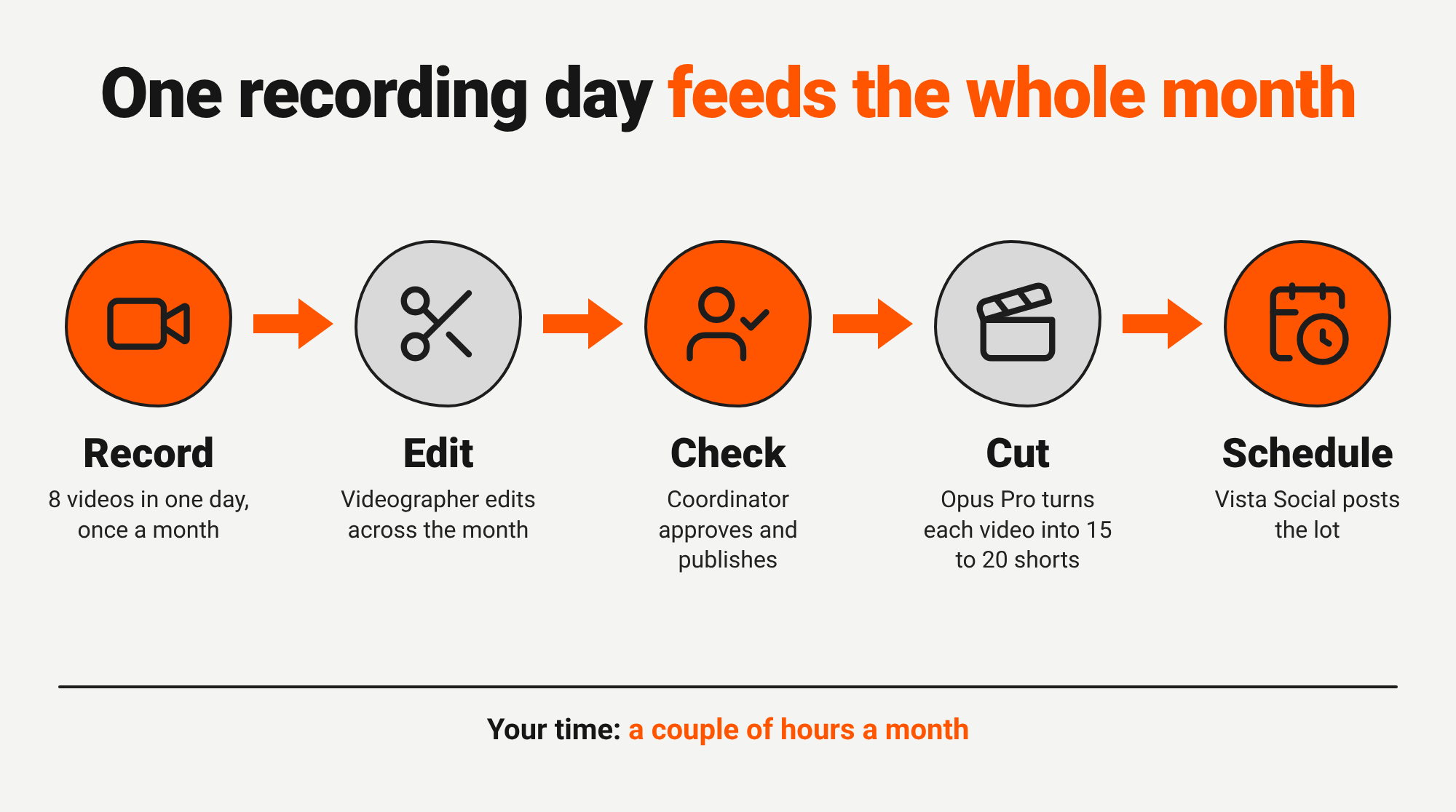
- A videographer comes to my office or house once a month. We record eight videos in bulk.
- He edits them over the month and drops each one into a shared folder.
- Our marketing coordinator checks each video and publishes it to YouTube.
- She plugs the long-form video into Opus Pro, which cuts a 10 to 15 minute video into 15 to 20 shorts. Those go out as YouTube Shorts and on Instagram too.
- Everything gets scheduled in Vista Social. You can bulk schedule LinkedIn and Instagram there, a month at a time.
Instagram reels I mostly do on the fly. Thirty seconds between meetings. No studio needed.
If you don't have a coordinator yet, hire a VA. There are plenty of good ones. Give them access to these tools, walk them through it once, and let them run it.
Step 2: Create a lead magnet worth swapping an email for
All that content needs somewhere to send people. That's your lead magnet: a free (or cheap) thing of real value that someone gets in exchange for their details.
Types of lead magnet that work
- White papers. Our favourite. We have one for SPOR, one for Squaredot and The Growth Engine for Business Simplified. The rule: they have to be real. Real surveys, real data. It takes time, but people can tell.
- Webinars. Host one every Thursday and point every post at it.
- A simple PDF guide. The easiest one to put together.
- A pricing estimator. Brilliant for custom-priced businesses. At SPOR everything is scoped from scratch, which is a long process. An estimator gives buyers a ballpark budget to start working with.
- An AI tool. A little chatbot that helps your customer with one specific problem.
The art isn't having loads of them. It's building one that works, then pushing it constantly.
Anatomy of a landing page that converts
Your CTA links to a landing page. That page does one job: get the download.
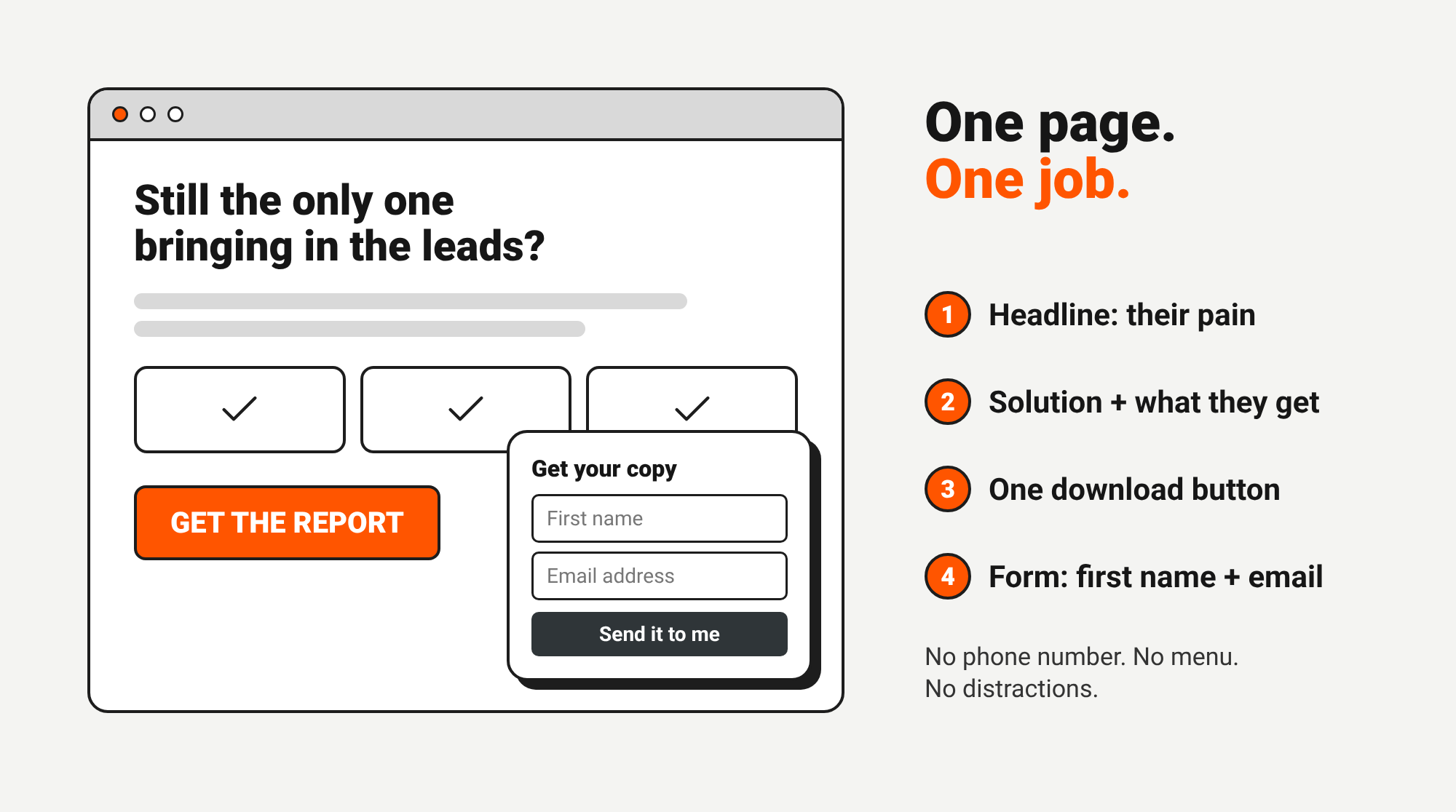
- A headline about the pain the lead magnet solves.
- The solution, and exactly what they'll get when they download it.
- A button that says something like "Download the white paper here".
- A form that asks for first name and email address. That's it. No phone number. Make it frictionless.
Don't just give the thing away with no form. The whole point is capturing who they are so you can follow up.
Your website isn't about you
Companies love an About Us page and a full history of how long they've been trading. Nobody cares. People land on your website because they've got a pain they need solving.
So the hero section at the top of your homepage should be your lead magnet. Go and look at SPOR's and Squaredot's homepages. Yes, there are case studies and other ways to get in touch. But the main goal for every visitor is to download the white paper.
And it works. Squaredot built this system and went from £800k to £1.2m in three months, with work from cold leads jumping from 6% to 59% (The Growth Engine, Business Simplified, 2026).
Want the data behind this system?
We surveyed 186 UK business owners turning over £100k to £5m. The Growth Engine shows what the ones who broke through actually did.
The tools to capture and follow up
Whatever you use, it needs to do three things: capture the details into a CRM, trigger an automated follow-up sequence, and let you broadcast to your list regularly. We use HubSpot. It's brilliant but not cheap. ClickFunnels, Mailchimp and AWeber all do the job too.
The moment someone fills in the form, they get an automatic email: "Thanks for downloading, here's your white paper." Then step three starts.
Step 3: Nurture leads with an email sequence until they're ready to buy
B2B buyers don't find you on the day they want to buy. Certainly not in my businesses. They need approvals, budgets, sign-off. If you only talk to them when you need work, you'll miss them. (We covered why in more detail in our lead generation process guide.)
Nurture is where you build familiarity and rapport digitally, so when they are ready, you're the obvious call. Not shoving it down their throats. Just being there, being useful.
The 5-email soap opera sequence
After the welcome email, we send five automated emails, one every other day. We call it the soap opera sequence.
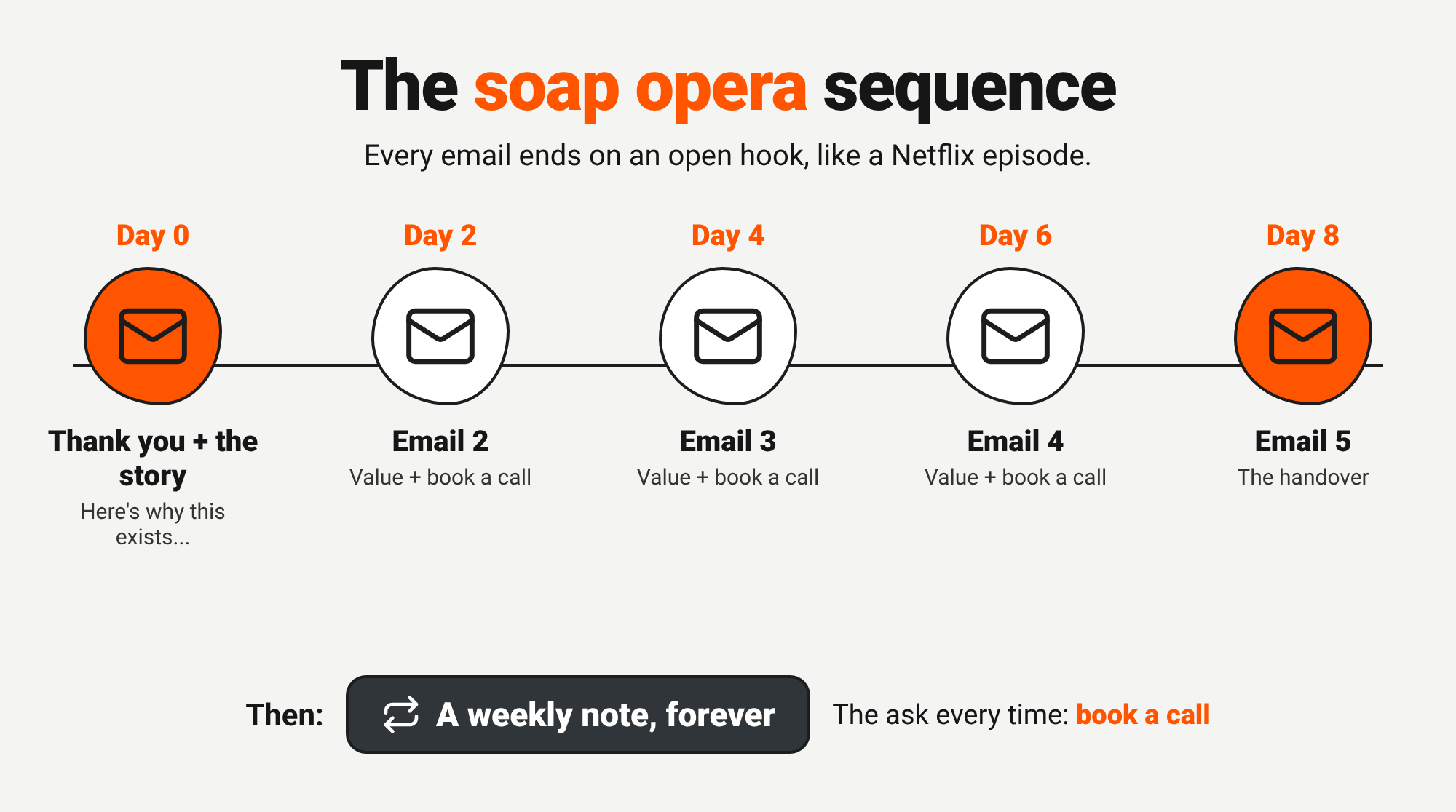
Think Netflix. You never finish an episode without wanting the next one, because it ends on an open hook. Your emails do the same.
- Email 1: Here's your white paper. Then a short story about why it exists: "I hit a bottleneck at £5m. Instead of guessing, I surveyed 186 businesses. One issue came up again and again: people don't know how to build an audience. I'll cover that in my next email." Open loop.
- Emails 2 to 4: Close the last loop, follow hook, setup, payoff, then open a new loop. The big change: the CTA is no longer "download". They've done that. Now it's "book a call". "If you want me to review how you're building your audience, grab a 30-minute slot here."
- Email 5: Wrap it up. "I've sent you a few emails this week, hope you found them useful. If you want a review, book a call. From now on I'll send a weekly email with something valuable on growing your business."
The weekly nurture email
Then you move to a weekly cadence. Every week, one email. I don't write these from scratch. I take what I've already published: a short story about my week, a pain I've felt across the businesses, the latest YouTube video, and a CTA to book a 30-minute call.
And the call doesn't have to be with you. It can go to your sales team. At Squaredot it might be a free site survey: fill in the form, we'll come and look at your space. The trigger goes to whoever handles it.
How to scale your lead generation team
We started with me doing a lot of this myself. Then the team took over. Once the mechanism is working, add people around it:
- A videographer to record and edit. We bulk record eight a month.
- A marketing coordinator or VA to build and schedule the posts.
- A sales team that gets notified the moment someone books a call from an email.
- Operations running the delivery, so you aren't.
That's how we got from £5m to £7m, and it's how the businesses in our survey grew without the founder driving every single meeting. Doing it all yourself isn't sustainable. I tried.
How this blog was made: one voicenote, a month of content
Want to know a secret? I didn't write this blog. I talked it.
I recorded a voicenote of about an hour, rambling through everything above. That got turned into this blog, step by step. Then the blog gets broken down into reels, carousels and image posts for the month, all following hook, setup, payoff, CTA, all pointing at The Growth Engine. My marketing coordinator schedules the lot.
One hour of my time. A month of content. That's the whole point: spend your time where it counts, and let the machine do the rest. Including when you're on holiday.
Frequently asked questions
How often should a small business post on social media?
As often as you can keep up consistently. We post twice a day on each platform. Consistency matters more than the exact number, and most people who see your content don't follow you yet, so don't worry about overdoing it.
What is the best lead magnet for a B2B business?
The one that solves a real problem with real substance. White papers built on genuine survey data work best for us, but webinars, PDF guides, pricing estimators and small AI tools all work. Build one properly and push it everywhere.
What should a lead magnet form ask for?
First name and email address. Nothing else. Every extra field adds friction and costs you downloads.
What is a soap opera email sequence?
A short series of automated emails, five in our case, sent every other day after someone downloads your lead magnet. Each one ends on an open loop so they want the next, and each one invites them to book a call.
Do I need a big team to run this?
No. Start with one recording day a month, a scheduling tool like Vista Social, a CRM with automated email, and a VA or coordinator. Add a videographer and sales team as it grows.
Download The Growth Engine
Everything in this blog is backed by our survey of 186 UK business owners turning over £100k to £5m. The Growth Engine covers the growth ceilings, the five growth profiles, the Market, Message and Machine framework, and real case studies, including Squaredot.

Hi, we are Business Simplified
Growth shouldn’t depend on you chasing every lead. Business Simplified uses real data to fix your pipeline, increase leads and improve sales, so you can lead your business instead of being trapped running it.
Get Our Growth Engine White Paper
We surveyed 186 UK businesses to find out what growth strategies actually work
We published those findings in our "Growth Engine" whitepaper. You can get a copy here.