Download my Whitepaper here:
By clicking submit, you agree to receive promotional emails and weekly content from Company.

How to Take a Holiday as a Business Owner (3 Step Fix)
Monday, November 23, 2026
If you can't take a holiday as a business owner without the whole thing grinding to a halt, you don't own a business yet. You own a job with a fancy title. Here is how I got out of that, in three steps.
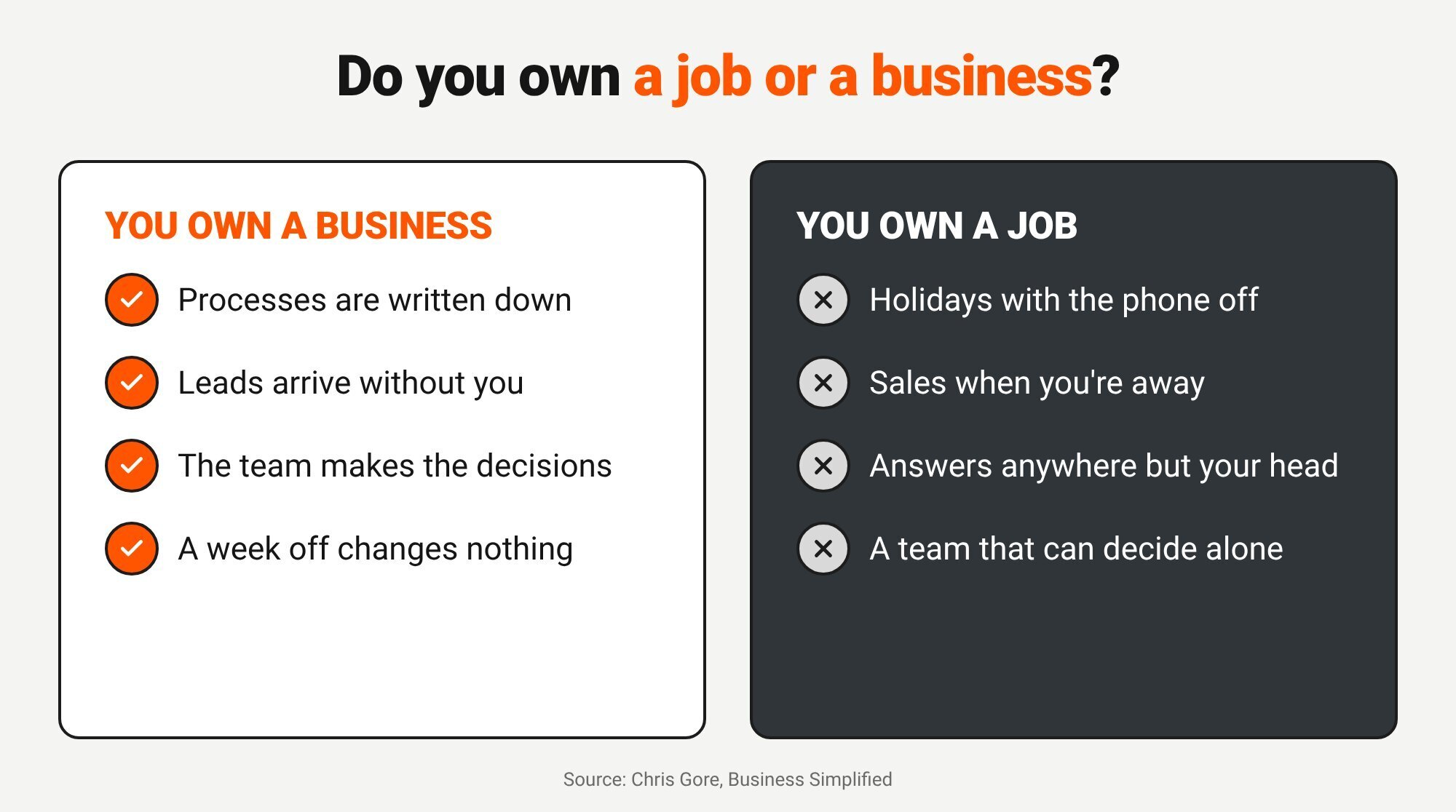
Quick test. If you switched your phone off and went on holiday for a week, would your business thrive without you? Or would it just stop?
Because if it stops, I hate to break this to you. You don't own a business. You own a job with, quite frankly, a fancy title.
In this blog I'll walk you through how to take a holiday as a business owner without everything falling over. It's the road I went down, from being the business to owning a business that runs and operates on its own, and the three things we did to get there. It's the written version of a short video, so watch that first if you'd rather listen.
Why you can't take a holiday as a business owner
We've all been there. We start a business with grand ideas about retiring early with millions of pounds in the bank. We watch the Dragons, everyone talks about investment and it all gets very fancy.
Then reality hits.
You start the business and you end up spinning every single plate. You try to grow revenue, but you're the sales team. You try to grow operations, but you're the person delivering the work.
Then you hire people, and things grind to a halt in a whole new way. Now there are HR issues. Employment contracts. Someone's cat has had a seizure and somehow that's on your desk too.
It becomes overwhelming. And then you book a holiday and find you can't really take it.
So that grand idea of starting a business and spending your days playing golf and fishing doesn't exist. Because you are the business.
You're not on your own with this. In our survey of 186 UK business owners, 77% told us they still personally win most of their new business. If the sales walk out of the door every time you do, a week off is always going to cost you.
It's the same root cause I covered in why feast and famine happens in business. One person doing every job.
I know because that was me
I own two companies. The first is a workplace technology company I started back in 2019. It grew, it went really well, and we then acquired a second business, an interior design company called Squaredot.
So I know exactly what this feels like, because it was me. Not being able to go on holiday properly for years and years at a time.
You know the big pains. You can't go away. Your phone is always on. Your wife is giving you the side eye because you're meant to be sunbathing with a mojito, and instead you're staring at your inbox again.
So how did we fix it? There were three things.
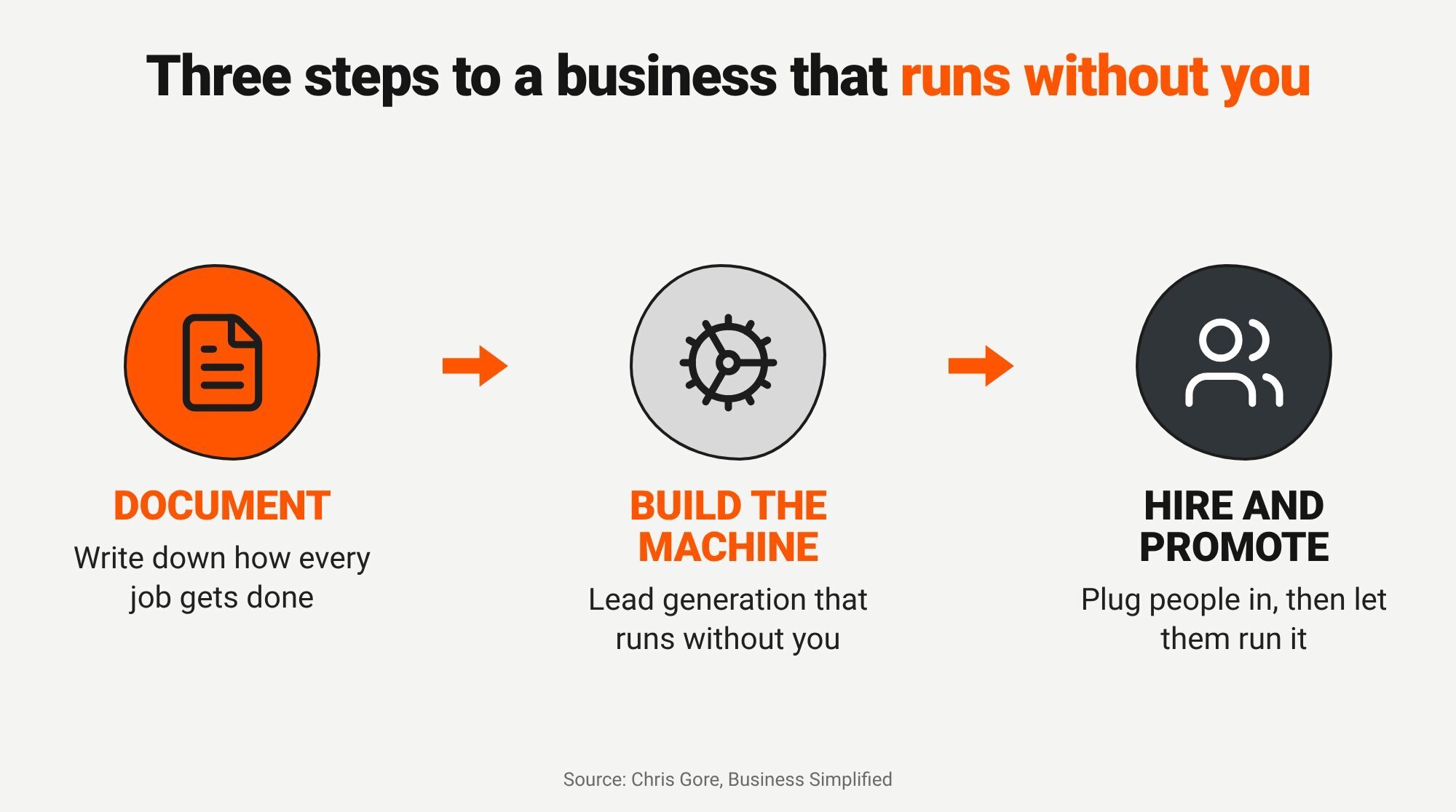
Step one: document every single thing you do
The very first thing, and the most important, was that we documented every single thing we did.
How do we win sales? How does a job run through operations? What happens when we raise an invoice? We sat down and wrote out every process across the business, from sales through to delivery, through to finance, and then the ongoing service. The whole lot.
Then we put it somewhere people could find it. We built a learning centre inside the business that all of our staff can get to. If someone wants to know how to raise an invoice or put together a risk assessment, they type it into the learning centre and it's fully documented, step by step.
That gave us two things.
- Somewhere to point new starters. When we hired, we had something to hand them that wasn't me.
- A culture. If you've got a question, you go to the learning centre first. Only if the answer isn't there do you go to your line manager.
Notice who isn't in that chain. Me.
That's the point. Every question that gets answered by a document is a phone call you don't get on the beach.
Step two: turn lead generation into a machine
The second thing we did was turn our lead generation into a machine.
My business relies on shaking hands and meeting people. And quite frankly, when you're on holiday trying to enjoy a pina colada, you can't shake hands and meet people.
So we built a machine to do it. Before we did, we surveyed other businesses around our size and asked them what they did to generate leads. We spoke to 186 of them, all doing between £100,000 and £5m in revenue, and wrote up the findings in a white paper called The Growth Engine.
The machine we built off the back of that used social media, blogs and email nurture sequences. Content brings people in, and the emails keep the conversation going until they're ready to talk. None of it needs me in the room.
I've written the longer version in how to build a lead generation machine that runs without you.
See how 186 UK owners built their machines
The Growth Engine is the white paper I mentioned. It sets out how UK businesses between £100,000 and £5m win work without the owner doing all of it. It's ours, and it's free.
Step three: hire into the system, then promote from within
The third thing was hiring. And the order here is the bit most people get wrong.
We only started to hire once the processes were written and the machines were built. We built those machines ourselves and ran them ourselves first. Then we plugged people into them.
That's very different from hiring someone and hoping they'll work it all out. If you hire a salesperson into a business with no leads and no process, you've mostly bought yourself another person to manage. I ran the numbers on that in the real cost of hiring a salesperson in the UK.
Once those people were in and running the systems, we started promoting from within. The ones who'd been running the systems moved up, and those promotions went all the way to our senior leadership team.
Then we did the scary bit. We gave that senior leadership team the autonomy to run the business.
What it looks like now
With the technology company, we're at the point where I don't run anything on that side any more.
I run marketing campaigns. I do talks and speeches. The senior leadership team runs the business. They escalate some things to me every month, but ultimately it's theirs to run.
That's the freedom it gives you. I could have used it to play a bit more golf, or go cycling, or get out for more walks.
What I actually did was go and buy another business. That's Squaredot, and we're putting the same structure into it. After we built the lead generation system there, Squaredot went from £800k to £1.2m in three months, with work from cold leads rising from 6% to 59%.
So the prize isn't only a week off. It's getting to choose what you do with your time.
The honest bit
I'm not going to pretend this is a weekend job.
- Documenting everything is dull. It's also the step everything else stands on. Skip it and your new hires will just bring every question back to you.
- You have to run the machine yourself first. You can't hand over something you haven't made work.
- Letting go is hard. Giving a leadership team real autonomy means they'll do some things differently from you. That's the deal.
- It takes time. If you're flying out a week on Friday, this won't save that holiday. It might save next year's.
And if you're happy being the business, that's a perfectly good choice. Plenty of people are. Just go in with your eyes open about what it means for your time off. There's more straight talk like this in the Honest Truths section, and it's a big part of why so few UK businesses ever reach £1m.
How to take a holiday as a business owner: where to start
You don't need all three steps finished before you book anything. Start here.
- For one week, write down every question your team asks you. That list is your first set of documents.
- Write up the top five and put them somewhere everyone can find them.
- Make the rule: check the documents first, then your line manager.
- Pick one part of your lead generation that could run without you, and set it running.
- Take a long weekend with the phone off. See what breaks. Fix that next.
Repeat that and the week off stops being a risk and starts being a test you can pass.
Frequently asked questions
Why can't I take a holiday as a business owner?
Usually because the business depends on you for sales, delivery and decisions. If the answers to everyday questions live in your head, the work stops when you do.
How do I take time off without my business stopping?
Document how the work gets done, build lead generation that runs without you, then hire people into those systems and give them the authority to run them.
What should I document first?
Start with the questions your team asks you most often, then cover the full path from winning a sale to delivering it, invoicing it and looking after the customer.
Do I need to hire before I can take a week off?
Not always, but hiring works far better once the processes are written. New people can then follow the system instead of asking you.
How long does it take to build a business that runs without you?
There's no fixed answer and I won't invent one. For us it happened in stages: documents first, then the lead machine, then hiring and promoting. Each stage bought back a bit more time.
Download The Growth Engine
We surveyed 186 UK business owners to find out how businesses between £100,000 and £5m win work without the owner doing all of it. The findings, and the system we built from them, are in the white paper.

Hi, we are Business Simplified
Growth shouldn’t depend on you chasing every lead. Business Simplified uses real data to fix your pipeline, increase leads and improve sales, so you can lead your business instead of being trapped running it.
Get Our Growth Engine White Paper
We surveyed 186 UK businesses to find out what growth strategies actually work
We published those findings in our "Growth Engine" whitepaper. You can get a copy here.