Download my Whitepaper here:
By clicking submit, you agree to receive promotional emails and weekly content from Company.

How to Stop Being the Bottleneck in Your Business
Tuesday, November 24, 2026
If you want to know how to stop being the bottleneck in your business, start by accepting an awkward fact. The business usually isn't the problem. You are. I was, and here's what I changed.
Of all the businesses started in 2020, 98% didn't reach £1m in revenue within three years. I dug into that number in why 98% of UK businesses never reach £1m.
For the most part, the problem wasn't the business. The problem was the owner sat in the middle of it. That was certainly true for me.
In this blog I'll walk you through how to stop being the bottleneck in your business, using what happened in mine: the three problems that kept us stuck under £1m, and the fixes that got us through. It's the written version of a short video, so watch that first if you'd rather listen.
What being the bottleneck in your business looks like
A bit of context first. I own two companies. One is a workplace design business we've only just acquired. The first one we started is a workplace technology company, and that's the one this story is about.
When we were trying to grow it, we kept running into the same three problems. Every one of them had my name on it.
You're not on your own if this sounds familiar. In our survey of 186 UK business owners, 77% told us they still personally win most of their new business. That's a lot of businesses with one person stood in the doorway.
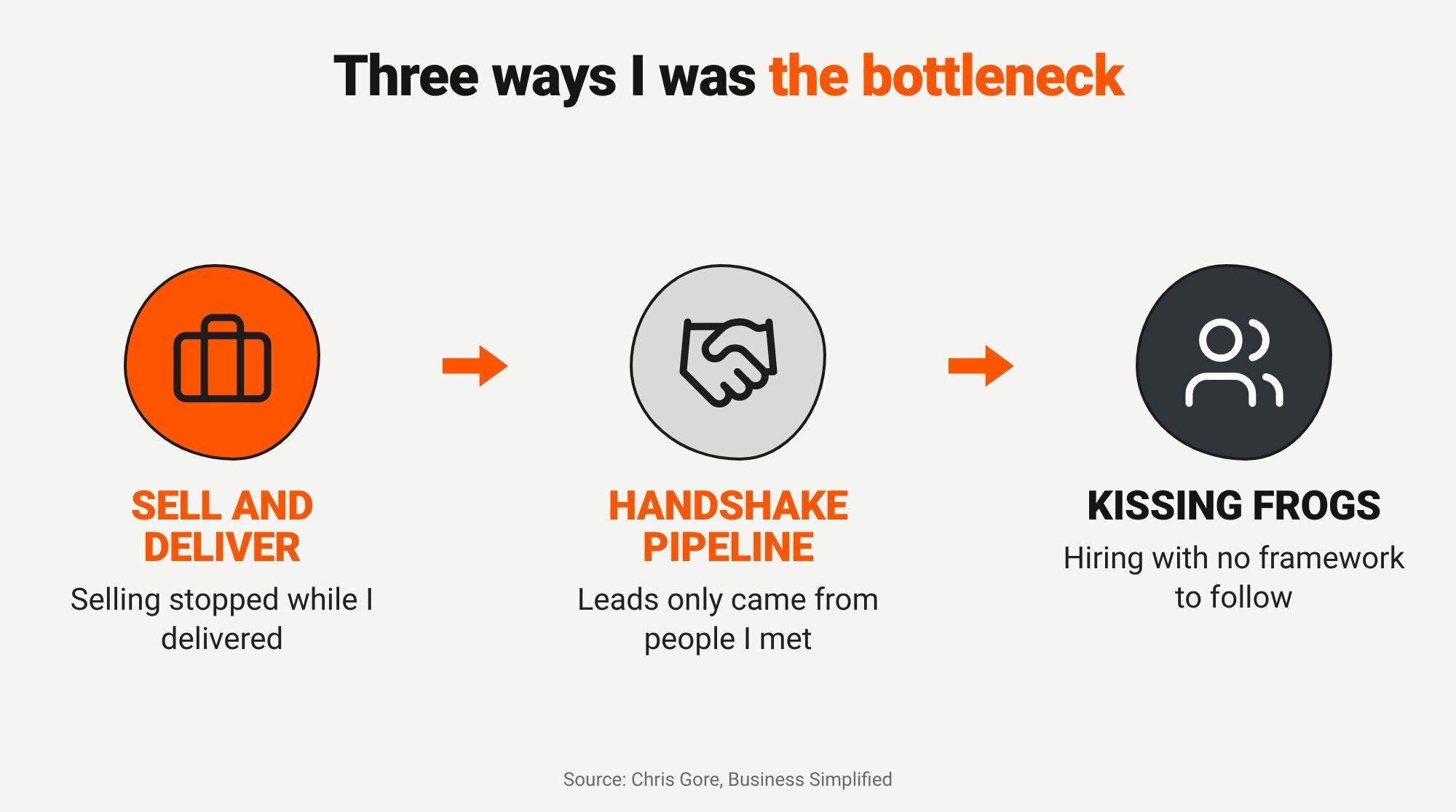
Problem one: I was the salesperson and the delivery team
In the early days I was the salesperson. I went out and pitched. I wrote the proposals. I built the presentations. I did all the marketing.
And that's fine. My co-founder and I did everything, we sold the first few projects and it was all good.
The trouble was that I was then delivering those projects too. Again, fine in the early days. But think about what happens next.
You sell a project on the front end and you make some revenue. Great. Then you're busy delivering it, which means you're not back in sales, keeping the pipeline topped up and creating the next opportunity.
So you feast for a moment while you deliver the project. Then famine, because nobody has been out there selling.
That cycle gets its own post: why feast and famine happens in business and how to fix it.
Problem two: our pipeline ran on handshakes and beers
The second problem was turning the prospecting side into something that didn't need me in the room.
In our industry, one of the biggest ways you win business is through people. Meeting clients. Shaking hands. Having a beer.
And that works. But you can't meet everybody. You can't see everybody.
We needed a way to get our product in front of more people without me going for a beer every single day. My liver couldn't handle it. And frankly, I wanted to see my kids more often.
If your new business depends on how many hands you personally shake in a week, growth has a ceiling. The ceiling is your diary.
Problem three: we kissed a few frogs
The third problem was growing the team, and growing it with people we trusted.
We kissed a few frogs. We brought people in, it didn't work out and we had to make changes.
Looking back, that wasn't really about the people. We were hiring into a business where the way of doing things lived in my head. So every new starter had to come to me to find out how the job was done. One more queue at the bottleneck.
How to stop being the bottleneck in your business: what we changed
So how did we fix it? Three things, and the order matters.
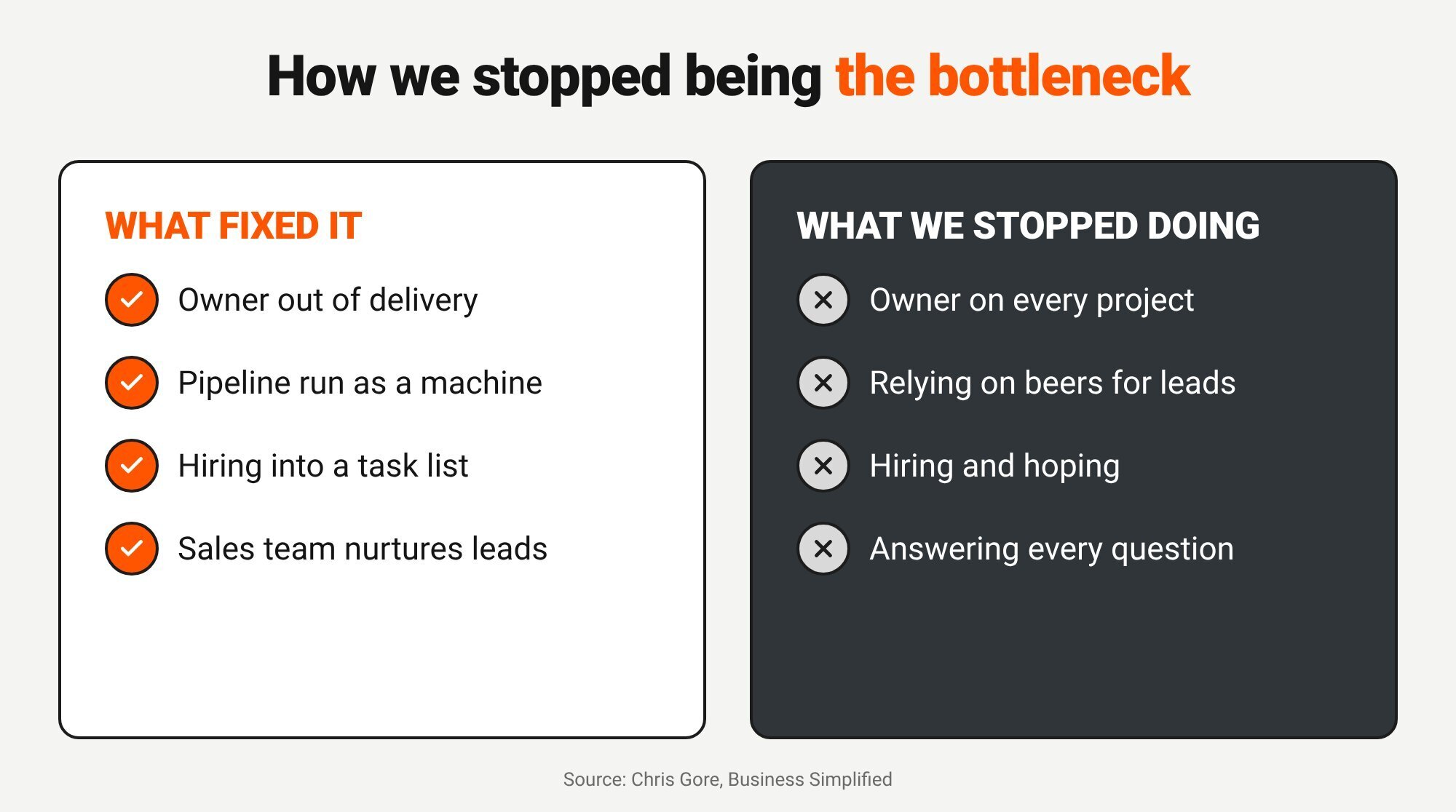
1. Get the owner out of delivery
The first thing we fixed was getting me out of delivery. We hired a delivery team so that when a project landed, I wasn't the one disappearing to deliver it.
That only works if the leads keep coming while you step back. Which brings me to the big one.
2. Turn the pipeline into a machine
Before we built anything, we asked other people how they did it. We surveyed 186 businesses, all turning over between £100,000 and £5m, about how they did their business development. The findings went into The Growth Engine white paper.
What that survey made clear to us was that a consistent pipeline, running as a machine, was the key to getting past £1m.
So we set one up. Social media campaigns. Blogs. Email nurture campaigns. Proper follow up.
It changed everything. Leads came in consistently, and we weren't constantly out having coffees and beers to get them.
Once the delivery team was in place, the leads carried on being nurtured by me. Today we have a sales team doing that. The machine brings the leads in, the sales team speaks to them, and the operations team delivers.
The step by step version is in how to build a lead generation machine that runs without you. If you're weighing up cold outreach against content, read inbound vs outbound lead generation too.
Are you the bottleneck? Find out in three minutes
The Growth Engine Scorecard is 17 quick questions. You get a score out of 100, your growth profile and an estimate of what your current setup is costing you.
3. Hire into a framework, not into a gap
This is how we stopped kissing frogs.
We built a framework for delivery. In our project management framework there's now a long task list that takes a project from start to finish.
When we hire, we plug people into that framework. They can deliver a project by following the task list. They don't need to follow me around.
That's a very different thing from hiring someone bright and hoping they work it out. It applies to sales hires as well. Before you put a salesperson on the payroll, have a look at hiring a salesperson vs outsourcing lead generation and a fractional sales director vs a full time one.
The honest bit
I'd love to tell you this is quick. It isn't.
- You have to build the machine while you're still the bottleneck. Nobody hands you a free month. You build it in the gaps.
- Content and nurture take time to pay back. If you need a sale by Friday, pick up the phone. The machine is for the months after that.
- A framework won't fix a bad hire. It makes good people productive faster. We still had to make changes along the way.
- Letting go stings. Someone else will run a project differently from how you would. That's the price of not doing it yourself.
And if you like being the person who sells it and delivers it, that's a fair choice. Just know that it caps the size of the business at the size of your week. I wrote about the other side of that in how to take a holiday as a business owner, and there's more straight talk in the Honest Truths section.
Where to start this week
If I had to boil it down to one piece of advice for getting past £1m, it's this. Turn the pipeline into a machine, switch it on and let it bring in leads consistently. Then hire through a framework you've already built for delivery.
Here's a small first move on each.
- Write down every job you did last week. Mark each one as sales, delivery or running the business.
- Pick the delivery job you do most often and write it up as a task list someone else could follow.
- Choose one way leads could reach you without a handshake, such as a regular post, a blog or a follow up email, and set it running.
- Next time you hire, hand them the task list on day one.
None of that needs a big budget. It needs you to stop being the answer to every question.
Frequently asked questions
How do I know if I'm the bottleneck in my business?
If sales slow down when you're busy delivering, if leads only come from people you meet in person, or if new staff need you to explain every job, the work is queuing behind you.
How do I stop being the bottleneck in my business?
Get yourself out of delivery, build lead generation that runs consistently without you, and hire people into a written framework so they can do the work without asking you.
Should I hire first or build systems first?
In my experience, systems first. We hired before the framework existed and kissed a few frogs. Once the task list was written, new people could follow it.
Why do so many businesses stall under £1m?
Often because the owner is still the salesperson and the delivery team. Selling stops while the work gets done, so revenue goes up and down and never builds.
What is a lead generation machine?
It's a set of things, such as social media, blogs, email nurture and follow up, that bring in and warm up leads consistently without the owner doing it by hand.
Find the weak link in your Growth Engine
Seventeen questions, about three minutes. The Growth Engine Scorecard gives you a score out of 100, your growth profile and an estimate of the revenue your setup is leaving on the table. It's ours, and it's free.

Hi, we are Business Simplified
Growth shouldn’t depend on you chasing every lead. Business Simplified uses real data to fix your pipeline, increase leads and improve sales, so you can lead your business instead of being trapped running it.
Get Our Growth Engine White Paper
We surveyed 186 UK businesses to find out what growth strategies actually work
We published those findings in our "Growth Engine" whitepaper. You can get a copy here.