Download my Whitepaper here:
By clicking submit, you agree to receive promotional emails and weekly content from Company.

How Much Does Lead Generation Cost in the UK? (2026)
Monday, November 09, 2026
Agencies quote you per lead, per meeting or per month. None of those numbers tell you what a customer actually costs. Here is the honest maths for a UK small business.
You've had three quotes for lead generation this month. One says £1,500 a month. One says £150 per booked meeting. One says "it depends". And you still can't answer the only question that matters: how much does lead generation cost to win one actual customer?
That's the problem. Most founders compare the price of the service, not the price of the result. So they pick the cheapest quote, get a pile of names that never buy, and decide lead generation "doesn't work for us".
In this blog I'll show you what lead generation costs in the UK in 2026, by channel and by type of lead, how to turn a cost per lead into a cost per customer, and the hidden costs nobody puts on the invoice. I'll also tell you when spending on leads is the wrong move entirely.
How much does lead generation cost in the UK? The short answer
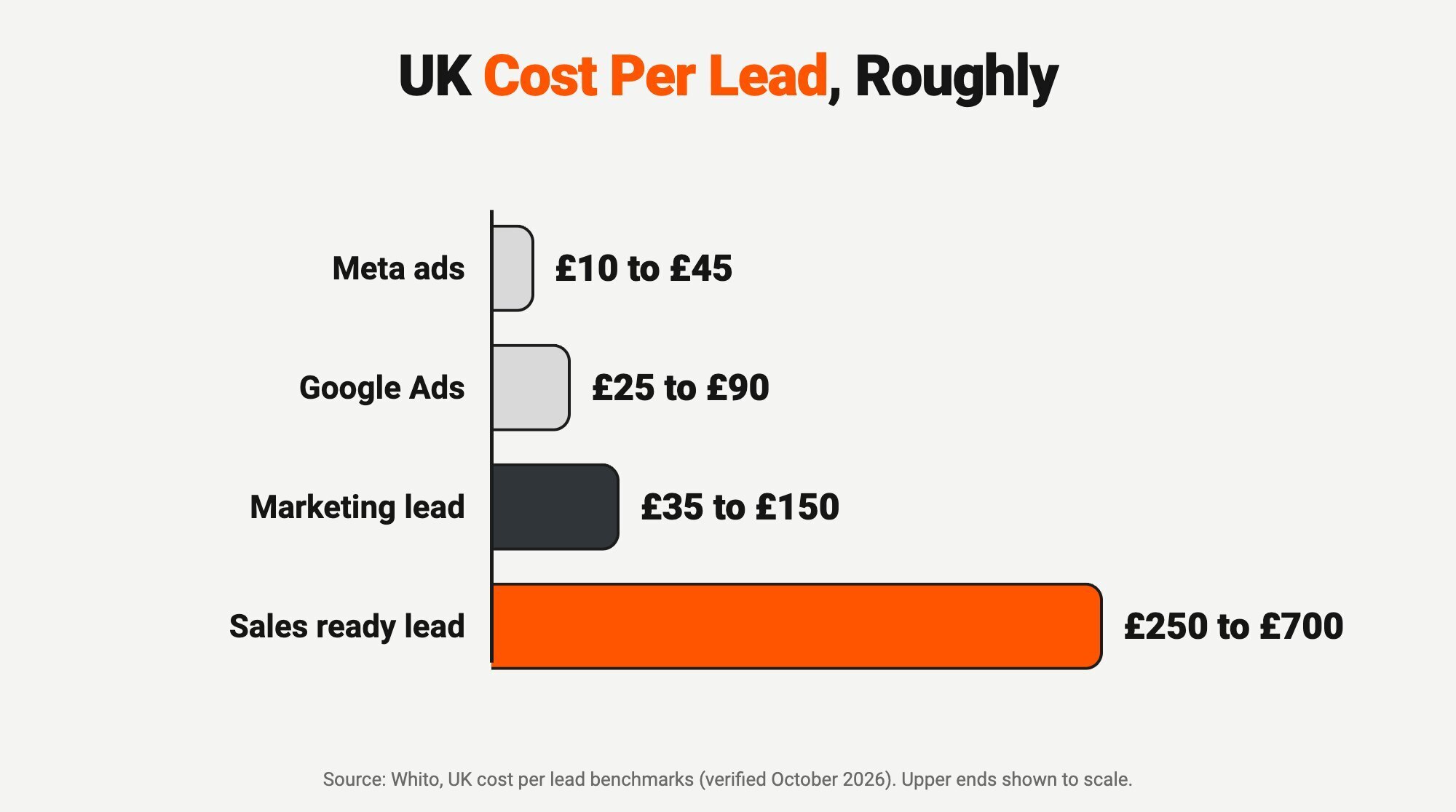
Here's the honest range. Published UK benchmarks compiled by Whito (verified October 2026) put a B2B services marketing lead at roughly £35 to £150. A sales ready lead, someone who has actually agreed to talk, sits at roughly £250 to £700. London campaigns run about 20 to 35% above the UK average.
By channel, the same source puts Meta ads at around £10 to £45 per lead and Google Ads at around £25 to £90. Treat those as rough planning numbers, not promises. They're compiled from other people's data, and your market, offer and price point will move them a lot.
The key point: a "lead" and a "sales ready lead" are not the same thing, and the gap between them is often ten times the price. When someone quotes you a cost per lead, the first question is always "what counts as a lead?"
The four ways you'll be charged
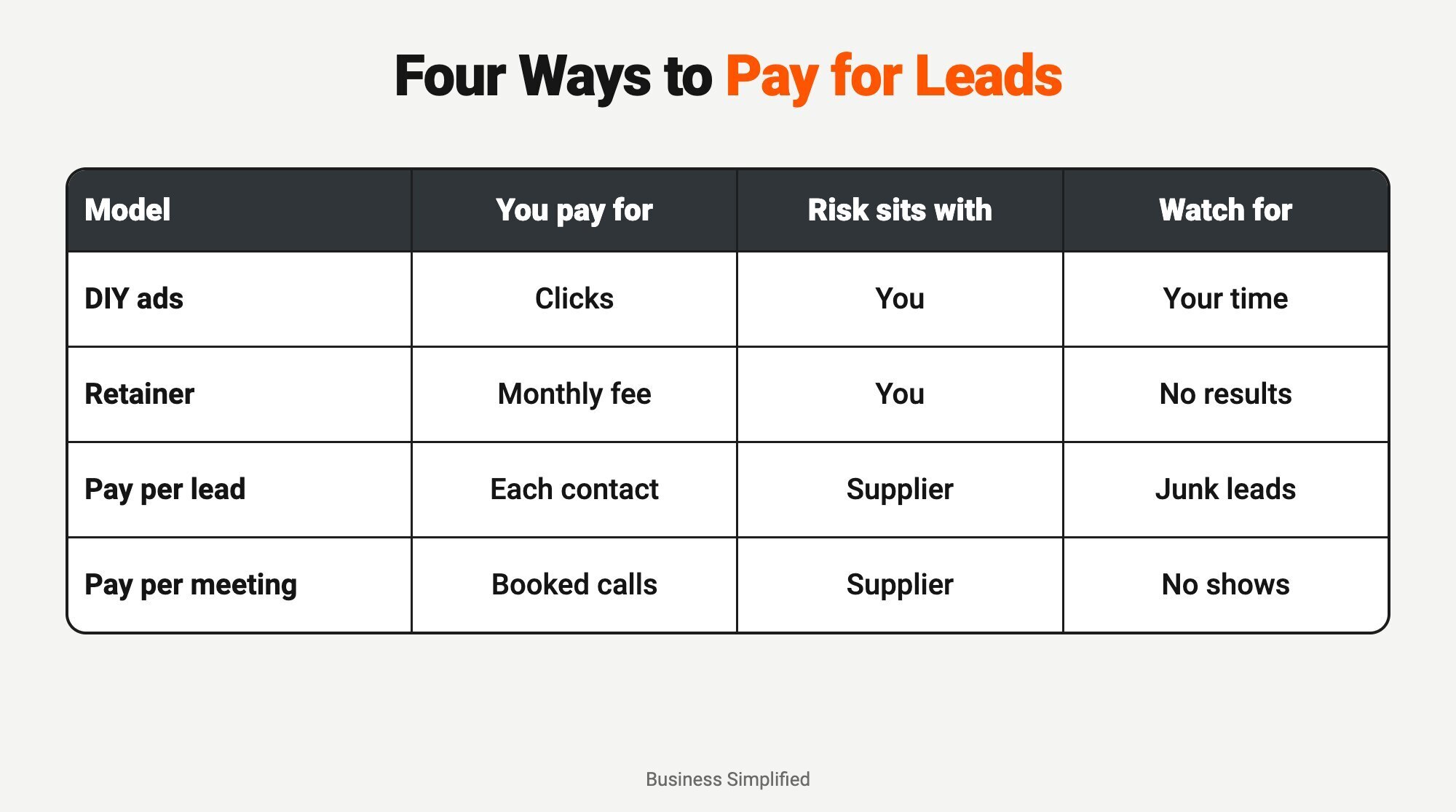
Whatever you buy, it will be priced one of four ways. Each one puts the risk in a different place.
1. Paid ads you run yourself
You pay the platform. You also pay with your time, or with a freelancer's fee to run the campaigns. Cheapest per lead on paper, but only if someone knows what they're doing. Badly run ads are the most expensive leads you'll ever buy, because you pay for the clicks either way.
2. Monthly retainer
An agency or freelancer charges a fixed fee to run outreach, ads or content. You carry the risk. If the leads don't come, you still pay. Ask for the agency's own numbers on similar clients before you sign anything.
3. Pay per lead
You pay for each contact handed over. Sounds safe. The catch is the definition. If a "lead" is anyone who downloaded a PDF, you'll get plenty, and most of them will never buy. I wrote about why this so often goes wrong in why lead generation agencies fail small businesses.
4. Pay per meeting
You pay for each booked call. Closer to a real result, so it costs more per unit. Watch for no shows, people who were never going to buy, and meetings with someone too junior to sign off a purchase. Agree in writing what counts as a qualifying meeting.
Turn cost per lead into cost per customer
This is the bit most founders skip, and it's the only number that matters. You need three figures: your cost per lead, the percentage of leads that become a sales conversation, and the percentage of conversations that become a customer.
Here's an illustrative example. Say you're paying £60 per marketing lead. One in five turns into a proper sales call. One in four of those calls becomes a customer. That's 20 leads per customer, so £1,200 to win one client.
Now compare a pay per meeting deal at £300 per booked call where one in three becomes a customer. That's £900 per client. The "expensive" option is cheaper. And this is why comparing quotes on price per lead is a trap.
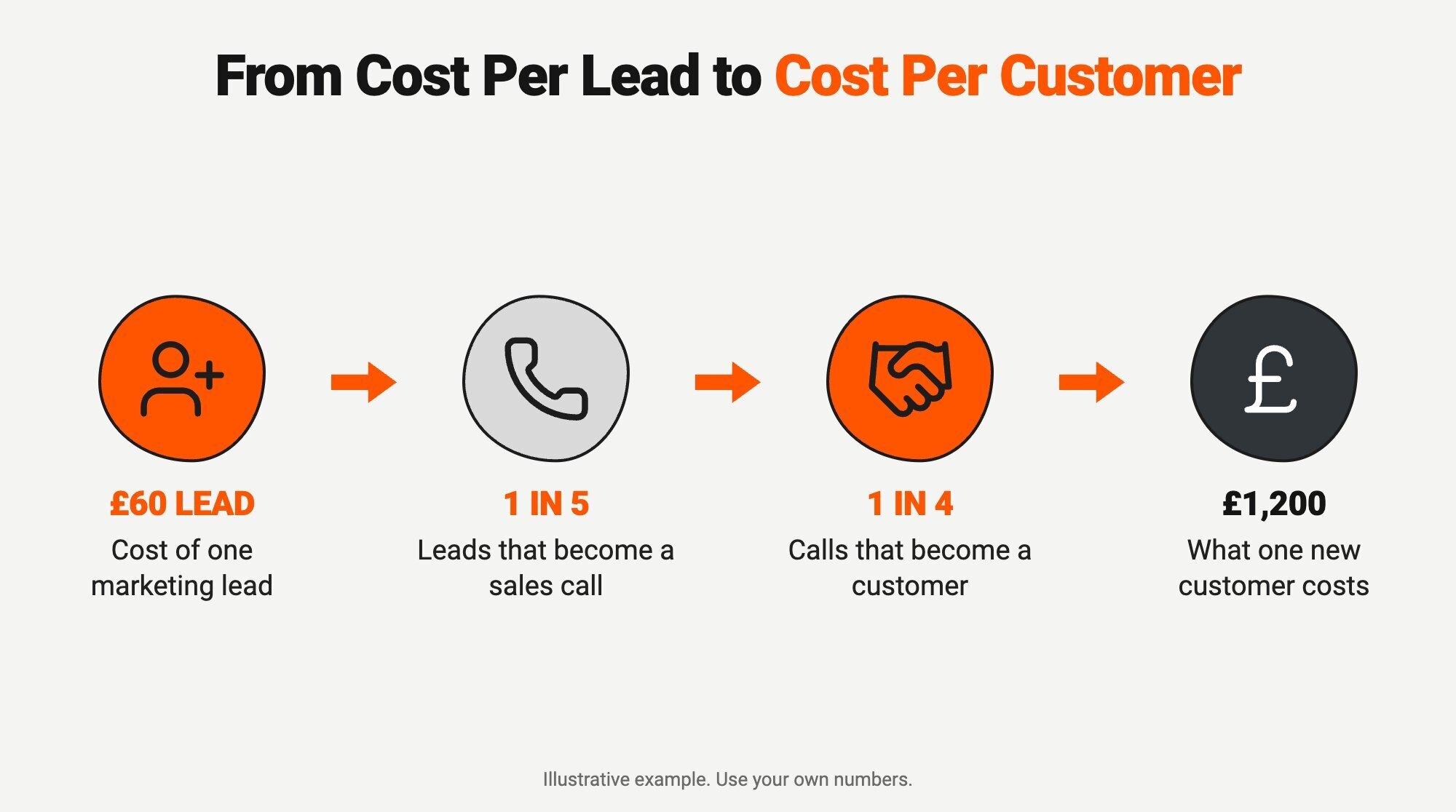
Then hold that cost per customer up against what a customer is worth over a year. If a client is worth £10,000 in gross profit, paying £1,200 to win one is a bargain. If they're worth £800, you've got a problem no lead generation agency can fix.
Not sure where your leads are leaking?
The Growth Engine Scorecard takes about three minutes. You get a score out of 100, your growth profile and a £ figure for the revenue your current setup is costing you, benchmarked against 186 UK business owners.
The hidden costs of lead generation nobody quotes you
The invoice is only part of it. These are the costs that show up later.
- Your time following up. If leads come in and you're the one who has to call them back, the real cost includes the hours you're not doing anything else. In our survey of 186 UK business owners, 77% said they still personally win most of their new business.
- Leads that go cold. Enquiries that sit for three days while you're delivering are money you've already spent and thrown away.
- Tools. A CRM, an email platform, a landing page builder. Small monthly costs that add up. I've compared some options in the best CRM for a small UK business.
- Bad fit customers. The cheapest leads often turn into the most demanding clients. That cost lands on your delivery team.
- Switching. Agency churn is common. Every switch costs a month or two of setup before anything works again.
Add those up and a £1,500 a month retainer can easily cost you double that in reality.
What should a UK small business budget for lead generation?
Work backwards, not forwards. Start with how many new customers you need this year. Multiply by your cost per customer. That's your lead generation budget. Then sense check it against your overall marketing spend, which I've covered in how much a small business should spend on marketing.
Illustrative example: you need 24 new clients this year and your cost per customer is £900. That's about £21,600 a year, or £1,800 a month. If that number makes you wince, the answer isn't to cut the budget. It's to improve the conversion rates in the middle, because that's where the money leaks.
When paying for lead generation is the wrong move
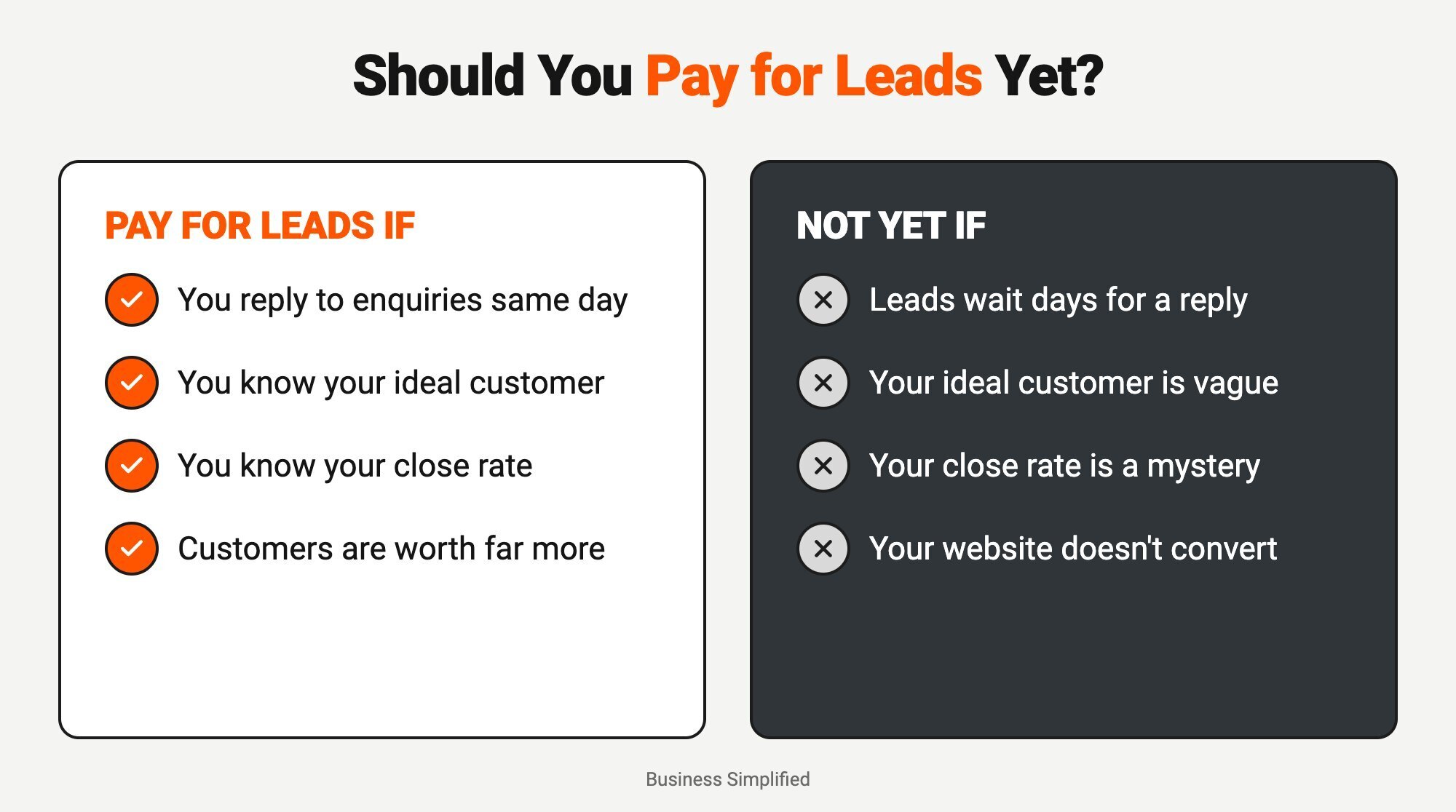
I'll be straight with you. Buying leads is a bad idea in a few situations:
- Nobody can follow up quickly. If you're the only salesperson and you're flat out delivering, more leads just means more leads going cold.
- You can't describe your ideal customer in one sentence. Then nobody you pay can find them for you.
- Your close rate is a mystery. If you don't know how many calls turn into customers, you can't work out what a lead is worth.
- Your offer isn't clear. Paying to send people to a website that doesn't say why they should choose you is like filling a bath with the plug out. More on that in website traffic but no leads.
Fix those first. They're cheaper than any agency.
Build it or buy it?
Buying leads is renting. The day you stop paying, they stop. Building your own system, an audience, a reason to give you their email, and follow up that runs without you, costs more effort up front and gets cheaper over time.
That's what we did at Squaredot. After building the system, work from cold leads went from 6% to 59% of new business, and turnover went from £800k to £1.2m in three months. I explain the three parts in how to build a lead generation machine that runs without you.
Most businesses need a mix. Paid for speed, owned for the long run. If you're weighing the two approaches, read inbound vs outbound lead generation next.
More posts on what growth really costs are in the What Growth Costs section.
Frequently asked questions
How much does lead generation cost in the UK?
Published UK benchmarks put a B2B marketing lead at roughly £35 to £150 and a sales ready lead at roughly £250 to £700. Your own numbers will vary with your market, price point and offer.
Is pay per lead or pay per meeting better?
Pay per meeting is usually closer to a real result, so it often works out cheaper per customer even though each unit costs more. Always agree in writing what counts as a lead or a qualifying meeting.
What is a good cost per lead?
There isn't one number. A good cost per lead is one where your cost per customer is comfortably below what a customer is worth to you in gross profit.
How do I work out my cost per customer?
Divide your cost per lead by the share of leads that become sales calls, then by the share of calls that become customers. That gives you what it costs to win one client.
Should a small business pay for lead generation?
Only if you can follow up quickly, you know who your ideal customer is and you know your close rate. If not, fix those first.
Take the Growth Engine Scorecard
Before you spend another pound on leads, find out where your growth is leaking. 17 quick questions, an instant score out of 100 and a £ estimate of what your setup is costing you. Free, and you get the full Growth Engine report too.

Hi, we are Business Simplified
Growth shouldn’t depend on you chasing every lead. Business Simplified uses real data to fix your pipeline, increase leads and improve sales, so you can lead your business instead of being trapped running it.
Get Our Growth Engine White Paper
We surveyed 186 UK businesses to find out what growth strategies actually work
We published those findings in our "Growth Engine" whitepaper. You can get a copy here.