Download my Whitepaper here:
By clicking submit, you agree to receive promotional emails and weekly content from Company.

Best CRM for a Small UK Business (Tested by a Founder)
Wednesday, November 04, 2026

Two CRMs I've paid for with my own money, three I've assessed from their published pricing, and an honest answer to whether you need one at all.
Your pipeline lives in your head. Or in your inbox. Or on a spreadsheet called "Leads FINAL v3" that nobody else is allowed to touch.
It works until it doesn't. A warm lead goes cold because you forgot to call back. A proposal sits unchased for three weeks. Your new hire asks "who should I follow up with?" and you realise the honest answer is "ask me, every single time".
That's usually the moment founders start googling the best CRM for small business UK owners can actually afford. Then they get buried in comparison sites written by people who have never had to chase an invoice.
In this blog I'll give you a short list of the CRMs worth looking at if you run a founder-led service business turning over £100k to £5m. I'll tell you which two I've used myself (HubSpot at SPOR, ClickFunnels for Business Simplified), which ones I've assessed from published pricing and features only, what each costs where there's a source, and the drawback nobody puts on the sales page.
Best CRM for small business UK: the quick picks
If you only read one section, read this one.
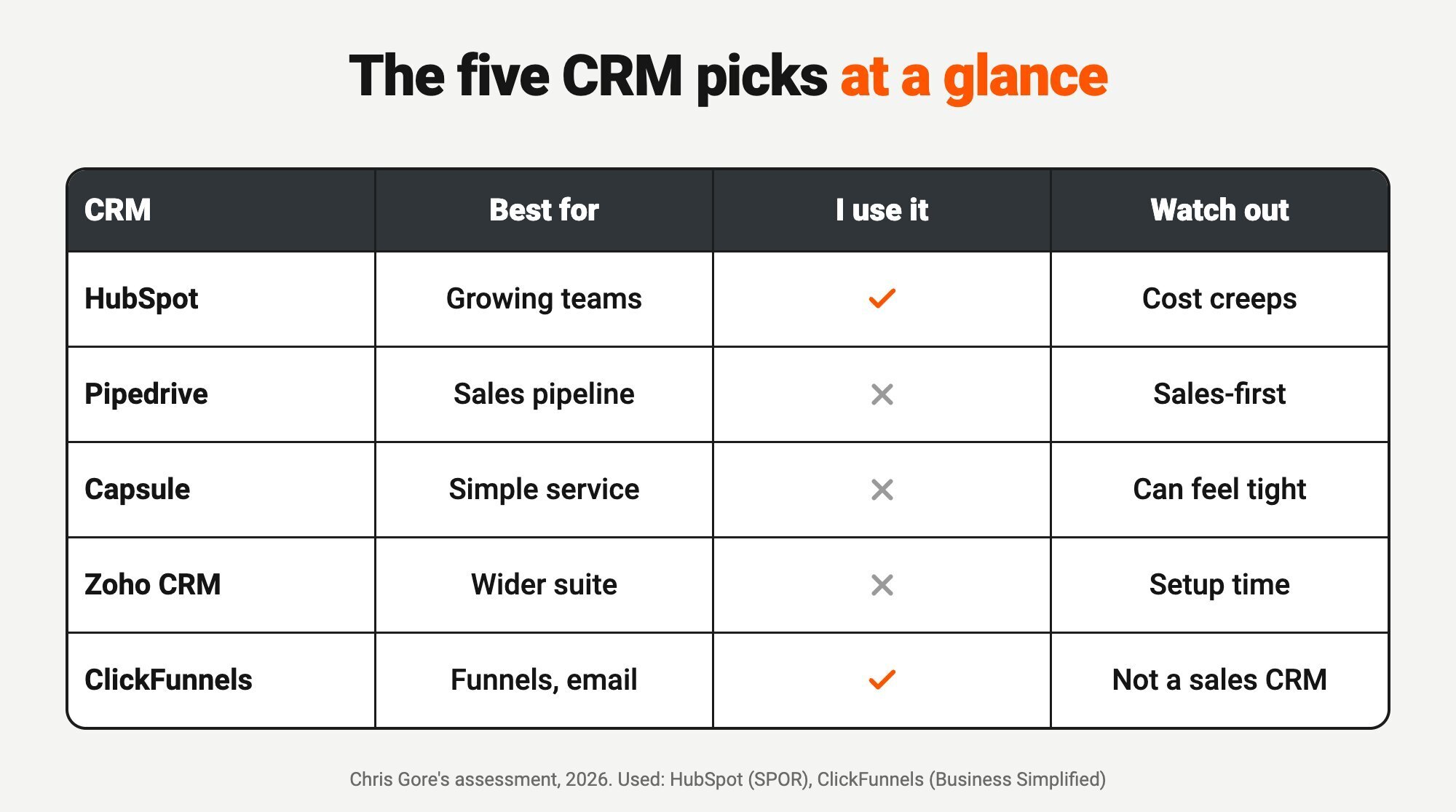
- Best all-rounder for a growing team: HubSpot (used at SPOR). Brilliant, but not cheap once you add seats.
- Best for a sales team living in a pipeline: Pipedrive (assessed, not used).
- Best simple CRM for a small service business: Capsule (assessed, not used).
- Best if you want a wider suite of business apps: Zoho CRM (assessed, not used).
- Best if your marketing is funnels, pages and email: ClickFunnels 2.0 (used for Business Simplified). Not a classic CRM, and that matters.
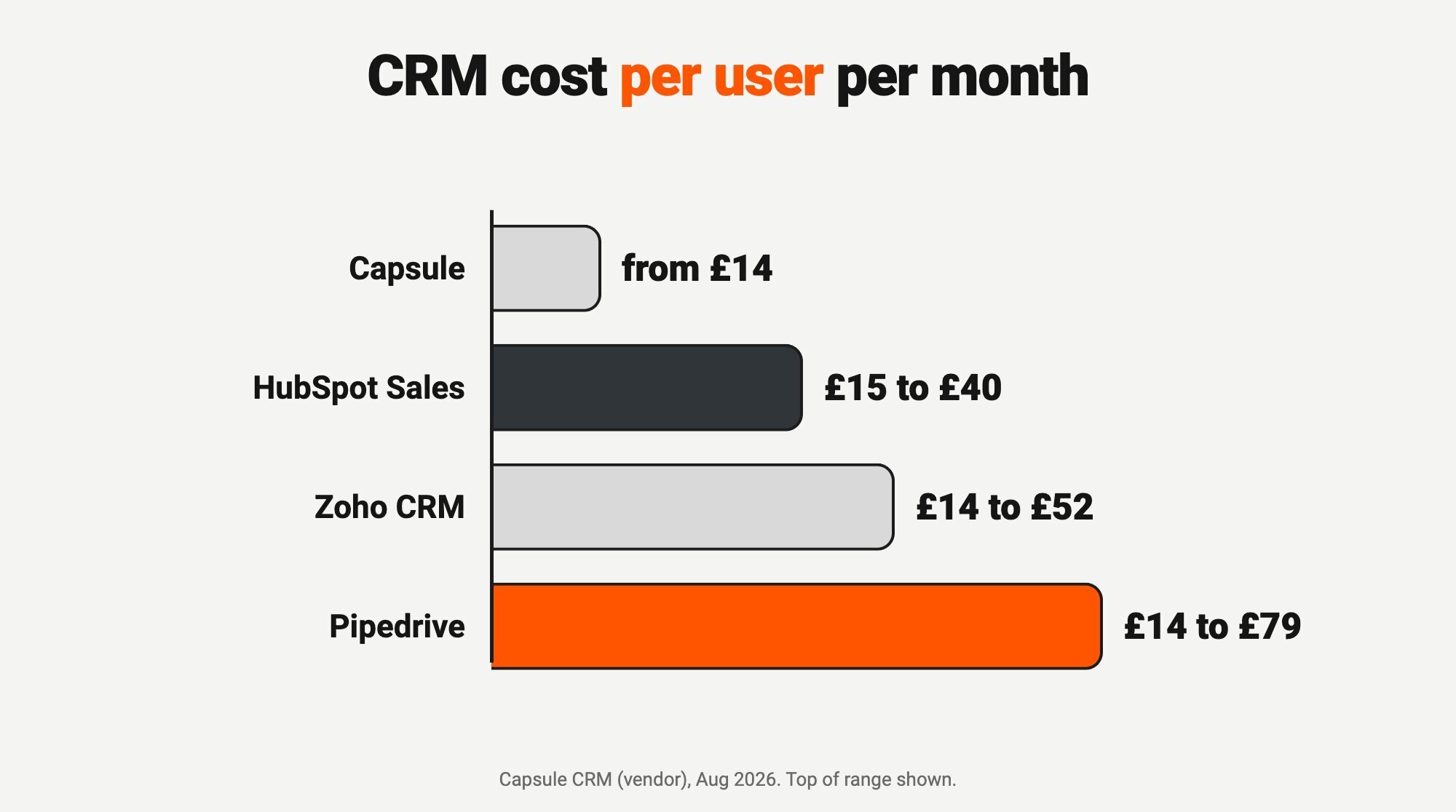
One important caveat on prices. The per-user figures below come from a comparison published by Capsule in August 2026. Capsule is a CRM vendor, so it's not a neutral source. I'm using it because it's the most recent UK pricing roundup I have, and I'd tell you to check every vendor's own pricing page before you buy. Prices move.
How I judged them (and what "tested" means here)
Let's be straight about method, because most "best of" lists aren't.
I've used two of these tools for real. HubSpot runs the sales side at SPOR. ClickFunnels 2.0 runs Business Simplified: this blog, the landing pages, the email broadcasts and the booking for the £97 Business Review. So when I say something about those two, it comes from living with them.
Pipedrive, Capsule and Zoho I have not run a business on. I've assessed them from their published pricing and features. That's still useful, but it's a different kind of opinion and you should weigh it accordingly.
I judged everything against one question: will this help a founder-led service business stop relying on the founder's memory to win work? Not "which has the most features". Most small businesses use a fraction of what they pay for.
1. HubSpot: best all-rounder (used at SPOR)
Best for: service businesses with a small sales or account management team who want CRM, email marketing, forms and simple automation in one place.
Cost: Capsule's comparison puts HubSpot Sales at roughly £15 to £40 per user per month. Separately, UK partner SpotDev lists the Starter Customer Platform at £18 a month per seat, billed annually, excluding VAT (checked July 2026). Check the official HubSpot pricing page before you commit.
My honest take: HubSpot is brilliant but not cheap. The free CRM is a genuinely good place to start. Pipelines, contact records, a meetings link, forms. Your team can see who's been spoken to and when, which on its own fixes half the "who's chasing this?" problem.
The drawback: the cost creeps. You start on free, add a couple of paid seats, then want the next tier for one feature, and suddenly it's a real line on your P&L. Go in knowing what you actually need. I've written a fuller HubSpot Starter review if you're weighing it up.
2. Pipedrive: best for pipeline-first sales teams (assessed, not used)
Best for: businesses where deals move through clear stages and someone (not just you) is responsible for moving them.
Cost: roughly £14 to £79 per user per month, per Capsule's comparison. The widest price range on this list.
Pipedrive is built around the visual sales pipeline. Deals as cards, stages as columns, drag them along. If your problem is "we have leads but nobody follows them through", that view is useful because stuck deals become obvious.
The drawback: it's sales-first. If your real problem is that you don't have enough leads in the first place, a better pipeline view won't fix it. And the top of that price range adds up fast across a team.
3. Capsule: best simple CRM for small service businesses (assessed, not used)
Best for: small teams who want contacts, follow-ups and a simple pipeline without a big setup project.
Cost: from roughly £14 per user per month, according to Capsule's own published figures.
Capsule positions itself as a straightforward CRM, and on paper that's what it is. For a five-person consultancy that just needs to stop losing track of conversations, simple is a feature, not a weakness.
The drawback: it's the vendor behind the price comparison I'm citing, so treat their framing of competitors with appropriate scepticism. And simple tools can feel tight once you want marketing automation alongside the CRM.
A CRM won't fix a founder-shaped sales process
In our survey of 186 UK business owners, 77% still personally win most new business. The Growth Engine shows how to build the Market, Message and Machine around you so the CRM has something to manage.
4. Zoho CRM: best if you want a wider suite (assessed, not used)
Best for: owners who like the idea of CRM sitting alongside a broader family of business apps from one provider.
Cost: roughly £14 to £52 per user per month, per Capsule's comparison.
Zoho's appeal is breadth. If you're the type who wants to configure things exactly how you like them, there's a lot to play with.
The drawback: breadth means setup time. A tool you can configure endlessly is a tool a busy founder can spend whole weekends configuring instead of selling. If you're already the bottleneck, be honest about whether you'll actually finish the setup.
5. ClickFunnels 2.0: best if your marketing is funnels and email (used for Business Simplified)
Best for: founders whose lead generation runs on landing pages, lead magnets, email nurture and bookings, and who want those in one place.
Cost: priced in US dollars. Launch is $97 a month ($970 a year), Scale $197, Optimize $297, per ClickFunnels' own pricing page.
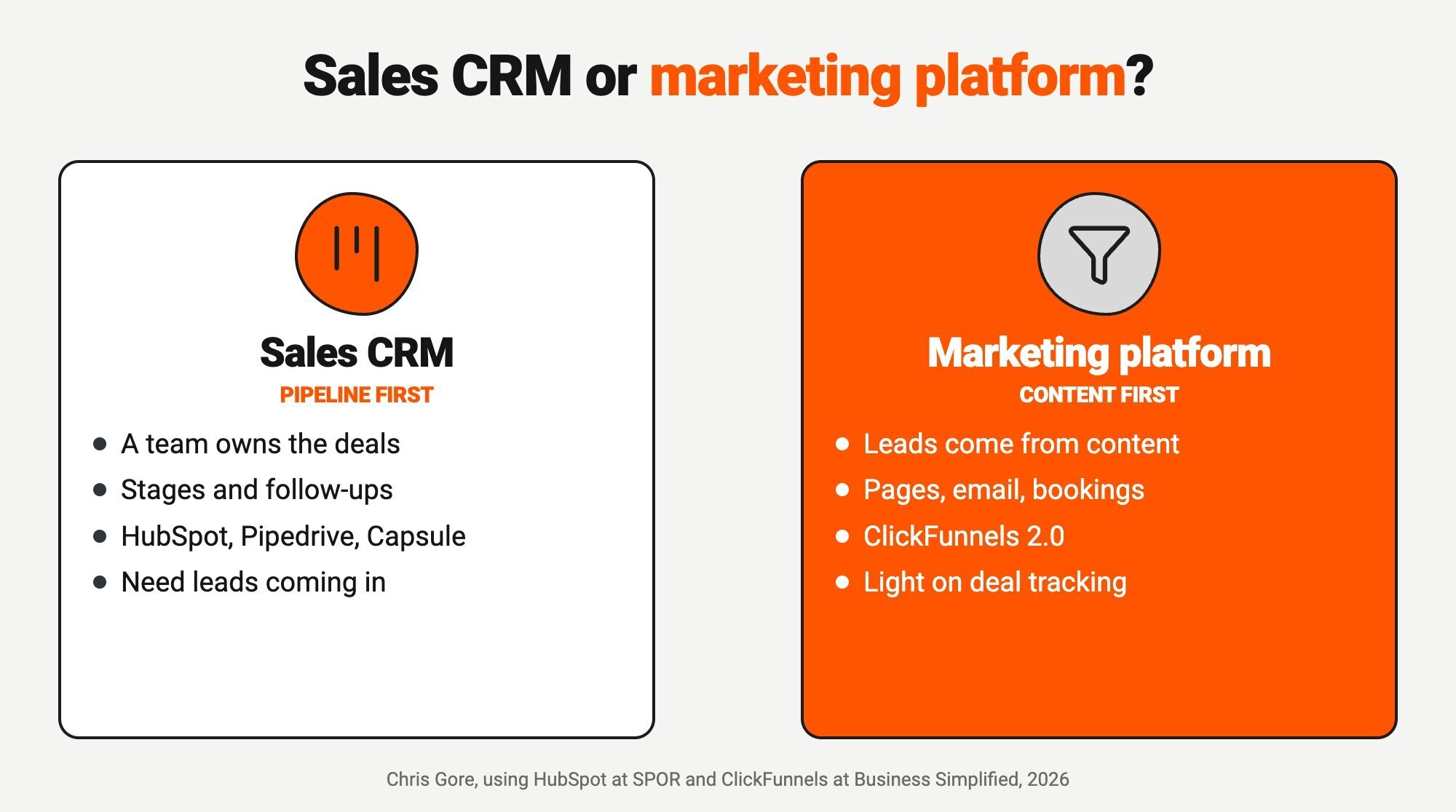
I'm including this because it's what I actually use for Business Simplified, and a lot of founders are choosing between "proper CRM" and "marketing platform with contacts". For me, the pages, emails and appointments all living together is the point. My full ClickFunnels 2.0 review goes deeper.
The drawback: it is not a classic sales CRM, and I wouldn't run SPOR's account management on it. USD pricing also means exchange rates matter, and you should check VAT treatment with your accountant.
The honest option nobody lists: a spreadsheet
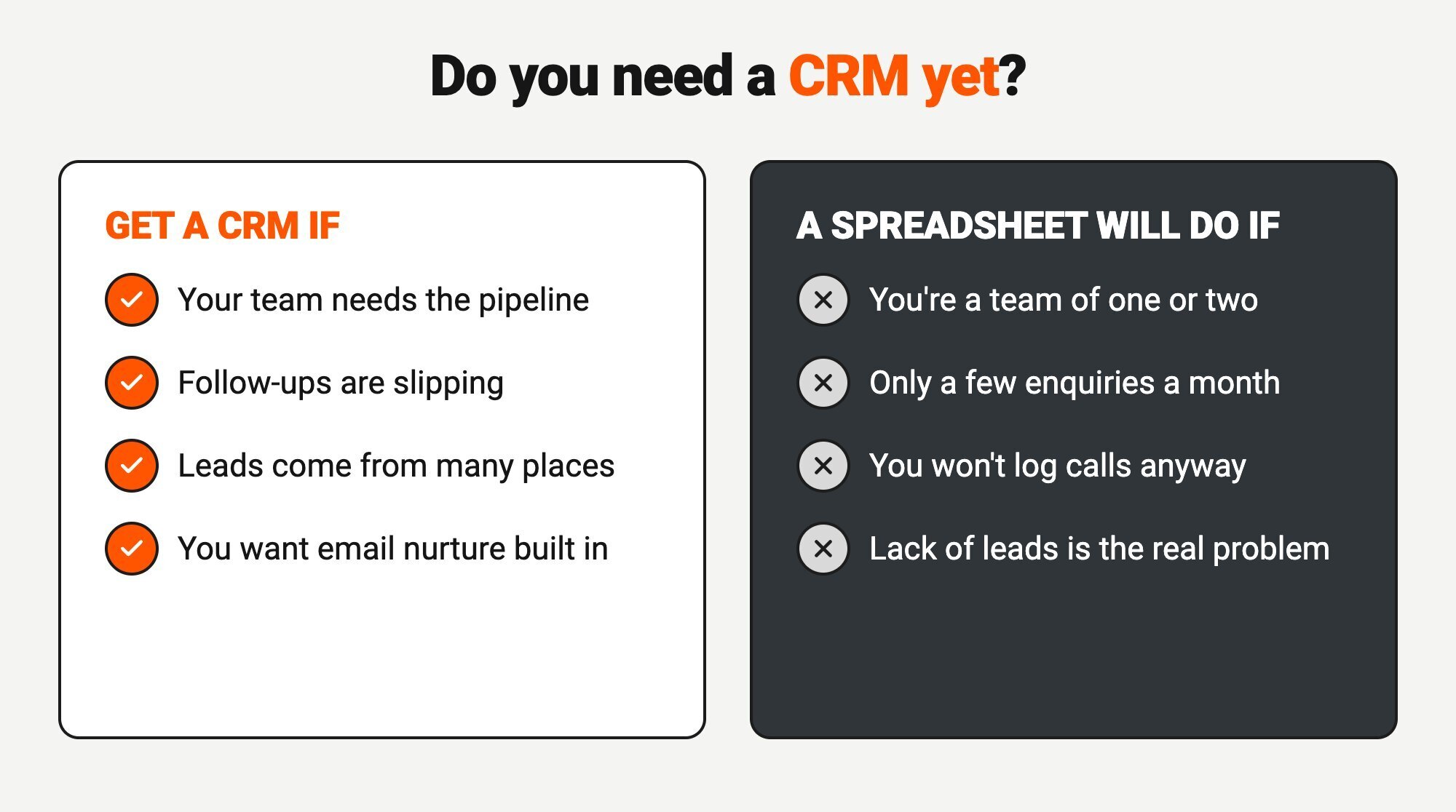
If you're a team of one or two and you get a handful of enquiries a month, a well-kept spreadsheet is fine. Really. The CRM isn't the system. The habit of logging every conversation and setting a next action is the system.
The moment a second person needs to see the pipeline, or you catch yourself forgetting follow-ups, move to a free CRM tier. Don't pay for seats you won't use.
Which is the best CRM for a small UK business like yours?
Here's how I'd choose, in order:
- Name the problem first. Losing track of follow-ups? Any of these will help. Not enough leads? No CRM will fix that, and you probably need a lead generation process before you need software.
- Count the people who'll use it. Per-user pricing means a five-seat team pays five times. Do the maths on the full team, not one seat.
- Decide where marketing lives. If email nurture and landing pages matter as much as the pipeline, HubSpot or ClickFunnels make more sense than a sales-only tool.
- Start free or on a trial. Use it for a month with real deals before you sign an annual contract.
- Check integrations yourself. Don't take a comparison site's word for it, mine included.
The bigger point: a CRM is part of the Machine, not the whole thing. If you're still the one who wins every deal, it'll just be a beautifully organised list of things only you can close. That's the pattern I write about in why most UK businesses never reach £1m, and it's why I'd think hard before hiring a salesperson just to feed the CRM.
Want more roundups like this one? They live in the Best Of category.
Frequently asked questions
What is the easiest CRM for a small business?
The easiest is the one your team will actually update. Simple tools like Capsule, or HubSpot's free CRM, are good starting points because setup is light. I'd trial two with real deals for a few weeks and keep the one people use without nagging.
Is HubSpot free really free?
The free CRM is free and genuinely useful for contacts, pipelines and a meetings link. Costs start when you add paid seats or need features from paid tiers. SpotDev lists Starter at £18 per seat a month billed annually, excluding VAT, as of July 2026.
How much should a CRM cost?
Capsule's August 2026 comparison puts mainstream options at roughly £14 to £79 per user per month. For a small team, budget for every user, not one seat, and check each vendor's current pricing page before you buy.
Do I need a CRM under 10 staff?
Not always. A team of one or two with low enquiry volume can run on a disciplined spreadsheet. Once a second person needs to see the pipeline, or follow-ups start slipping, a free CRM tier is worth it.
Which CRM integrates with Xero?
Integrations change, so check each CRM's integration marketplace (and Xero's app store) for a current, supported connection before you choose. Don't rely on a blog post for this one, including mine.
Download The Growth Engine
Choosing the best CRM for small business UK teams is the easy bit. The Growth Engine, based on 186 UK business owners, shows the Market, Message and Machine that fill it with leads that don't depend on you, including how Squaredot grew from £800k to £1.2m in three months.

Hi, we are Business Simplified
Growth shouldn’t depend on you chasing every lead. Business Simplified uses real data to fix your pipeline, increase leads and improve sales, so you can lead your business instead of being trapped running it.
Get Our Growth Engine White Paper
We surveyed 186 UK businesses to find out what growth strategies actually work
We published those findings in our "Growth Engine" whitepaper. You can get a copy here.