Download my Whitepaper here:
By clicking submit, you agree to receive promotional emails and weekly content from Company.

Website Traffic But No Leads? 7 Honest Reasons Why
Monday, November 09, 2026
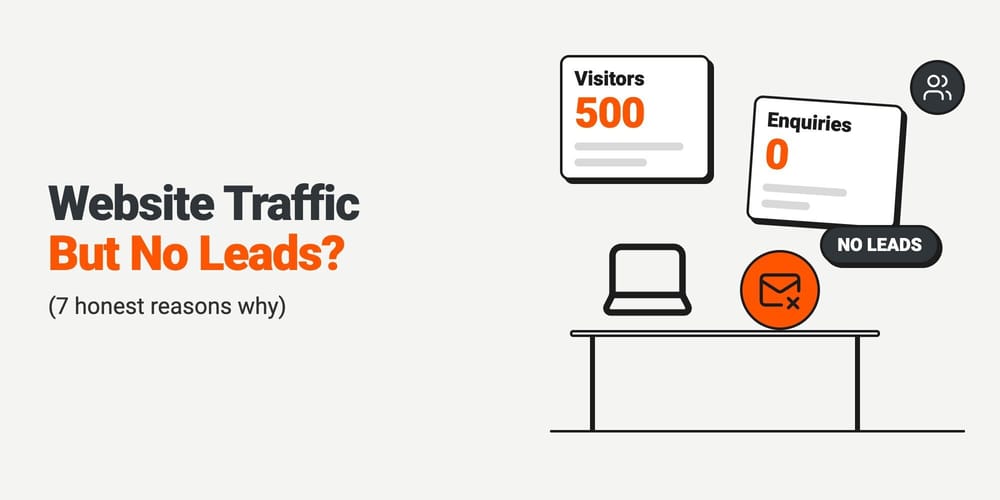
People visit. Nobody enquires. You've paid for the new website, maybe some ads too, and the contact form sits there like a shop with the lights on and the door locked.
You check Google Analytics. Hundreds of visitors this month. You check your inbox. Two enquiries, and one of them is someone trying to sell you SEO. Website traffic but no leads. It's one of the most common things founders tell me, and it's maddening, because it feels like the website is working and also not working at the same time.
Here's the uncomfortable bit. It's rarely the design. It's rarely the traffic either. It's almost always what happens, or doesn't happen, once someone lands.
In this blog I'll give you the seven honest reasons your website gets traffic but no leads, how to tell which one is yours, and what to fix first. I'll also tell you when the website isn't the problem at all.
First, what's a normal number of leads from website traffic?
Before you panic, get a baseline. Across 41,000 landing pages, Unbounce found a median conversion rate of 6.6%. That's a page built for one job, with one offer. A general business homepage will usually convert far lower than that, because people arrive for all sorts of reasons.
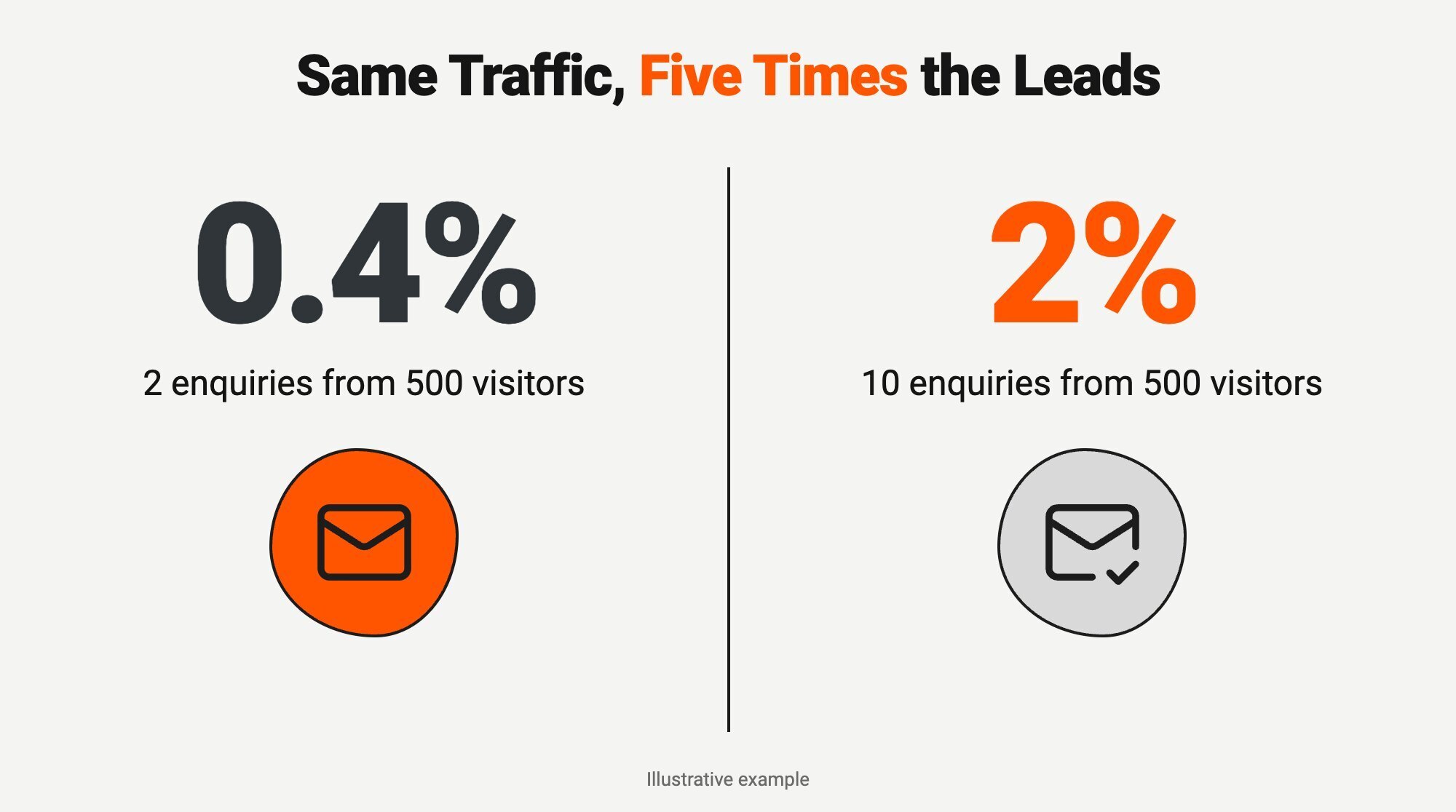
So if 500 people visit and two enquire, that's 0.4%. Low, but not unusual for a site with no clear next step. The good news: going from 0.4% to 2% is often a few weeks of work, not a rebuild.
7 reasons your website has traffic but no leads
1. The wrong people are visiting
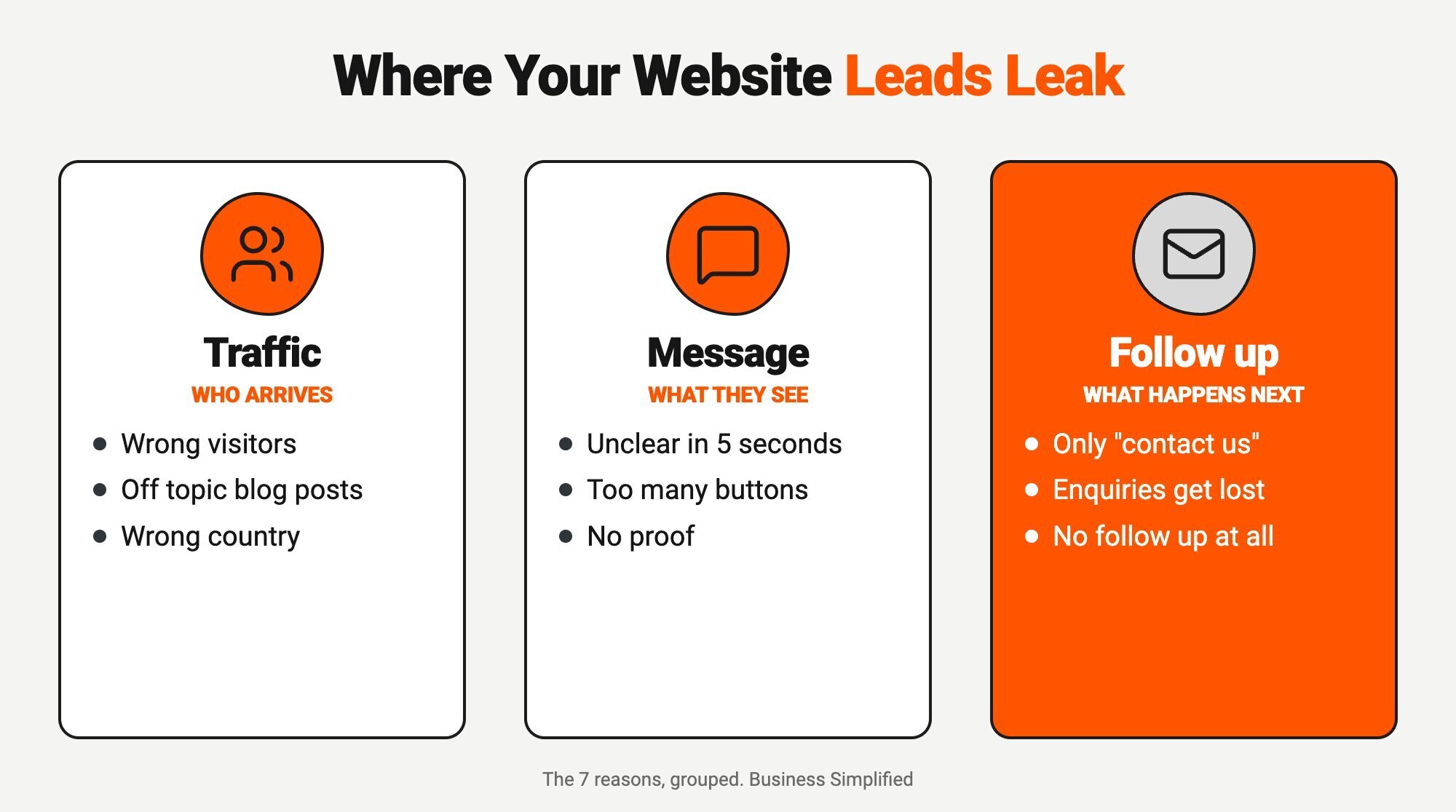
Traffic is a vanity number if it's the wrong traffic. Blog posts that rank for broad questions, students, competitors, people in other countries. Check where visitors come from and which pages they land on. If your busiest page has nothing to do with what you sell, that's your answer.
2. Nobody can tell what you do in five seconds
Your homepage headline says something like "Delivering excellence through innovation". Lovely. What do you actually do, for whom, and why should they pick you? If a stranger can't answer that in five seconds, they leave. This is the Message part of the Growth Engine, and I cover it in how UK SMEs grow from £100k to £5m.
3. The only option is "contact us"
Most visitors aren't ready to talk to you. They're researching. If the only thing you offer is a contact form, you're asking for marriage on the first date. Give them a smaller step: something useful in exchange for an email address.
4. Too many buttons
Call us, email us, book a demo, download this, follow us on Instagram, sign up to the newsletter. When everything is a call to action, nothing is. One page, one main button.
5. No proof
No case studies, no real numbers, no named clients, no reviews. People don't believe claims. They believe evidence. Even one specific result ("we took this business from X to Y") beats a page of adjectives.
6. Enquiries are getting lost
Sometimes the leads are coming, they're just landing in an inbox nobody checks, or the form is broken. Test your own form today. I'm serious. Then check how fast you reply. A lead that waits three days isn't a lead any more.
7. There's no follow up
Someone downloads your guide and then hears nothing. Ever. That's not a lead, that's a name in a database. The money is in the follow up: a short email sequence that builds trust and gives them a reason to talk to you.
Find out which one is costing you
The Growth Engine Scorecard asks 17 quick questions about your customers, message and follow up, then shows you where the leaks are and puts a £ figure on them.
How to tell which problem you have
You don't need an expensive audit. Open Google Analytics and answer four questions:
- Where do visitors come from? If most arrive from one blog post about something unrelated, that's reason 1.
- How long do they stay on your homepage? If people leave within seconds, it's probably reason 2.
- How many reach your contact page? If plenty visit it but few submit, look at reasons 4 and 6.
- What happens after someone does enquire? If you can't answer that, it's reason 7.
Then ask three people who don't know your business to look at your homepage for five seconds and tell you what you do. Their answers will be humbling. That's the point.
What to fix first
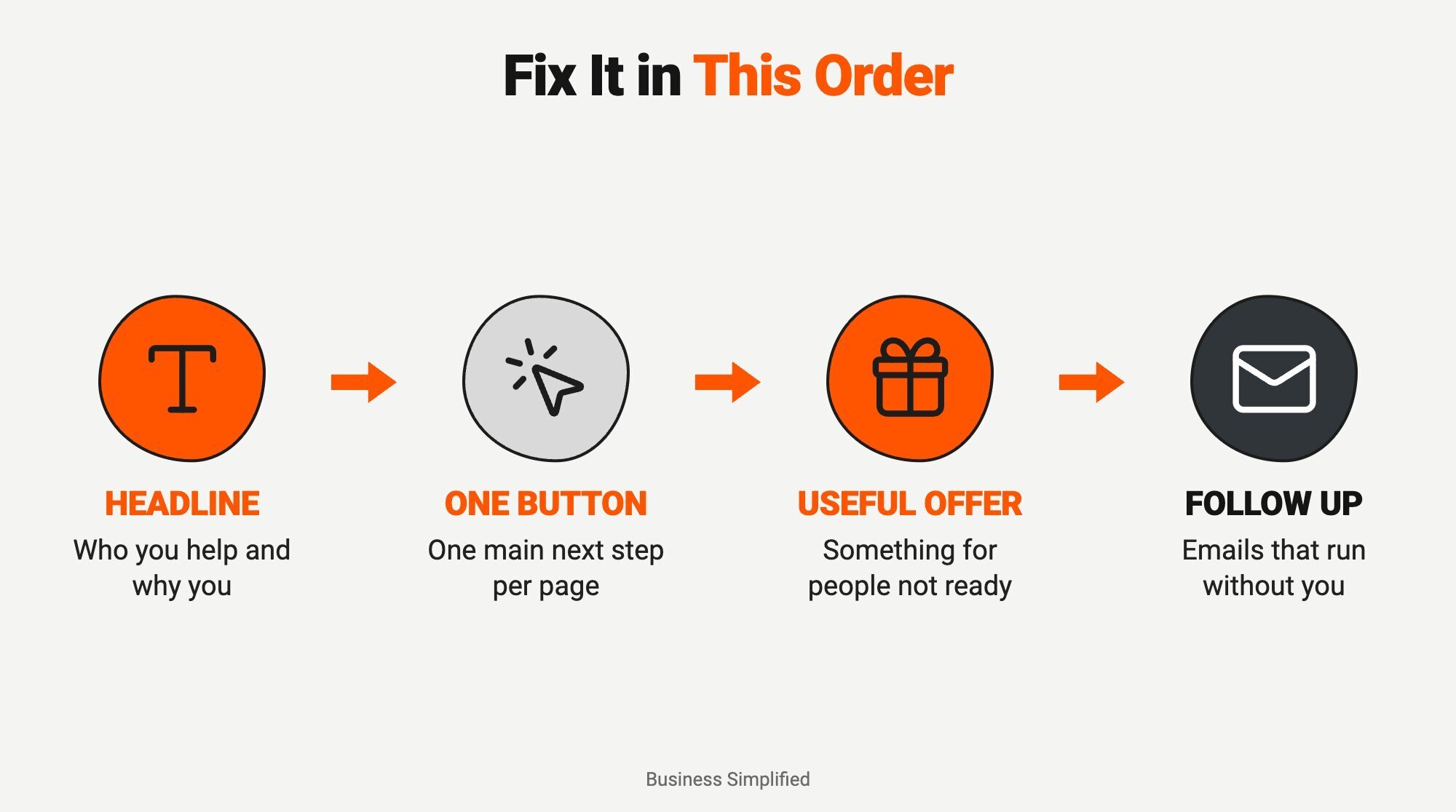
Do it in this order, because each fix makes the next one worth more:
- The headline. Who you help, what you help them do, and why you. One sentence.
- One main next step. Pick the action you want most visitors to take and make it obvious on every page.
- A useful offer for people who aren't ready. A checklist, a scorecard, a short report. I've ranked the options in the best lead magnet ideas for a UK service business.
- Follow up that runs without you. A few emails, sent automatically, that turn a download into a conversation.
- Then, and only then, more traffic.
When the website isn't the problem
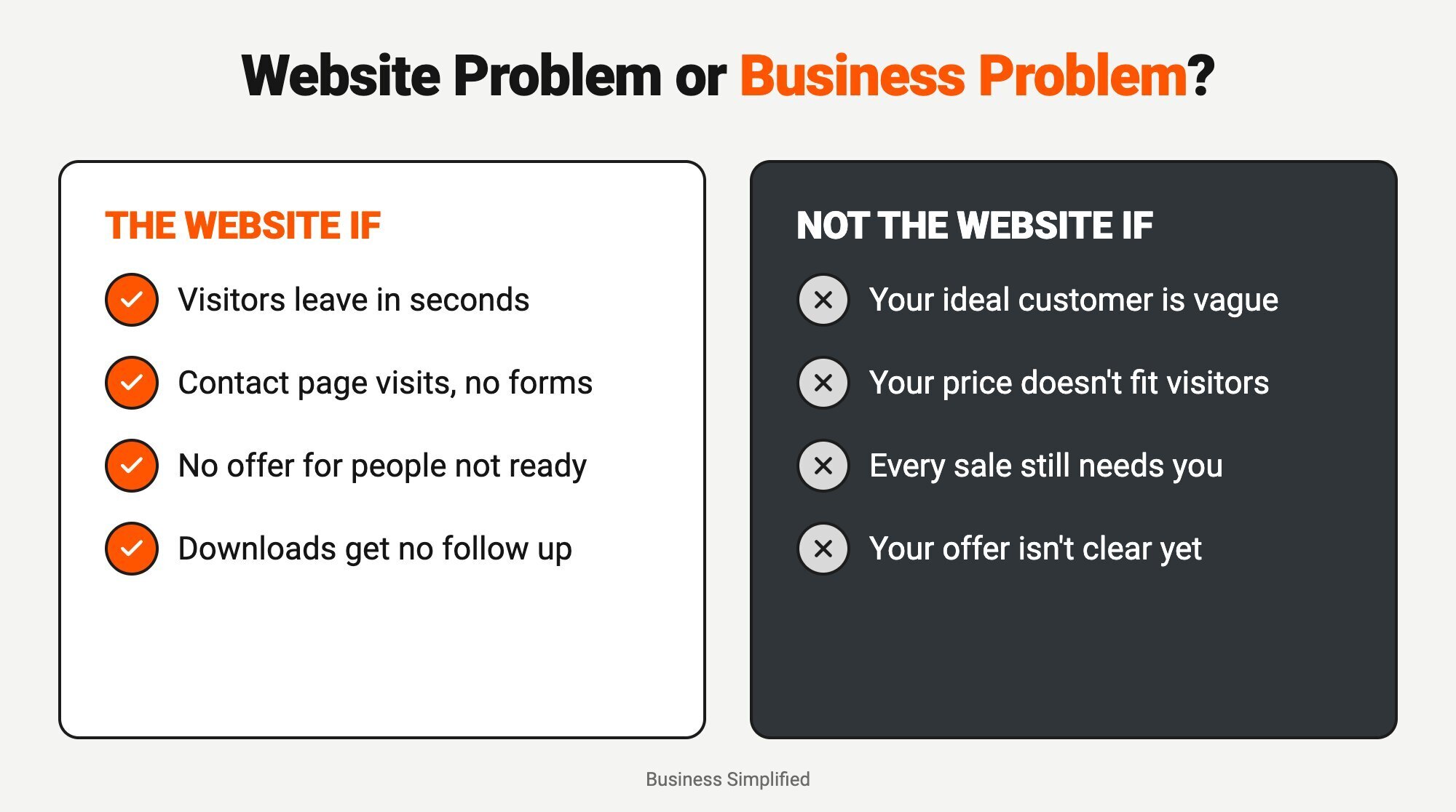
Here's the honest truth. Sometimes the website is fine and the business is the problem. If you can't describe your ideal customer in one sentence, no website can attract them. If your price makes no sense to the people visiting, no headline will fix that. And if every lead still has to go through you personally, you'll hit a ceiling however good the site is.
In our survey of 186 UK business owners, 86% had stalled at one of three growth ceilings, and 77% still personally won most of their new business. The website is often where that shows up, not where it starts. I explain why in why 98% of UK businesses never reach £1m.
Also be careful about rushing to an agency. More traffic sent to a site that doesn't convert just makes the problem more expensive. I've written about that in why lead generation agencies fail small businesses, and you'll find more posts like it in Honest Truths.
What about SEO and ads?
More traffic is the answer most agencies will sell you, because it's the thing they sell. And it is part of the answer, eventually. But think of it like a leaky bucket. If 99.6% of visitors leave without a trace, doubling the traffic doubles the leak, not the leads.
Get the page converting first. Once you know that roughly one in fifty visitors becomes an enquiry, you can work out exactly what more traffic is worth to you, and whether ads or SEO make sense at all. That's when spending on traffic becomes a decision, not a gamble.
A one week plan to start getting leads
You don't need a three month project. Here's what to do this week:
- Monday: test your contact form and check where enquiries actually go. Fix anything broken. Set a rule that every enquiry gets a reply the same working day.
- Tuesday: rewrite your homepage headline. One sentence: who you help, what you help them do, and why you. Run the five second test on three people.
- Wednesday: remove every competing button from your homepage and pick one main action. Put it at the top, in the middle and at the bottom.
- Thursday: add proof. One specific result from a real client, with numbers if they're happy to share them.
- Friday: add a simple offer for people who aren't ready to talk, and a short welcome email that goes out automatically.
Then leave it alone for a month and measure. Same traffic, how many more enquiries? That number tells you whether to keep going or look deeper. If you want to know what more traffic would cost once the site converts, I've broken it down in how much lead generation costs in the UK.
Frequently asked questions
Why does my website get traffic but no leads?
Usually the wrong visitors, an unclear message, no next step for people who aren't ready to talk, or no follow up. Less often, enquiries are simply getting lost.
What is a good conversion rate for a business website?
Landing pages built for one offer have a median of about 6.6% according to Unbounce. A general homepage will usually convert lower. Track your own rate and improve it month by month.
Do I need a new website to get more leads?
Rarely. A clearer headline, one main button, a useful offer and automatic follow up usually make more difference than a redesign.
Should I spend more on ads if my website gets no leads?
Not yet. Fix the conversion first. More traffic to a page that doesn't convert just costs more.
How quickly should I reply to a website enquiry?
As fast as you can, ideally the same day. Every day an enquiry waits, it gets colder.
Take the Growth Engine Scorecard
Find out exactly where your website and sales process are leaking. 17 questions, about three minutes, with your score out of 100, your growth profile and the £ figure your current setup is costing you.

Hi, we are Business Simplified
Growth shouldn’t depend on you chasing every lead. Business Simplified uses real data to fix your pipeline, increase leads and improve sales, so you can lead your business instead of being trapped running it.
Get Our Growth Engine White Paper
We surveyed 186 UK businesses to find out what growth strategies actually work
We published those findings in our "Growth Engine" whitepaper. You can get a copy here.