Download my Whitepaper here:
By clicking submit, you agree to receive promotional emails and weekly content from Company.

How Much Should a Small Business Spend on Marketing?
Wednesday, November 04, 2026

The UK benchmarks for marketing spend as a percentage of turnover, the worked maths for a £500k and £1m business, and why the percentage matters less than what you spend it on.
Most founders I speak to set their marketing budget the same way. They look at what's left in the bank at the end of the month, panic slightly, and spend a bit of that. Then referrals dry up, the pipeline goes quiet and they ask the same question everyone asks: how much should a small business spend on marketing in the UK?
Then they Google it, get told "it depends", and go back to waiting for the phone to ring.
It does depend. But there are real UK benchmarks, and you can do the sums in five minutes.
In this blog I'll give you the UK figures for marketing spend as a percentage of turnover, show you the worked maths for a few business sizes, explain how I'd split the money between channels, and show you how to tell whether it's actually working.
How much should a small business spend on marketing in the UK?
Here are the numbers worth knowing:
- UK businesses spent an average of 7.7% of revenue on marketing in 2024, a Marketing Week figure quoted by JDR.
- JDR, which is a marketing agency so bear that in mind, recommends 9% to 10%.
- A CIM and MORI study reported by Marketing Week found firms turning over less than £1m spend just over 10% of turnover on marketing, against an average of 7.2%.
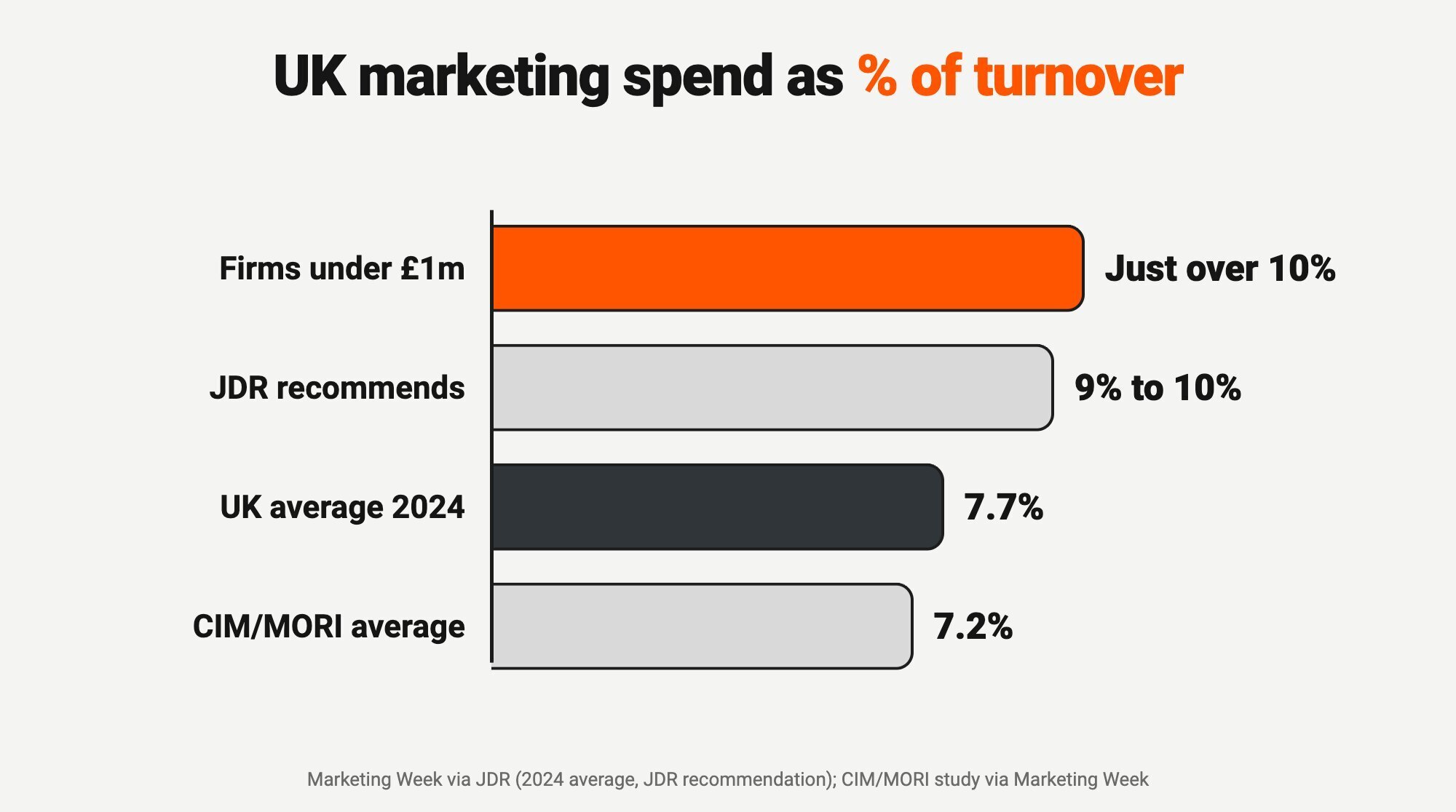
Notice the pattern. Smaller firms spend a bigger slice, not a smaller one. That makes sense. A small business has no brand to coast on, so it has to work harder to get seen.
So if you want a single starting point: somewhere between 7% and 10% of turnover is a sensible range for a small UK business that's trying to grow. Below that, you're probably relying on referrals and hope.
Marketing budget percentage of turnover in the UK: the worked maths
Percentages are easy to nod at and hard to feel. So here's what they look like in pounds. The turnover figures are illustrative. The percentages are the benchmarks above, plus 5% as a "cautious" line for comparison.
| Turnover (illustrative) | 5% (cautious) | 7.7% (UK average) | 10% (small firm level) |
|---|---|---|---|
| £250,000 | £12,500 | £19,250 | £25,000 |
| £500,000 | £25,000 | £38,500 | £50,000 |
| £1,000,000 | £50,000 | £77,000 | £100,000 |
| £2,000,000 | £100,000 | £154,000 | £200,000 |
Two things usually happen when founders see this table. Either "I'm nowhere near that", or "that's an awful lot of money for something I can't measure". Both are fair. Let's deal with them.
Marketing budget for a £1m business
A £1m business spending at the UK average would put about £77,000 a year into marketing. At the small firm level, £100,000. Before you choke on your tea, remember this includes people. If you employ a marketer, their cost sits in that number. So does your CRM, your website, your content production and any ads.
Most £1m founder-led businesses I see are spending a fraction of that in cash and making up the gap with the founder's own time. Which works, right up until it doesn't. In our survey, 77% of owners still personally win most new business (The Growth Engine, Business Simplified, 2026). Your time is a marketing cost too. It just never shows up on the P&L.
Is 10% too much?
Not if it's producing clients at a cost you can afford. Yes, if you're spending it on things you can't track. The percentage is a sense check, not a target. A 10% budget spent on random boosted posts is worse than 5% spent on a system that turns strangers into enquiries.
Spend on a machine, not on noise
The Growth Engine shows how 186 UK owners turning over £100k to £5m are really winning work, and the Market, Message and Machine framework for spending your marketing budget where it compounds.
How to set a marketing budget (without guessing)
Here's the process I'd use. It takes an afternoon and a spreadsheet.
- Start with the goal. How much new revenue do you want next year? Turn that into a number of new clients.
- Do the reverse maths. How many enquiries do you need to win that many clients? How many conversations to get those enquiries?
- Sense check against the benchmark. Does your plan land somewhere near 7% to 10% of turnover? If it's way under, you're probably underestimating what it takes.
- Review every 90 days. Move money from what isn't working to what is.
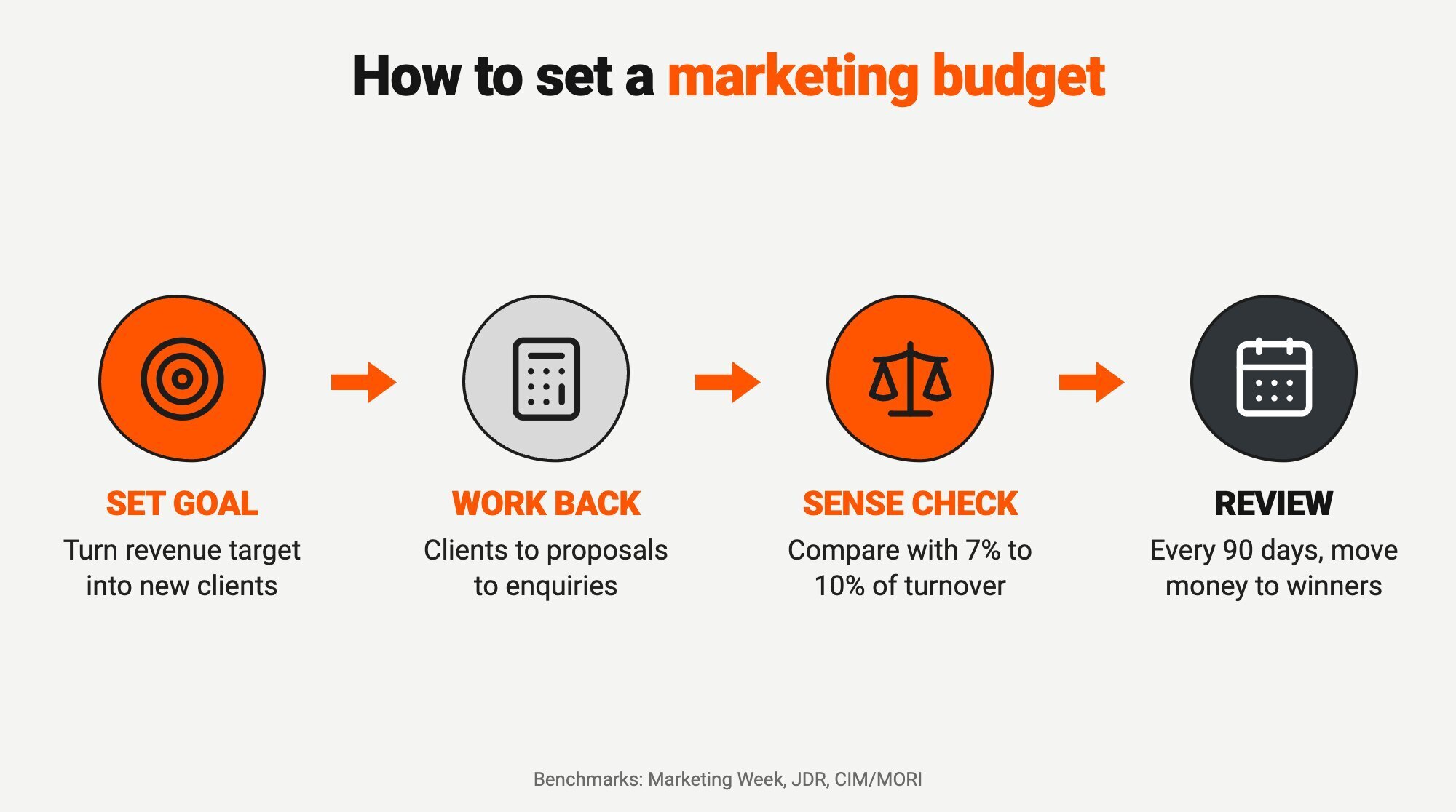
Here's an example of step 2. All numbers are illustrative.
- Goal: 10 new clients next year
- You win 1 in 4 proposals, so you need 40 proposals
- 1 in 3 enquiries turns into a proposal, so you need 120 enquiries
- That's about 10 good enquiries a month. Now ask: what will it cost to generate 10 a month without me doing all of it?
That last question is the one that matters. I've written up the full approach in how to create a lead generation process.
How to split a small business marketing budget between channels
There's no universal split, and I'd be wary of anyone who gives you one without knowing your business. But here's how I'd think about it for a founder-led service business between £100k and £5m.
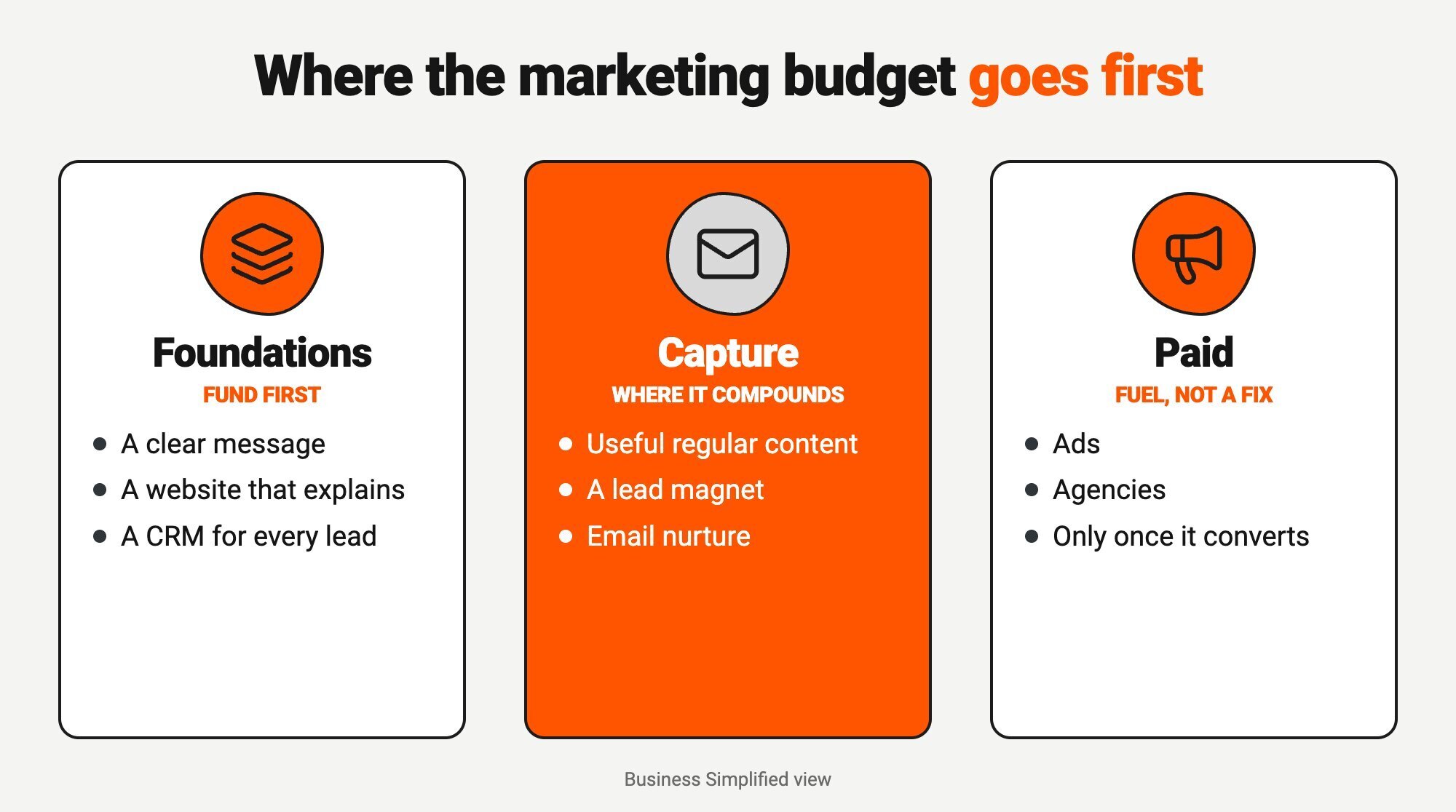
1. The foundations (do these first)
A clear message, a website that explains what you do, and a CRM so leads don't live in your inbox. If you haven't got one, see my guide to the best CRM for a small UK business.
2. Audience and content
Regular, useful content that shows you know your stuff. This is slow but it compounds. One thing I've learned the hard way: 69% of the people who see my content don't follow me. So content alone isn't enough. You need a way to capture people.
3. Capture and nurture
A lead magnet and an email sequence that turns a passing viewer into an enquiry. This is the bit most small businesses skip, and it's where the money compounds. I break it down in the lead generation machine that runs without you.
4. Paid and outsourced
Ads and agencies can pour fuel on a system that already works. They rarely fix one that doesn't. That's a big part of why lead generation agencies fail small businesses.
This isn't theory for me. At Squaredot, once the system was built, work from cold leads went from 6% to 59% and turnover grew from £800k to £1.2m in three months (The Growth Engine, Business Simplified, 2026). The budget didn't change the outcome. What it was spent on did.
How to measure marketing ROI
You don't need a data team. You need three numbers, tracked monthly:
- Cost per enquiry: what you spent divided by the enquiries it produced
- Cost per client: what you spent divided by the clients you won
- Client value: the gross profit a typical client brings in over a year
A quick illustrative example. You spend £3,000 in a month and win 2 clients. That's £1,500 per client. If each client is worth £8,000 in gross profit in year one, every £1 you spent brought back about £5.33. Keep doing that. If a client is worth £1,000, stop and rethink.
The honest drawback: content and brand work take months to show up in these numbers, so judge them over a quarter, not a week.
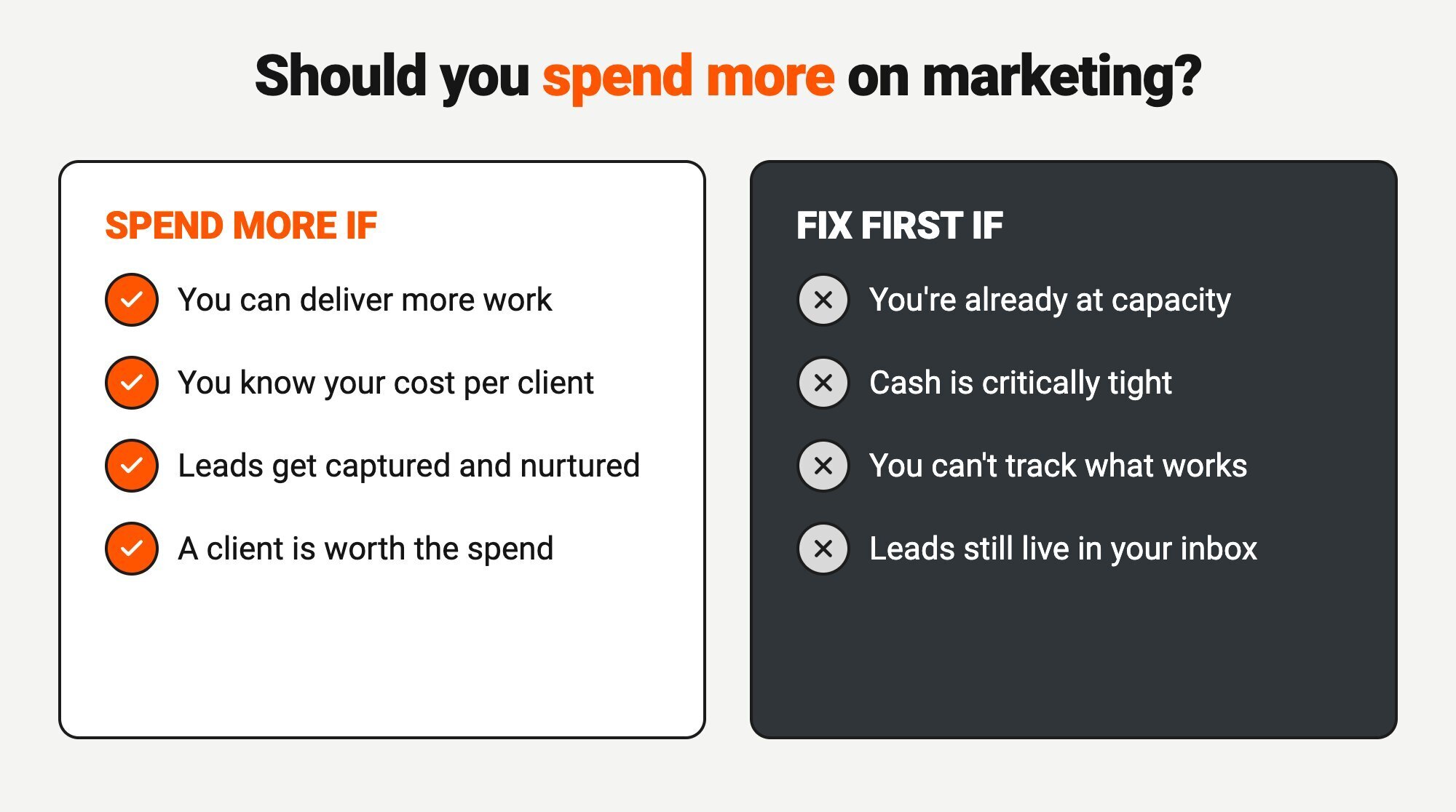
Who this advice isn't for
If you're at capacity and can't deliver more work, spending more on marketing just creates unhappy clients. Fix delivery first. And if cash is critically tight, a big marketing push isn't the answer this month. Start with the free stuff: content, referrals asked for properly, and following up on old leads.
So, how much should a small business spend on marketing in the UK?
The UK average was 7.7% of revenue in 2024, and firms under £1m typically spend just over 10%. For a £500k business, that's roughly £38,500 to £50,000 a year, people and tools included. Use that as a sense check, then build the real budget from your growth goal backwards, and spend it on a system that keeps working when you're not in the room.
If you're weighing marketing spend against a sales hire, read the real cost of hiring a salesperson in the UK, or browse the rest of What Growth Costs.
Frequently asked questions
What percentage of turnover should go on marketing?
UK businesses spent an average of 7.7% of revenue on marketing in 2024, and firms under £1m spend just over 10%. Somewhere between 7% and 10% is a sensible starting range for a small business that wants to grow.
How much should a £500k business spend?
At the UK average of 7.7%, about £38,500 a year. At 10%, £50,000. That includes people, tools and content, not just ads. Build the real figure from your growth goal backwards.
Is 10% too much?
Not if it's winning clients at a cost you can afford. Firms under £1m typically spend just over 10% already. It's too much if you can't track what it produces.
How do I split budget between channels?
Fund the foundations first (message, website, CRM), then content, then a lead magnet and email nurture. Add paid ads or agencies once you have a system that already converts.
How do I measure marketing ROI?
Track cost per enquiry, cost per client and client value every month. Divide the gross profit from new clients by what you spent. Judge content and brand work over a quarter, not a week.
Download The Growth Engine
Before you set next year's marketing budget, see how 186 UK owners are winning work and where 86% of them get stuck. Includes the full Squaredot case study.

Hi, we are Business Simplified
Growth shouldn’t depend on you chasing every lead. Business Simplified uses real data to fix your pipeline, increase leads and improve sales, so you can lead your business instead of being trapped running it.
Get Our Growth Engine White Paper
We surveyed 186 UK businesses to find out what growth strategies actually work
We published those findings in our "Growth Engine" whitepaper. You can get a copy here.