Download my Whitepaper here:
By clicking submit, you agree to receive promotional emails and weekly content from Company.

Is Business Coaching Worth It? An Honest Answer for UK Founders
Wednesday, November 04, 2026

I sell coaching. So you'd expect me to say yes. The honest answer is "sometimes", and this post is about working out which side of that line you're on before you spend a penny.
You've had the LinkedIn ads. You've heard the friend who swears their coach changed everything. You've probably also heard the other story: someone who paid thousands for a year of nice chats and a branded notebook. So is business coaching worth it in the UK, or is it an expensive way to feel productive?
Here's the uncomfortable bit. I run Business Simplified, which is a coaching business for founder-led UK SMEs. I have every reason to tell you coaching always pays. It doesn't. Some founders get a brilliant return. Some waste their money. The difference usually has nothing to do with the coach's certificates.
In this blog I'll give you the honest answer: what the evidence actually says about business coaching ROI, why coaching fails, who it works for, who it doesn't, and a simple test you can run on yourself before you sign anything.
Is business coaching worth it in the UK? The short answer
Business coaching is worth it when three things are true at once. You have a specific problem that is costing you real money. You will actually do the work between sessions. And the coach has a method for your particular problem, not just good listening skills.
If one of those is missing, the maths starts to wobble. If two are missing, you're paying for therapy with a whiteboard.
That's not me being cynical about my own industry. It's me being honest about it. Coaching is a multiplier. It multiplies the effort and decisions you bring. Multiply zero and you still get zero, just with an invoice attached.
What the evidence says about business coaching ROI
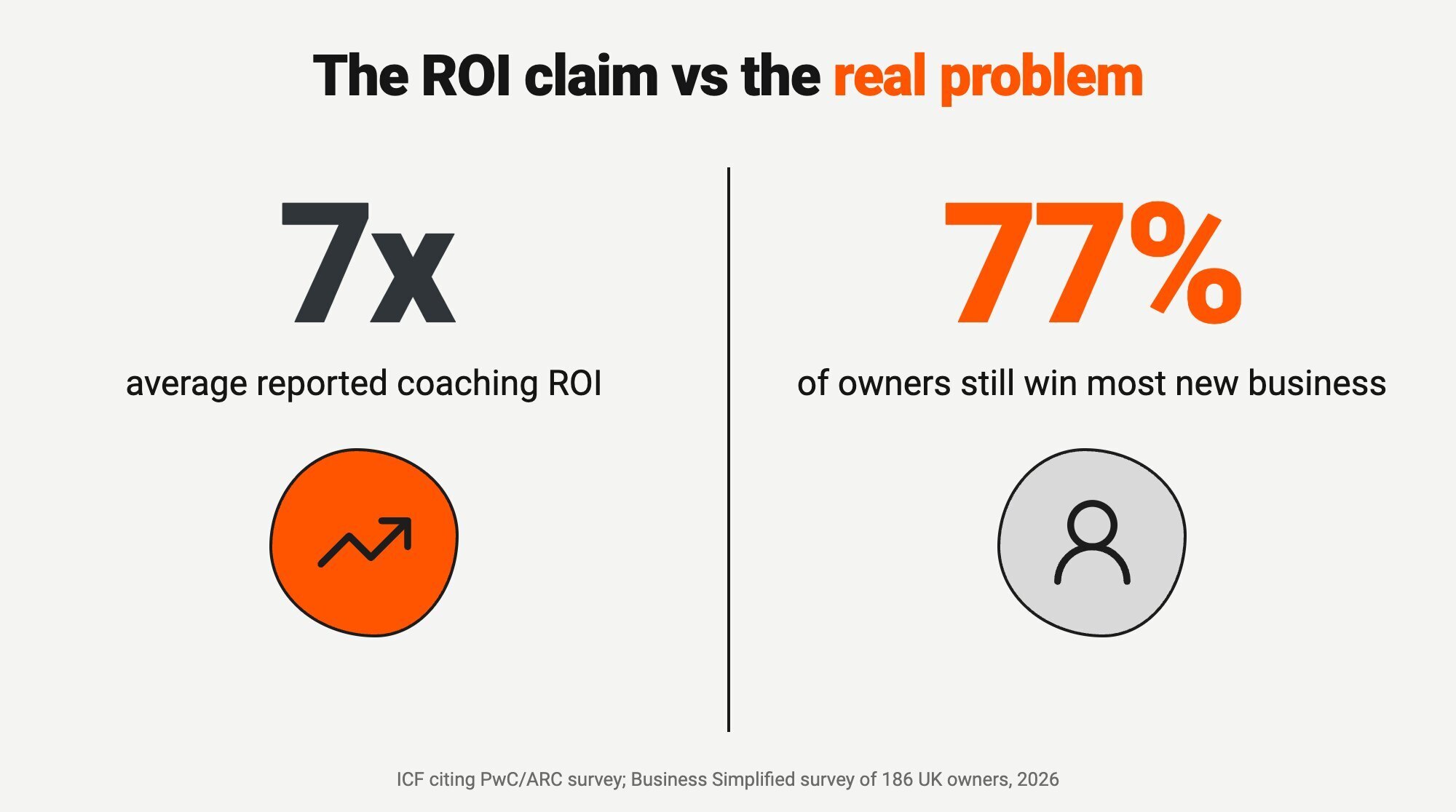
The figure you'll see quoted everywhere is that coaching returns seven times its cost. That comes from a PwC and Association Resource Centre survey cited by the International Coaching Federation, which reports an average ROI of 7x the cost of coaching.
I'd treat that number with care, for three reasons:
- The ICF is the coaching industry's own body. That doesn't make the number wrong, but it's not a neutral referee.
- The survey year isn't clearly stated. A headline stat with fuzzy dates is a headline stat, not a forecast.
- Averages hide the spread. An average of 7x can be a handful of huge wins and a long tail of people who got nothing.
So no, I won't promise you 7x. Nobody honest can. What I will say is that the founders who get a return almost always point to one or two concrete changes: they stopped being the only person who could sell, they built a repeatable way to win work, or they finally made a decision they'd been dodging for a year.
Our own research points in the same direction. In The Growth Engine, our survey of 186 UK business owners turning over £100k to £5m, 77% said they still personally win most of their new business, and 86% had stalled at one of three growth ceilings (Business Simplified survey of 186 UK business owners, 2026). That's the problem coaching is supposed to solve. If a coach doesn't move you on that, the ROI is going to be thin, whatever the brochure says.
What business coaching actually costs
You can't judge whether something is worth it without a price. One UK coach's pricing guide puts the typical bands at:
| Format | Typical UK price |
|---|---|
| One-to-one sessions | £100 to £500 an hour |
| Intensive days | £1,000 to £3,000 |
| Group programmes | £200 to £800 a month |
| 3 to 6 month packages | £3,000 to £15,000 |
That's a wide range, and price alone tells you very little about quality. I've written a full breakdown in how much a business coach costs in the UK if you want to go deeper on what each band should include.
Here's a simple way to think about it (illustrative). If you're paying £6,000 for six months and the coaching helps you land two extra clients worth £10,000 each in gross profit, that's a clear return. If you can't name what "two extra clients" would look like for your business, you're not ready to judge the spend yet.
Know your ceiling before you pay anyone to fix it
The Growth Engine shows the three growth ceilings 86% of UK owners hit, and which of five growth profiles you fit. Read it first and you'll know exactly what to ask a coach for.
Why business coaching fails (the bit coaches don't advertise)
I've seen coaching fail more often than the industry likes to admit. Usually for one of these reasons.
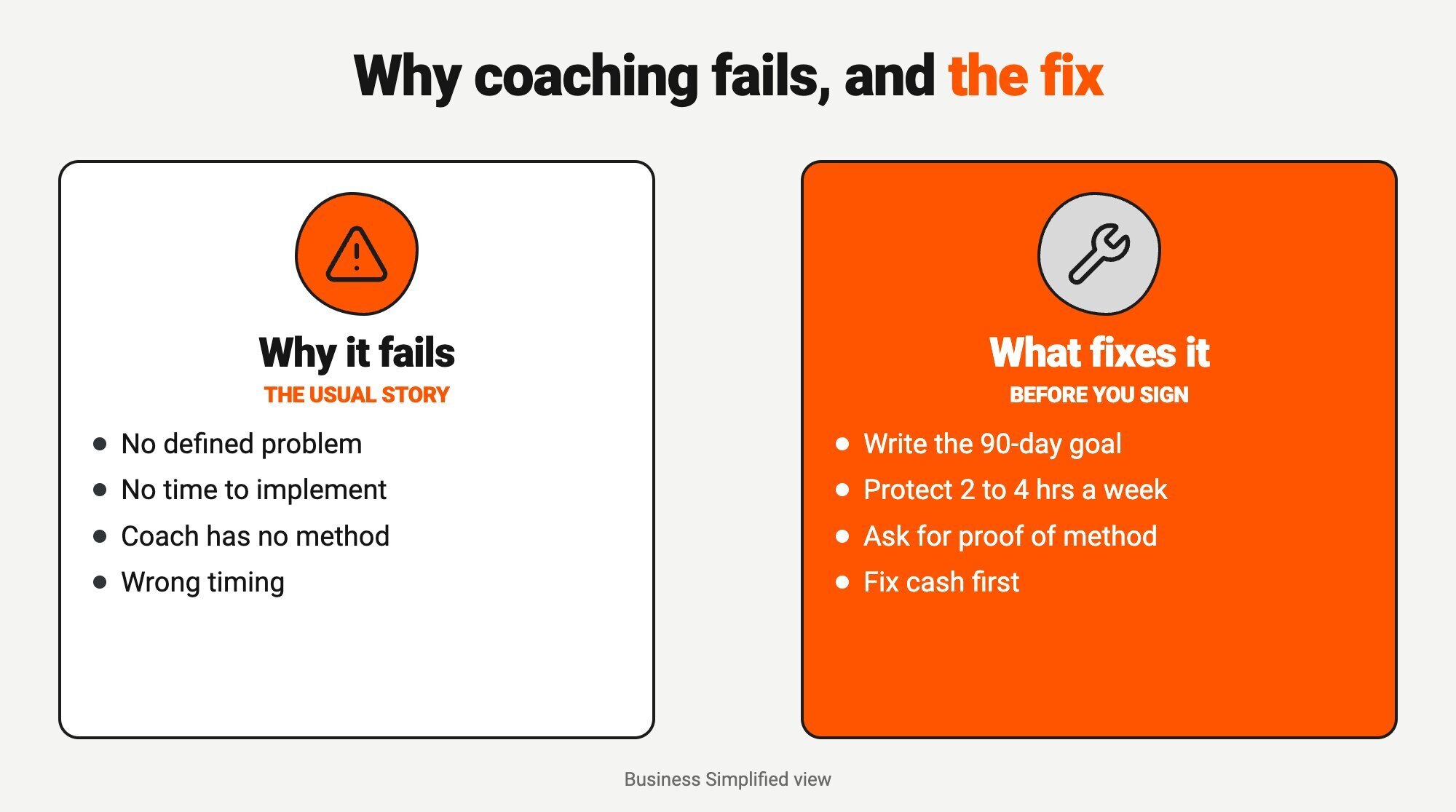
1. There's no defined problem
"I want to grow" isn't a problem. It's a wish. Coaching without a clear target drifts into weekly catch-ups that feel useful and change nothing. If you can't write down what you want to be different in 90 days, start there.
2. The founder doesn't do the work
This is the big one. Coaching gives you clarity and accountability. It doesn't give you hours. If you're already working 60 hours a week in the business and you add a coach without removing anything, the actions from each session quietly pile up and die.
3. The coach has no method for your problem
Plenty of coaches are excellent at asking questions. That's valuable for some things. But if your problem is that sales depend entirely on you and your pipeline goes feast or famine, you need someone who has built a lead generation process, not someone who'll ask how that makes you feel.
4. You needed a different kind of help
Sometimes you don't need a coach at all. You need a consultant to fix something specific, or a mentor who has been there. If you're not sure which, read my comparison of business coach vs consultant vs mentor. Hiring the wrong one is the most common way people decide coaching "doesn't work".
5. The timing is wrong
If cash is critically tight, or you're in the middle of a crisis, coaching is usually the wrong spend. Fix the fire first. I've written a whole post on when you should NOT hire a business coach, and I'd rather you read that than hire me at the wrong moment.
Who business coaching works for
In my experience, the founders who get real value from business coaching share a few traits:
- They've already proven the business works. There's revenue, there are happy customers, there's something to build on.
- They're stuck at a ceiling, often the point where everything still runs through them.
- They'll protect time each week to actually implement.
- They want a system, not motivation.
- They're willing to hear things they don't like.
That last one matters. When I grew SPOR to around £5m, I got stuck trying to reach £7.5m. I hired a sales team, which turned me from a seller into a manager, and I went round in circles for two years. What I eventually learned was that more effort wasn't the answer. The system was the problem, not the people. An honest outside view helps you see that kind of thing much faster.
Who business coaching does not work for
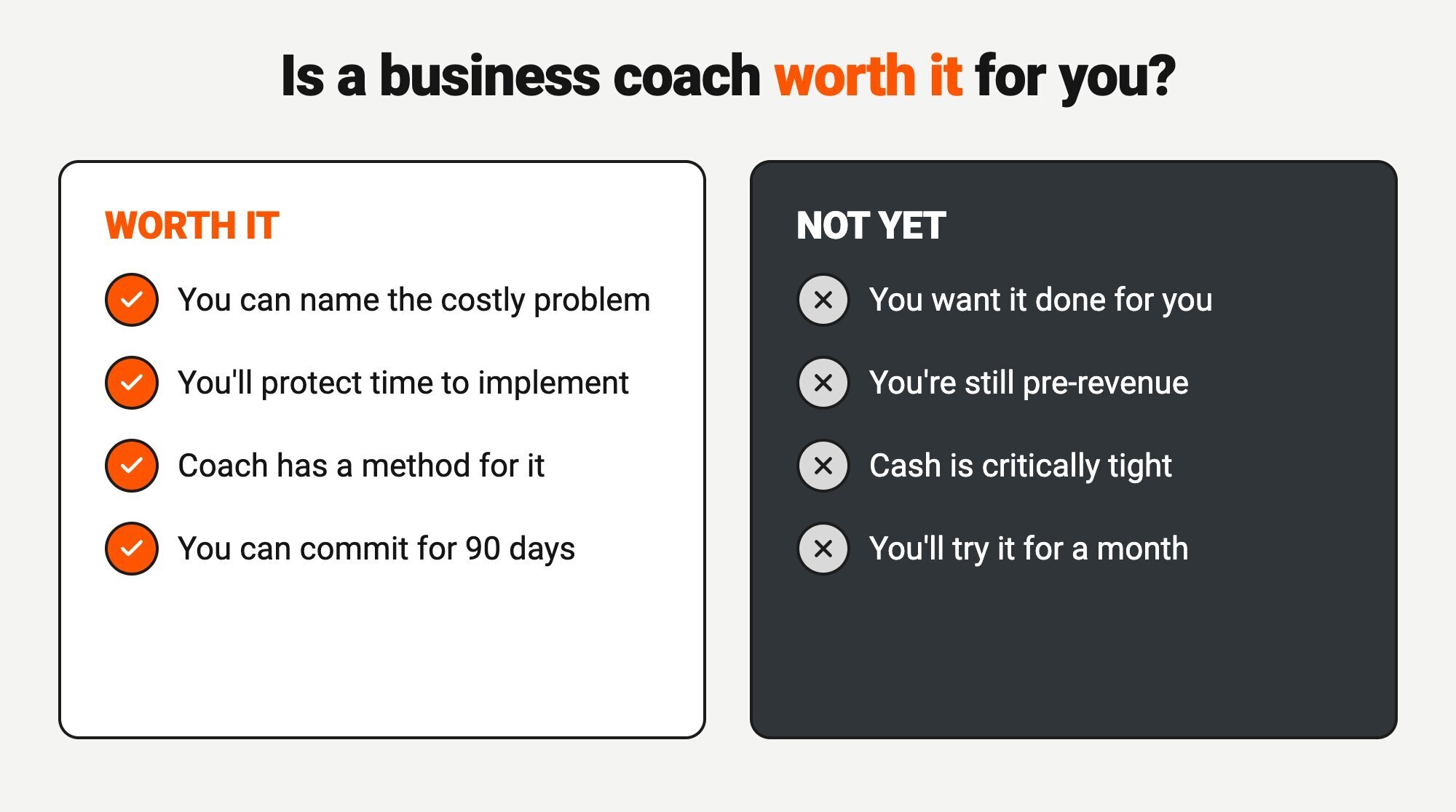
And the flip side. Coaching is probably not worth it for you right now if:
- You want someone to do the work for you. That's an agency or a hire, not a coach.
- You're pre-revenue and still testing whether anyone will buy.
- You're hoping coaching will fix a problem you already know the answer to but don't want to act on.
- You'll only commit for a month to "see how it goes". Most meaningful change takes at least a quarter.
Coach or course? A cheaper route to test the water
If you're on the fence, you don't have to jump straight into a £10,000 package. Structured programmes can be a much cheaper way to find out whether outside help suits you. Help to Grow: Management is a good example for businesses with staff, and I've reviewed it honestly in my Help to Grow Management review. There's also a broader list in my guide to the best business growth programmes in the UK.
Books are cheaper still. If you haven't read the classics on systems and scaling, start with my list of the best business growth books for founders before you pay anyone.
Full disclosure: our own entry point is a £97 Business Review, a paid call where we look at where you're stuck. It exists precisely so nobody signs up for a bigger programme without knowing whether it fits.
A simple test: is a business coach worth it for you?
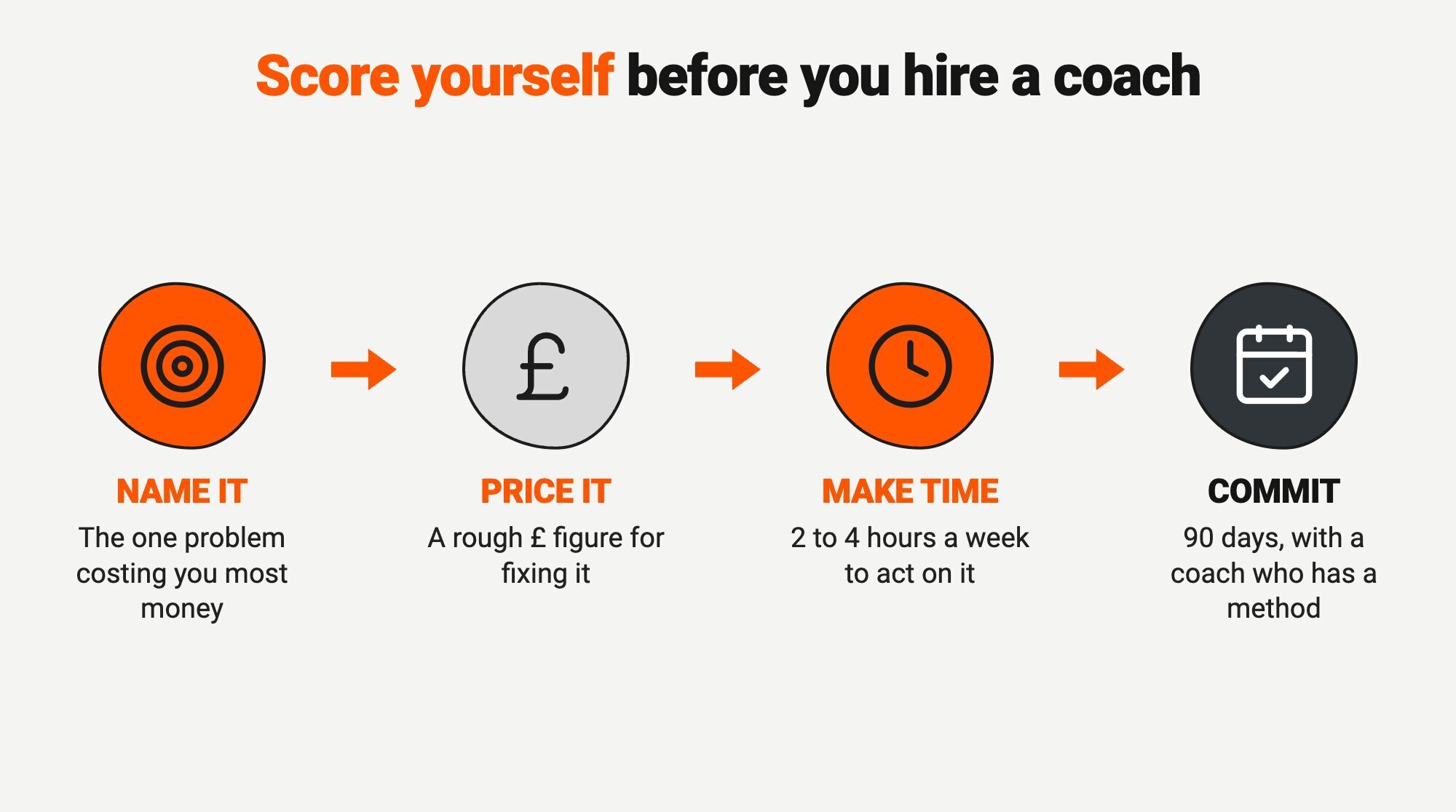
Answer these honestly. If you get four or five "yes" answers, coaching is likely to pay. Fewer than three, spend the money elsewhere for now.
- Can I name the one problem that is costing me the most money right now?
- Can I put a rough £ figure on fixing it?
- Will I protect two to four hours a week to act on what comes out of sessions?
- Does this coach have a specific method for my problem, and proof they've used it?
- Can I commit for at least 90 days?
That's it. No magic. Coaching works when the problem is clear, the founder is committed and the method fits. Everything else is noise.
For more honest takes like this, have a look at the rest of the Honest Truths series, or read why 98% of UK businesses never reach £1m.
Frequently asked questions
Does business coaching actually work?
It can, but not by itself. Coaching works when you have a defined problem, a coach with a method for it, and you do the work between sessions. Without those, it rarely changes much.
What ROI can I expect from business coaching?
A PwC and Association Resource Centre survey cited by the ICF reports an average ROI of 7x the cost, but treat that with care. Your own return depends on how much the problem you're fixing is costing you.
How long until I see results from coaching?
Expect to commit at least 90 days. You may get clarity in the first few sessions, but real changes in revenue or workload usually take a quarter or more to show.
What makes business coaching fail?
The usual causes are no clear problem, a founder with no time to implement, a coach without a method for the issue, hiring a coach when you needed a consultant or mentor, and bad timing.
Should I hire a coach or do a course?
If you're unsure, start with a structured course or programme. It's cheaper and shows you whether outside help suits you. Move to a coach when you need tailored help on a specific problem.
Download The Growth Engine
Before you decide whether business coaching is worth it for you, find out where you're actually stuck. The Growth Engine covers the three growth ceilings, five growth profiles and the Market, Message and Machine framework, based on 186 UK business owners.

Hi, we are Business Simplified
Growth shouldn’t depend on you chasing every lead. Business Simplified uses real data to fix your pipeline, increase leads and improve sales, so you can lead your business instead of being trapped running it.
Get Our Growth Engine White Paper
We surveyed 186 UK businesses to find out what growth strategies actually work
We published those findings in our "Growth Engine" whitepaper. You can get a copy here.