Download my Whitepaper here:
By clicking submit, you agree to receive promotional emails and weekly content from Company.

Best Business Growth Programmes for UK SMEs
Wednesday, November 04, 2026

Most "growth programme" lists are really startup accelerator lists. This one is for established UK businesses turning over £100k to £5m.
You search for business growth programmes UK owners can join, and the results are full of accelerators for tech startups. Pitch days. Equity. Demo days. Founders in hoodies.
That's not you. You've got a real business, real customers and real payroll. You're not looking for investment. You're looking for a way past the ceiling you've been bumping into for two years, without it all still depending on you.
In this blog I'll cover the growth programmes that actually suit an established SME: what each one is, who it's best for, what it costs where there's a published figure, and the honest drawback. Two of the options are mine, and I'll flag them clearly. For everything else, a straight disclosure: I haven't been through these programmes myself. I've assessed them from their published pricing, format and eligibility details, so check the official sites before you apply.
Business growth programmes UK: the quick picks
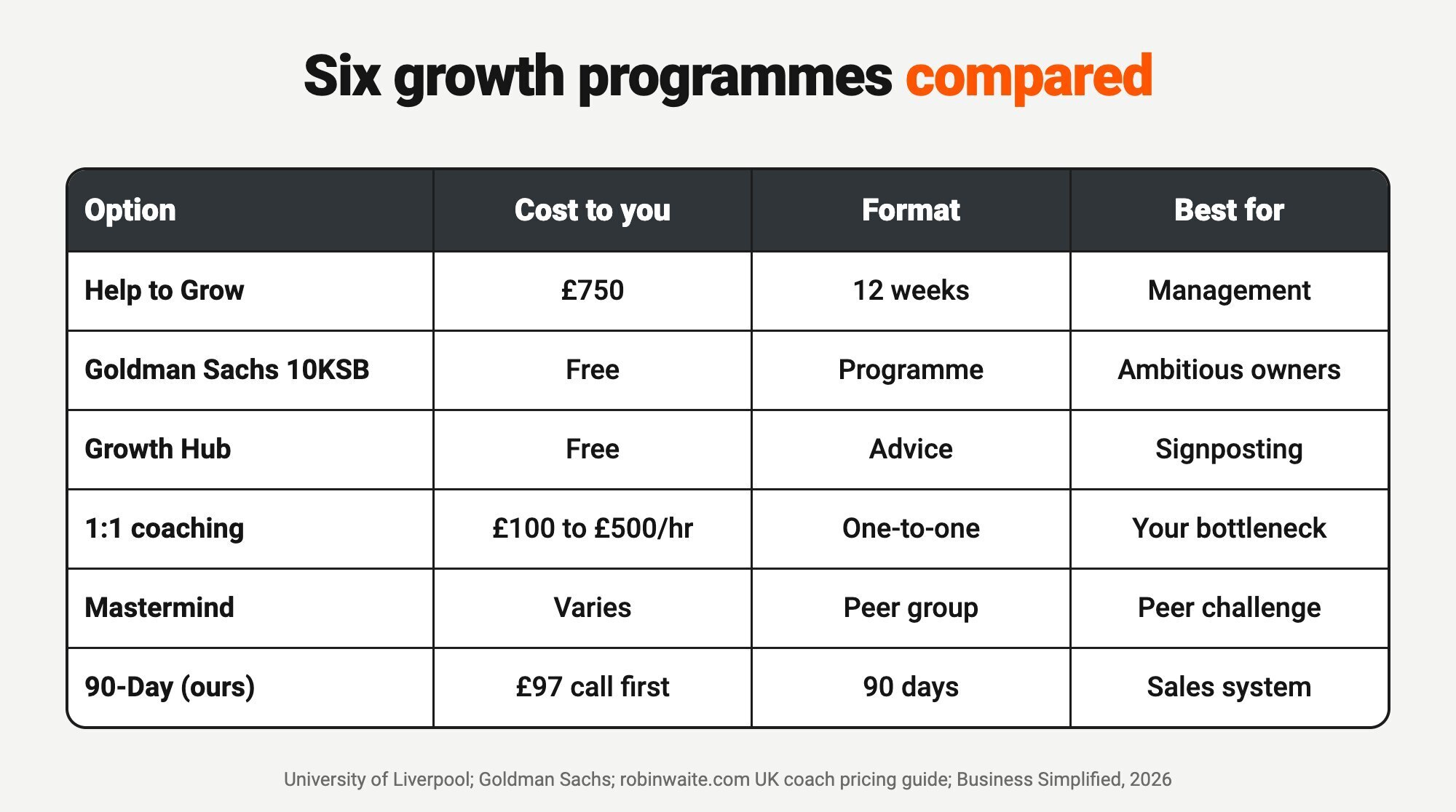
- Best funded option for management skills: Help to Grow: Management.
- Best free programme for established owners: Goldman Sachs 10,000 Small Businesses UK (check current eligibility).
- Best free first stop: your local Growth Hub (England).
- Best for tailored, hands-on help: one-to-one business coaching.
- Best for owners who learn from other owners: peer groups and masterminds.
- Best for building a sales and marketing system fast: the Business Simplified 90-Day Accelerator (full disclosure: this one's ours).
One bit of context before we start. If you do want the startup accelerator side of things, Beauhurst keeps a roundup of UK accelerator programmes. It's a useful list, just aimed at a different kind of business from the one most of my readers run.
1. Help to Grow: Management
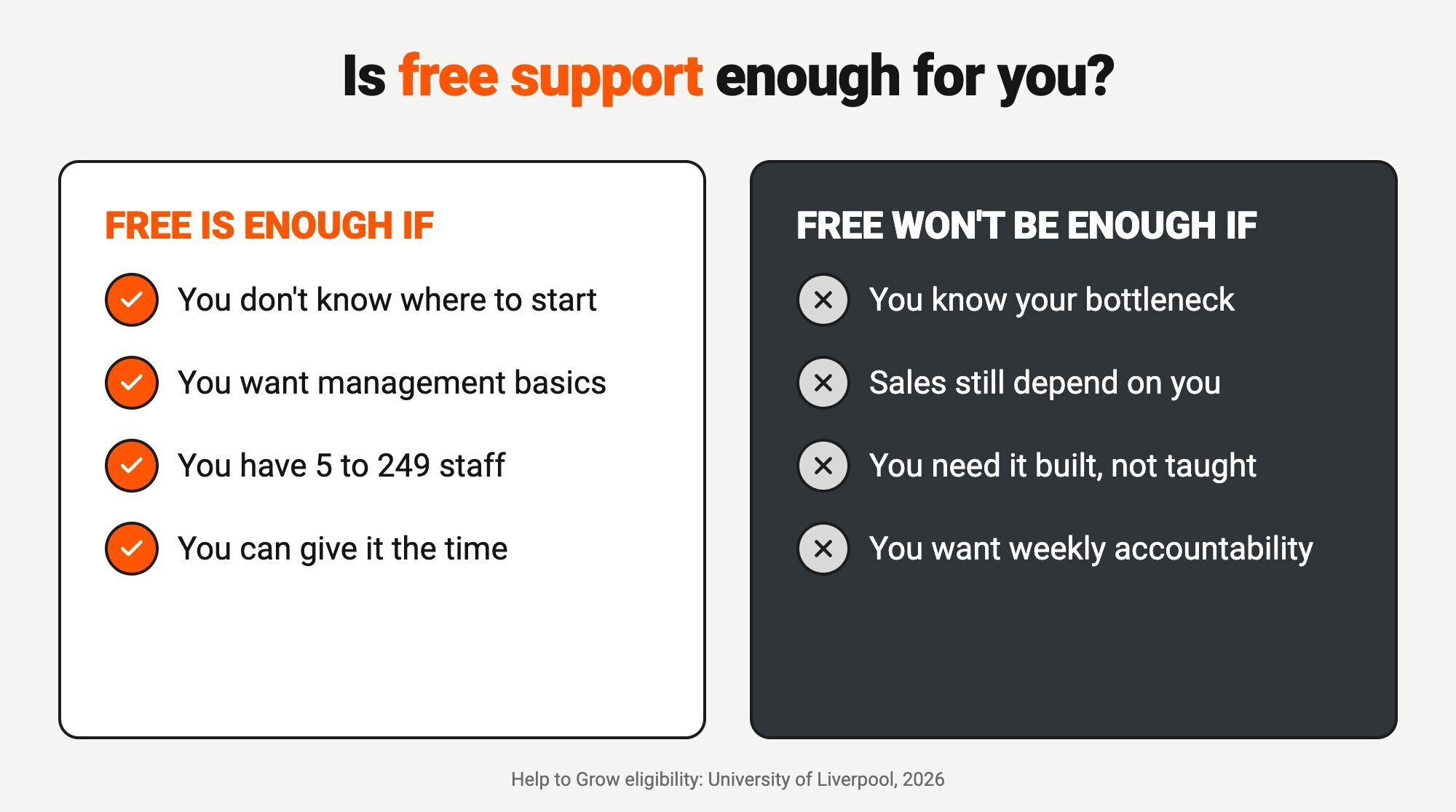
Best for: owners of businesses with 5 to 249 staff who want structured management training alongside other business owners.
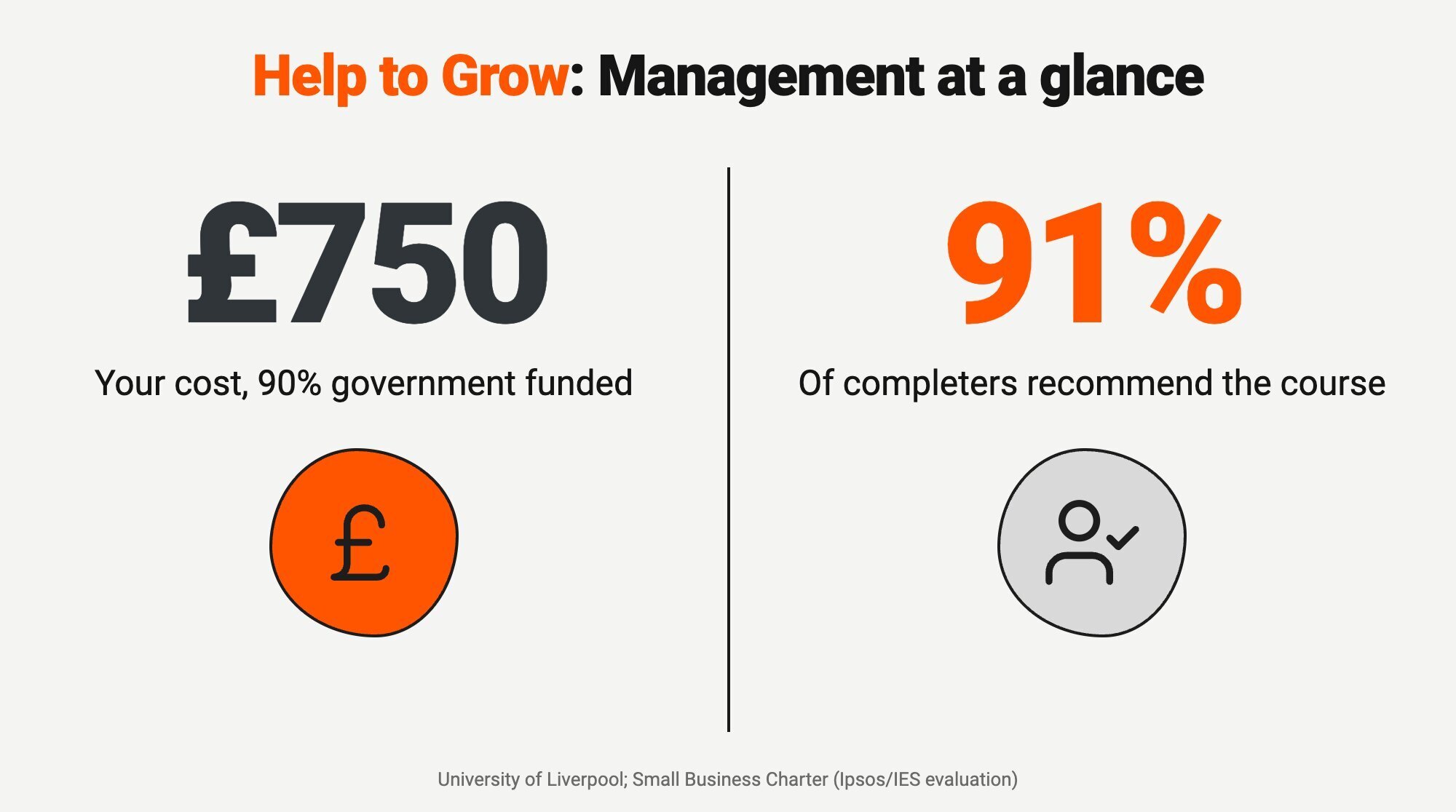
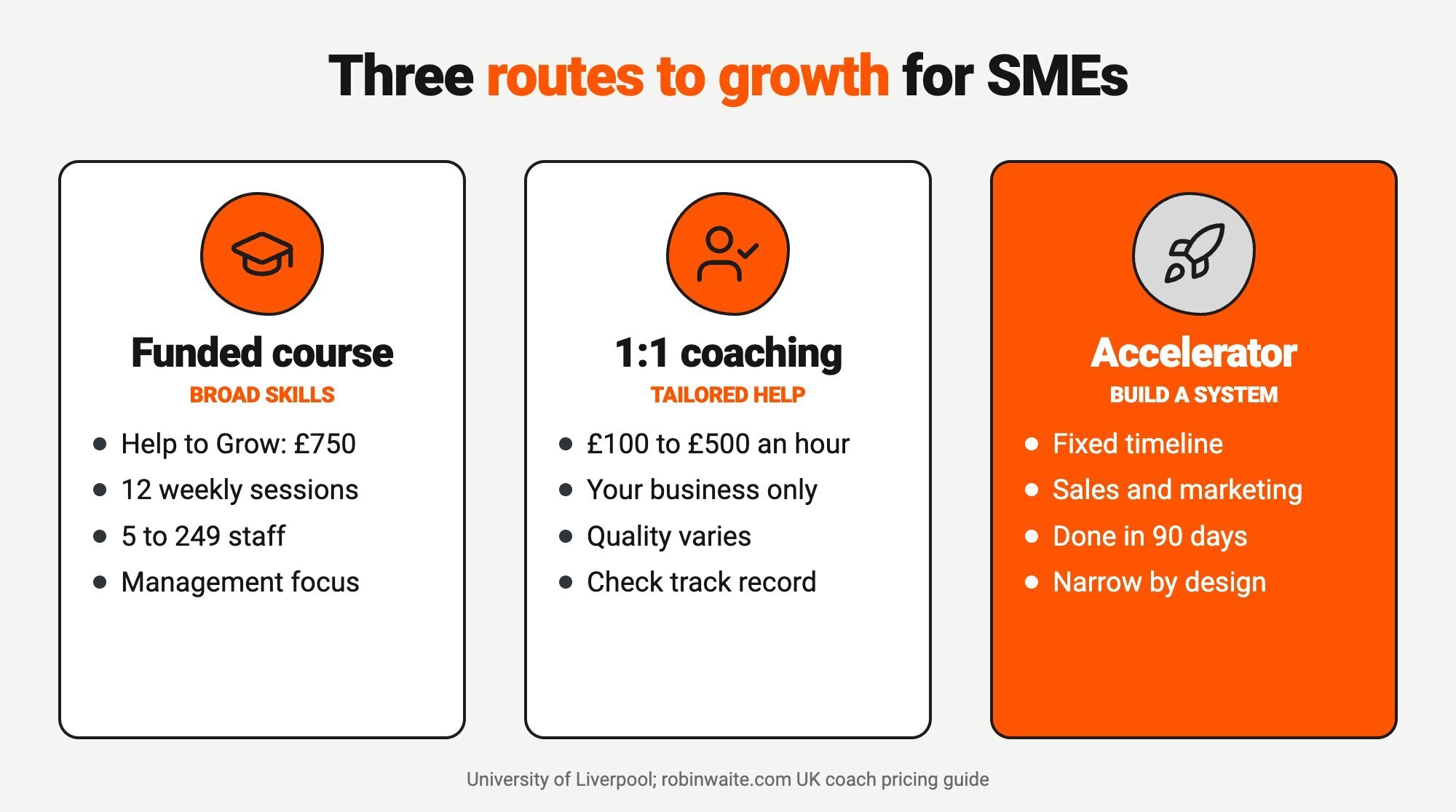
Cost: £750, with the course 90% government funded. It runs as 12 weekly sessions. The University of Liverpool, for example, lists its next cohort as starting on 9 November 2026.
For £750, this is hard to argue with. It includes one-to-one mentoring, and an independent evaluation reported that 91% of completers would recommend it, with 70% reporting greater confidence.
The drawback: it's management education, which is broad by design. It'll make you a better-rounded leader. It won't build your lead generation for you. And if you have fewer than five staff, you're not eligible. I've gone into more detail in my Help to Grow Management review.
2. Goldman Sachs 10,000 Small Businesses UK
Best for: established small business owners with clear growth ambitions who can commit serious time to a structured programme.
Cost: it's a free growth programme. Eligibility criteria, intake dates and format change, so check the official site for current details before you plan around it.
The appeal is obvious: a serious, structured programme for owners of established businesses rather than startups, at no cost. That's exactly the gap most SME owners fall into.
The drawback: free programmes tend to be in demand and time-hungry. If you're the bottleneck in your business today, be honest about whether you can step away for it. I won't quote numbers here because I can't verify the current ones for you.
3. Your local Growth Hub
Best for: any owner in England who doesn't know where to start and wants free, impartial signposting.
Cost: England's local Growth Hubs offer free advice.
Think of it as government business support's front door. What each hub offers varies by area, so check yours. At its best, it'll point you to funded programmes, local events and specialist help you didn't know existed.
The drawback: it's advice and signposting, not delivery. Nobody from the Growth Hub is going to sit with you every week and hold you to account. Quality varies by region too.
Which growth ceiling are you stuck at?
86% of the 186 UK owners we surveyed have stalled at one of three growth ceilings. The Growth Engine helps you work out which one is yours, so you can pick a programme that fixes the right thing.
4. One-to-one business coaching
Best for: owners who need help specific to their business, at their pace, and who'll actually act on it.
Cost: one UK coach's pricing guide puts one-to-one coaching at £100 to £500 an hour, intensive days at £1,000 to £3,000, and 3 to 6 month packages at £3,000 to £15,000.
Coaching isn't a "programme" in the formal sense, but for a lot of SME owners it's the real alternative to one. The upside is focus: every hour is about your business, not a case study.
The drawback: quality varies wildly, and anyone can call themselves a business coach. And yes, I'm a coach, so I'm hardly neutral. Read when you should NOT hire a business coach and how much a business coach costs in the UK before you sign anything.
5. Peer groups and masterminds
Best for: owners who've hit the "lonely at the top" stage and learn best from people a few steps ahead or alongside them.
Cost: varies hugely, from free local networks to paid groups. I don't have a reliable published benchmark, so I won't invent one.
A good peer group gives you honest challenge from people who've been there. Full disclosure: Business Simplified runs a Mastermind, so I've got skin in this game too.
The drawback: the group is only as good as the people in it. Wrong mix of businesses or stages and it becomes a talking shop. Ask to meet members before joining.
6. Business Simplified 90-Day Accelerator (full disclosure: this one's ours)
Best for: founder-led service businesses turning over £100k to £5m where sales still depend on the founder and the pipeline is feast or famine.
Cost: not published in this article. The usual first step is the £97 Business Review, a paid call where we look at where you're stuck.
Obviously I'm biased. The accelerator is built around the Market, Message and Machine framework from The Growth Engine, with a focus on getting a working lead generation system in place over 90 days. It's the same framework Squaredot used: after building the system, it went from £800k to £1.2m in three months, with work from cold leads rising from 6% to 59%.
The drawback: it's narrow on purpose. It focuses on sales and marketing, not finance, HR or operations. If your real problem is cash flow or a broken delivery team, a broader programme like Help to Grow will serve you better. That's me being straight with you.
Who none of these programmes are for
Let's save you some time. If you're pre-revenue and looking for investment, this list isn't for you. Go to the startup accelerators. If you're turning over less than about £100k and still working out what you sell and to whom, most of these will be too early. Spend the money on getting customers instead.
And if you're hoping a programme will do the work for you, none of them will. Every option here, mine included, only works if you turn up, do the uncomfortable bits and change how you run the business. The programme is the scaffolding. You still have to build the house.
How to choose between business growth programmes in the UK
Here's the order I'd think about it in:
- Name the ceiling. Leadership and management gaps point to Help to Grow. A founder-dependent sales pipeline points to something focused on lead generation. If you don't know, read why most UK businesses never reach £1m first.
- Check eligibility early. Staff numbers rule some programmes in or out before quality even comes into it.
- Be honest about time. The best programme you can't attend is worse than an average one you finish.
- Start with what's free or funded. Your Growth Hub and Help to Grow cost little to explore.
- Ask what you'll have at the end. A certificate, a plan, or a working system? Those aren't the same thing.
If you're torn between a programme and a person, my comparison of business coach vs consultant vs mentor may help. And there are more roundups, including the best business growth books for founders, in the Best Of category.
Frequently asked questions
Are there free business growth programmes in the UK?
Yes. Goldman Sachs 10,000 Small Businesses UK is a free programme for established owners (check current eligibility on the official site), and England's local Growth Hubs offer free advice. Help to Grow: Management isn't free, but it's 90% funded, costing £750.
Should I choose an accelerator or coaching?
An accelerator gives you structure, a timeline and usually a group. Coaching gives you one-to-one focus on your specific business. If you need a system built fast, an accelerator. If your problems are unusual or personal to you, coaching.
Which programmes suit service businesses?
Help to Grow suits any sector with 5 to 249 staff. For founder-led service businesses where sales depend on the owner, a programme focused on lead generation and sales systems usually fits better than a general management course.
What do business growth programmes cost?
From free (Growth Hubs, Goldman Sachs 10,000 Small Businesses UK) to £750 for Help to Grow: Management. One UK coach's pricing guide puts 3 to 6 month coaching packages at £3,000 to £15,000.
How do I choose a growth programme?
Start with the problem, not the programme. Work out which ceiling you're stuck at, check eligibility, be realistic about the time you can give, and ask what you'll have at the end: knowledge, a plan or a working system.
Download The Growth Engine
Before you pick from the business growth programmes UK owners are offered, find out what's actually holding you back. The Growth Engine surveyed 186 UK business owners and found 77% still personally win most new business. It shows how to change that.

Hi, we are Business Simplified
Growth shouldn’t depend on you chasing every lead. Business Simplified uses real data to fix your pipeline, increase leads and improve sales, so you can lead your business instead of being trapped running it.
Get Our Growth Engine White Paper
We surveyed 186 UK businesses to find out what growth strategies actually work
We published those findings in our "Growth Engine" whitepaper. You can get a copy here.