Download my Whitepaper here:
By clicking submit, you agree to receive promotional emails and weekly content from Company.

The Best Business Growth Books for Founders (and Why)
Wednesday, November 04, 2026

Ten books worth your time if you run a £100k to £5m business, what each one is actually for, and the honest catch with every one of them.
You've got a stack of business books by the bed. Half read. One has a receipt in it as a bookmark from 2023.
Meanwhile the business is still you. You're selling, delivering, chasing invoices and answering the team's questions at 9pm. Reading about systems feels like a luxury when you haven't got a system for lunch.
Here's the thing. Most lists of the best business books for small business owners are written for startup founders raising money, or for corporate managers. Very few are written for the owner of an established service business who's stuck at a ceiling and doing everything themselves.
In this blog I'll give you my shortlist for that owner. Ten books, grouped by the problem they solve, with who each is best for and the honest drawback. A quick note on method: these are books I rate as a founder, described from what they cover. I'm not quoting them, and I'd encourage you to read the publisher's description before you buy.
The best business books for small business owners: quick picks
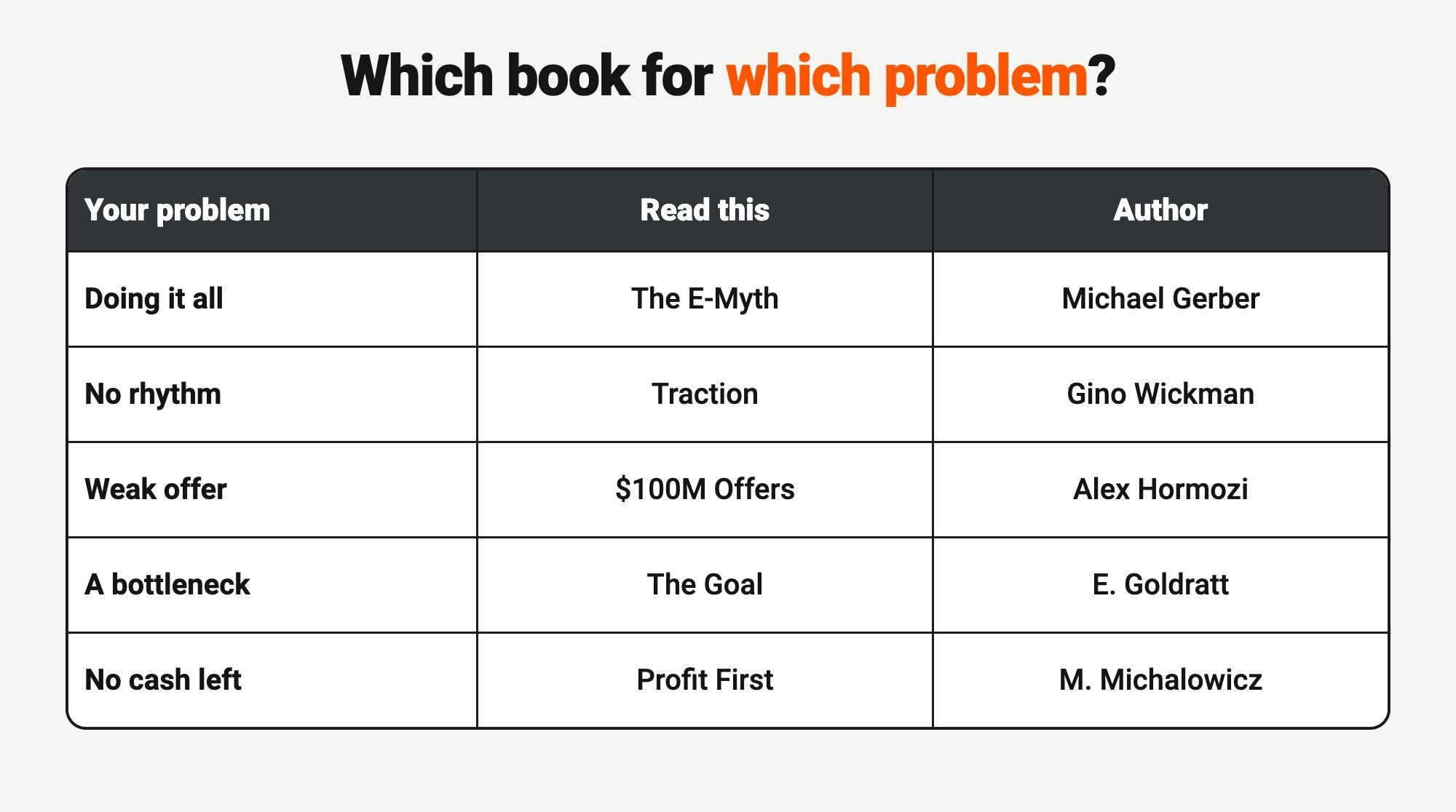
- If you're doing everything yourself: The E-Myth Revisited, Michael E. Gerber.
- If the business has no rhythm: Traction, Gino Wickman.
- If you're scaling past £1m: Scaling Up, Verne Harnish.
- If you want a business that runs without you: Built to Sell, John Warrillow.
- If you can't let go of tasks: Who Not How, Dan Sullivan and Benjamin Hardy.
- If nobody's buying at your price: $100M Offers, Alex Hormozi.
- If nobody knows who you are: Key Person of Influence, Daniel Priestley.
- If work keeps getting stuck somewhere: The Goal, Eliyahu M. Goldratt.
- If there's never any cash left: Profit First, Mike Michalowicz.
- If you keep starting and not finishing: Atomic Habits, James Clear.
Books for getting the business off your shoulders
1. The E-Myth Revisited by Michael E. Gerber
Best for: the owner who is the best technician in the business and therefore does all the work.
Gerber's big idea is that most small businesses are started by people who are good at the work, not at running a business. He splits the owner into three roles (the technician, the manager and the entrepreneur) and argues you should build the business as if it were a franchise prototype: documented, repeatable, not dependent on you. If you've ever thought "it's quicker if I just do it", this is your book.
The drawback: it tells you why to systemise far better than it tells you how. You'll finish fired up and then need something more practical to act on it.
2. Built to Sell by John Warrillow
Best for: service business owners, especially agencies and consultancies, who want a business that could run (or be sold) without them.
It's written as a story about an agency owner who turns a bespoke service into a standardised, repeatable offer and steps out of the day to day. Even if you never plan to sell, the test of "could this run without me?" is a brilliant lens.
The drawback: the fable format is light. Quick to read, but you'll have to do the translation into your own business yourself.
3. Who Not How by Dan Sullivan and Benjamin Hardy
Best for: the founder who instinctively asks "how do I do this?" when the better question is "who could do this?"
The premise is simple and that's its strength. Stop trying to learn and do everything. Find the right people and give them the outcome. Good medicine for owners who hoard tasks.
The drawback: one idea stretched over a whole book. And "find a who" assumes you can afford one. At £150k turnover that's a real constraint, not a mindset problem.
Business growth books for running the machine
4. Traction by Gino Wickman
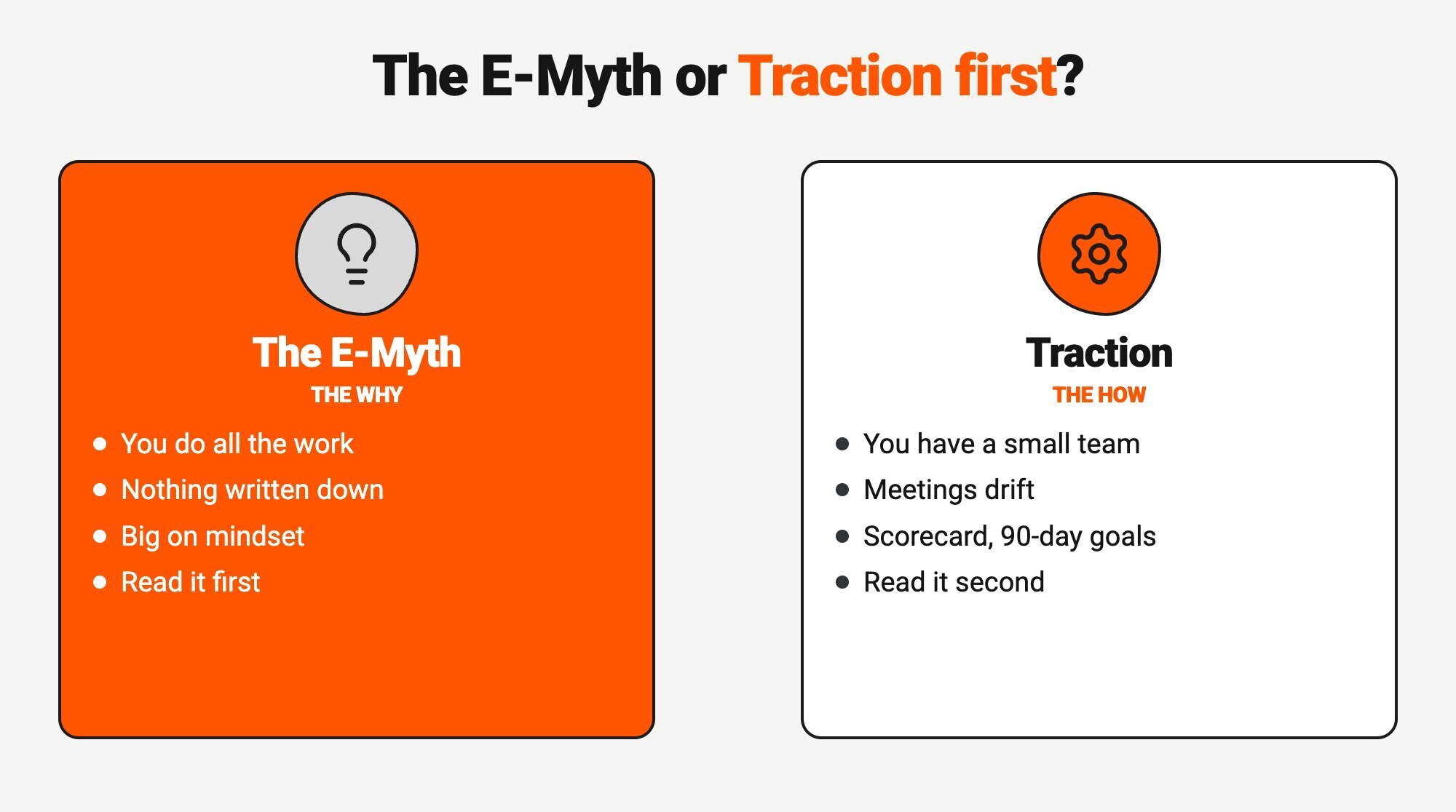
Best for: businesses with a small leadership team where meetings drift, priorities change weekly and nobody owns the numbers.
Traction sets out the Entrepreneurial Operating System (EOS): six components covering vision, people, data, issues, process and traction, plus a weekly meeting rhythm, a scorecard and 90-day priorities. It's practical, which is its big strength.
The drawback: it's a whole system. Adopt half of it and you get the meetings without the results. It also assumes you have a team to run it with.
5. Scaling Up by Verne Harnish
Best for: owners heading past £1m with a growing team who need strategy, execution and cash pulled into one plan.
Harnish organises growth around four decisions (people, strategy, execution and cash) and offers tools like a one-page strategic plan. It's the most complete toolkit on this list.
The drawback: it's dense. For a £300k business with three staff, it can feel like being handed a pilot's manual when you're still learning to drive. Come back to it later.
6. The Goal by Eliyahu M. Goldratt
Best for: anyone whose business has a bottleneck they can feel but can't name.
It's a novel about a plant manager trying to save his factory, and it teaches the Theory of Constraints: find the one constraint that limits the whole system and fix that first. In most founder-led businesses I see, the constraint is the founder.
The drawback: it's set in manufacturing, and the story format is slow if you want the lesson fast. Service business owners have to work to apply it.
Reading won't build the system for you
86% of the 186 UK owners we surveyed have stalled at one of three growth ceilings. The Growth Engine turns the ideas in these books into a Market, Message and Machine for a £100k to £5m business.
Books on selling, offers and getting known
7. $100M Offers by Alex Hormozi
Best for: owners competing on price, or struggling to explain why anyone should pick them.
Hormozi's focus is building an offer so strong it's hard to refuse, using a value equation that looks at the outcome, the likelihood of getting it, the time it takes and the effort involved. For service businesses stuck in a race to the bottom, it's a useful kick.
The drawback: the tone is loud and the examples lean towards gyms and info products. B2B service firms need to tone it down before it hits a procurement team.
8. Key Person of Influence by Daniel Priestley
Best for: founders whose business depends on their reputation but who've never built one deliberately.
Priestley sets out five steps to becoming a known name in your niche: pitch, publish, product, profile and partnership.
The drawback: it can make the founder even more central. If your problem is that sales depend on you, becoming more famous doesn't fix it on its own. Pair it with something about systems.
Books for cash and personal habits
9. Profit First by Mike Michalowicz
Best for: owners whose turnover grows but whose bank balance never seems to.
The method flips the usual sum: take profit first, then run the business on what's left, by splitting income into separate accounts by percentage. Simple, behavioural, and it works because it's hard to ignore.
The drawback: it's written for the US, so tax framing and percentages need adapting. Talk to your accountant before setting it up in the UK.
10. Atomic Habits by James Clear
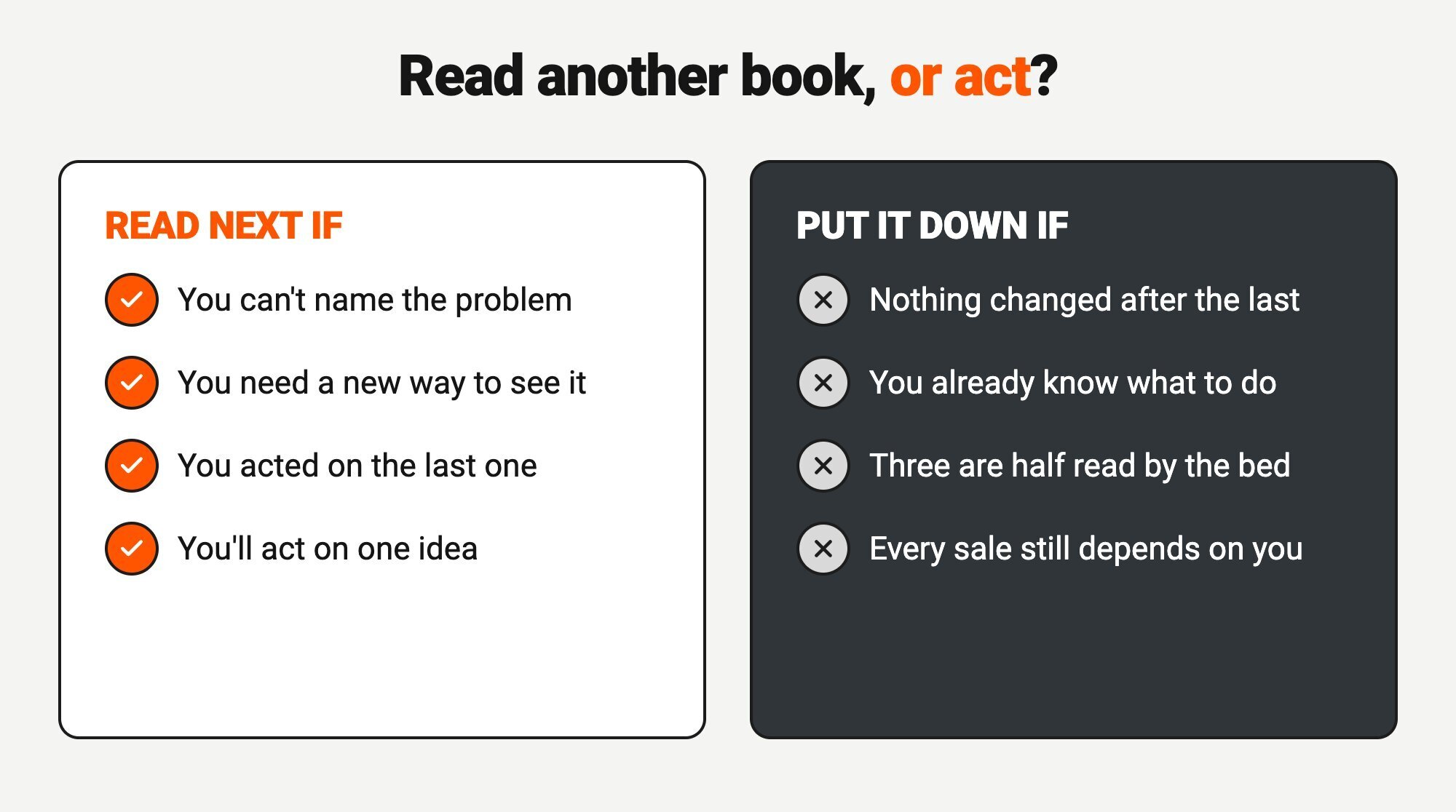
Best for: the founder who knows what to do and keeps not doing it.
Not a business book, but it's about building systems for behaviour: small changes, made easy and repeated. If your plan for weekly content or sales calls keeps dying by week three, this is the fix.
The drawback: it won't tell you what to work on. Great habits around the wrong priorities just get you to the wrong place faster.
Bonus (full disclosure: this one's mine): Work Isn't Working by Chris Gore
Best for: owners thinking about how and where their team works, the workplace and the future of work.
I wrote it, so I'm hardly neutral. It's about the future of work and how workplaces are changing. It's not a growth playbook, so if you're stuck at a ceiling, read the ten above first.
The drawback: it's the least directly relevant book here to growing revenue. I'd rather be honest about that than pretend otherwise.
How to get value from the best business books for small business owners
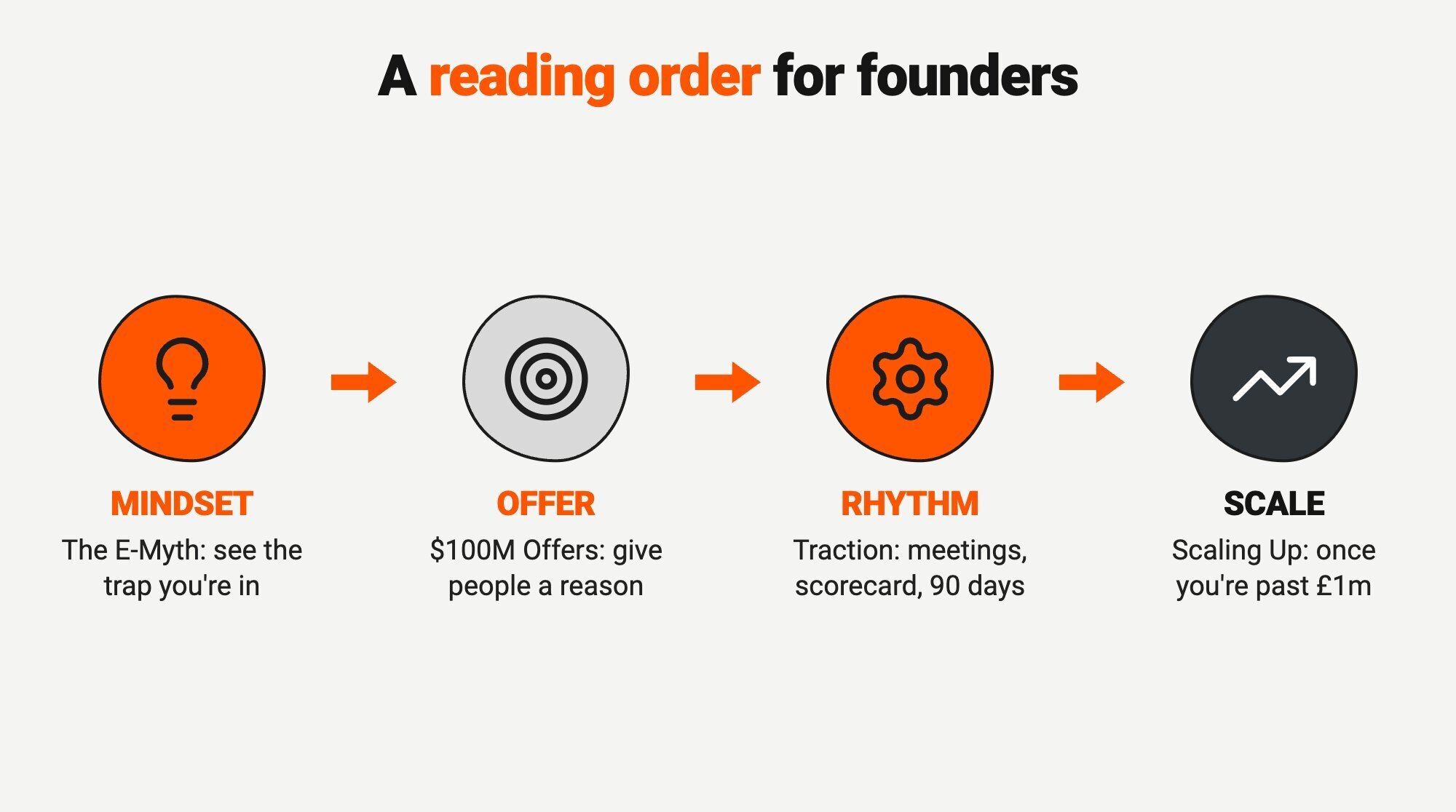
Reading isn't the bottleneck. Doing is. Here's how I'd use this list:
- Pick one problem, one book. Use the quick picks above. Don't read Scaling Up and Traction at the same time and try to install both.
- Read with a notebook. Write down the one change you'll make this month. Just one.
- Make the change before the next book. If you can't name what changed in your business after a book, you didn't finish it, you just read it.
- Get outside eyes. Books can't see your business. A peer group, mentor or coach can. If you're weighing that up, my piece on business coach vs consultant vs mentor covers the difference, and is business coaching worth it is the honest version.
If you want the short version of how these ideas fit together for a UK SME, start with how UK SMEs grow from £100k to £5m, then read about building a lead generation machine that runs without you. And if a structured course appeals more than a reading list, see my roundup of the best business growth programmes for UK SMEs. More lists live in the Best Of category.
Frequently asked questions
What business book should every owner read?
If I had to pick one, The E-Myth Revisited by Michael E. Gerber. It names the trap most small business owners are in, being the technician who does all the work, and makes the case for building a business that doesn't depend on you.
What are the best books for scaling past £1m?
Scaling Up by Verne Harnish and Traction by Gino Wickman. Both give you an operating rhythm for a leadership team. Pick one and implement it properly rather than mixing the two.
Should I read E-Myth or Traction first?
E-Myth first if you're still doing most of the work yourself, because it changes how you see the business. Traction first if you already have a small leadership team and need structure, meetings and a scorecard.
What are the best books on leadership for founders?
For founder-led SMEs, Who Not How is useful for learning to hand work to others, and Traction covers leading a team through a clear rhythm. Pair either with a habit-focused book like Atomic Habits so the changes stick.
Are audiobooks as good as reading?
For story-led books like The Goal or Built to Sell, audio works well. For toolkits like Scaling Up or Traction, I'd want the physical or ebook version so you can go back to the frameworks and make notes.
Download The Growth Engine
The best business books for small business owners give you ideas. The Growth Engine, based on 186 UK business owners, shows how to turn them into a system, including how Squaredot grew from £800k to £1.2m in three months with work from cold leads rising from 6% to 59%.

Hi, we are Business Simplified
Growth shouldn’t depend on you chasing every lead. Business Simplified uses real data to fix your pipeline, increase leads and improve sales, so you can lead your business instead of being trapped running it.
Get Our Growth Engine White Paper
We surveyed 186 UK businesses to find out what growth strategies actually work
We published those findings in our "Growth Engine" whitepaper. You can get a copy here.