Download my Whitepaper here:
By clicking submit, you agree to receive promotional emails and weekly content from Company.

Business Coach vs Consultant vs Mentor: Which Do You Need?
Wednesday, November 04, 2026

Three people who all want to "help you grow". They do very different jobs, charge very differently, and the wrong one at the wrong time is an expensive way to stay stuck.
You know something has to change. Sales still depend on you. Referrals are drying up. The month is either feast or famine and you're the only person who can fix it.
So you start looking for help, and within ten minutes you're drowning in titles. Business coach. Consultant. Mentor. Advisor. They all sound sensible. They all promise growth. And nobody explains the difference in plain English.
In this blog I'll settle the business coach vs consultant vs mentor question properly. I'll explain what each one actually does, what they cost in the UK, who each one is NOT for, and give you a straight "choose this if" verdict. Full disclosure before we start: I run a coaching business. I'll try hard to be fair to the other two, and I'll tell you when coaching is the wrong answer.
Business coach vs consultant vs mentor: the short version
Here's the simplest way I can put it.
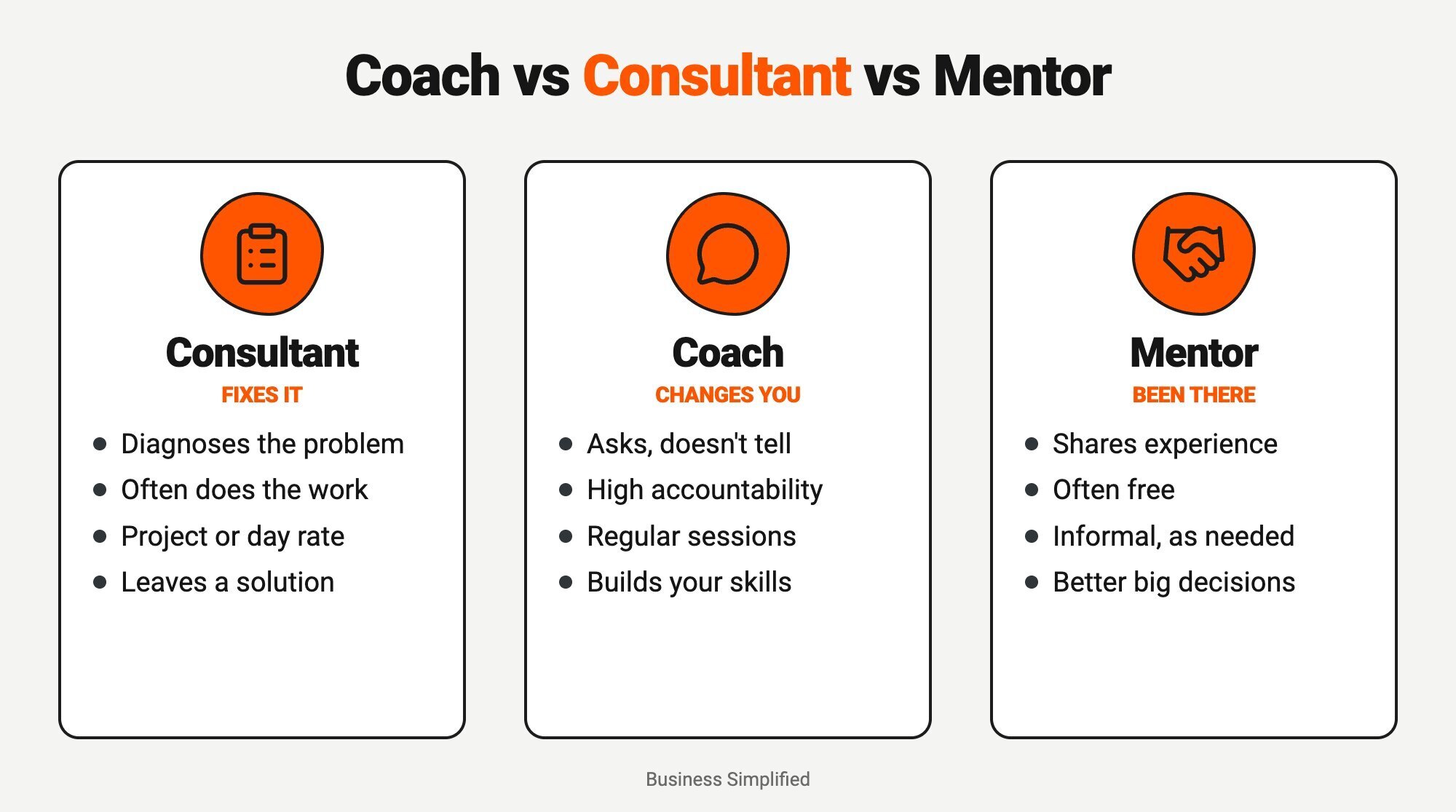
- A consultant does the thinking for you. They diagnose a problem, recommend a fix, and often build it. You're buying their expertise and their time.
- A coach makes you do the thinking. They ask questions, challenge your assumptions, and hold you accountable for doing what you said you'd do. You're buying a change in how you run the business.
- A mentor shares what they've done. They've walked the road before you and tell you where the potholes are. You're buying (or being gifted) their experience.
In real life the lines blur. Plenty of coaches give advice. Plenty of consultants coach. Good mentors ask brilliant questions. But the core job is different, and that's what you should be choosing on.
What a business consultant actually does
A consultant is a specialist you bring in to solve a defined problem. Your pricing is a mess. Your CRM is a graveyard. You need a sales process written down. They come in, work out what's wrong, and hand you a solution.
Where consultants shine:
- Technical problems with a right answer (systems, finance, compliance, process design).
- Projects with a clear start and end.
- When you genuinely don't have the knowledge in house and don't need to learn it.
The honest drawback: when the consultant leaves, the knowledge often leaves with them. If the real problem is that you are the bottleneck, a consultant can build you the most beautiful process in the world and you'll still be the one who has to run it on Monday morning. I've seen plenty of expensive slide decks sitting in a drawer.
Consultants usually charge by the day or by the project. I don't have a verified UK benchmark for consulting day rates, so I won't make one up. Get three quotes and ask exactly what gets delivered.
What a business coach actually does
A coach works on you, and through you on the business. Regular sessions, usually weekly or monthly. They ask awkward questions, help you prioritise, and keep you honest about the stuff you said you'd do last time.
Where coaches shine:
- When you know roughly what to do but keep not doing it.
- When you're stuck at a growth ceiling and can't see why.
- When the business needs you to change how you work: delegating, stepping out of sales, building a team that doesn't need you in every meeting.
The honest drawback: a coach won't do the work. If you want someone to come in and fix it while you carry on as normal, coaching will frustrate you and waste your money. Also, "business coach" isn't a regulated title in the UK. Anyone can call themselves one. Check they've actually grown something.
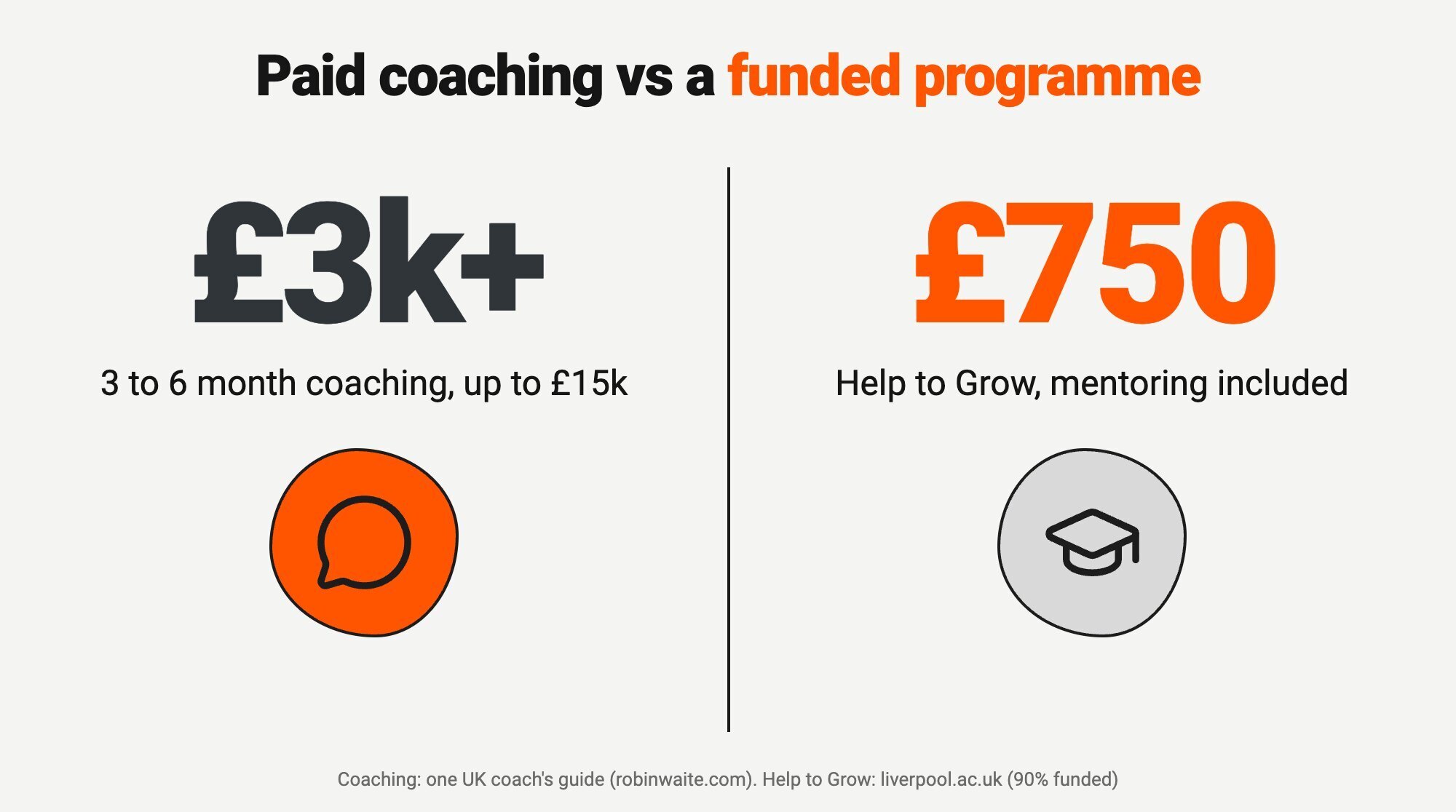
On price, one UK coach's pricing guide puts one-to-one coaching at £100 to £500 an hour, intensive days at £1,000 to £3,000, group programmes at £200 to £800 a month, and 3 to 6 month packages at £3,000 to £15,000. I've broken those numbers down further in how much a business coach costs in the UK.
Not sure what's actually holding you back?
The Growth Engine is our survey of 186 UK business owners. It shows the three growth ceilings most owners hit and which kind of help fits each one, so you can pick the right support first time.
What a business mentor actually does
A mentor is someone who's been where you're trying to go. They've built the business, made the mistakes, hired the wrong people, and survived. They share what they learned.
Where mentors shine:
- Big judgement calls: should I take on investment, sell, open a second office?
- Perspective when you're too close to the problem.
- Introductions and a network you don't have yet.
The honest drawback: a mentor's advice is only as good as how similar their situation was to yours. What worked for someone who scaled a software company in 2010 might be terrible advice for your service business today. And because mentoring is often informal and unpaid, there's usually no structure and no accountability. You get a great coffee, a few nuggets, and then life gets in the way.
Mentoring can also come packaged with other support. The government backed Help to Grow: Management course, for example, includes one-to-one mentoring alongside the taught sessions, and 91% of people who complete it say they'd recommend it. I've written up a full Help to Grow Management review if you want the detail.
Coaching vs mentoring vs consulting: side by side
| Business coach | Consultant | Mentor | |
|---|---|---|---|
| Core job | Changes how you run the business | Fixes a specific problem | Shares their experience |
| Who does the work | You, with support | Mostly them | You |
| Typical format | Regular sessions over months | Project or day rate | Informal, as needed |
| Accountability | High, it's the whole point | To the deliverable | Usually low |
| Typical cost | £200 to £800 a month group; £3,000 to £15,000 for a 3 to 6 month package (one UK guide) | Varies widely; get quotes | Often free or low cost |
| Lasting effect | Builds your capability | Leaves a solution, not always the skill | Better decisions |
Which do you need? It depends on your growth ceiling
This is the bit most comparison articles skip. The right choice isn't about which one is "best". It's about what's actually stopping you growing.
In our Growth Engine research (Business Simplified survey of 186 UK business owners, 2026), 77% of owners said they still personally win most of their new business, and 86% had stalled at one of three growth ceilings. That tells me most owners don't have a knowledge problem. They have a founder dependency problem. And you can't consult your way out of founder dependency, because the fix involves you changing what you do every day.
I learned this the hard way. I grew SPOR to around £5m in about three years, then got stuck trying to reach £7.5m. I hired a sales team, which turned me from a seller into a manager, and I went round in circles for two years. More expertise wasn't the missing piece. A system that didn't rely on me was. If that sounds familiar, read why 98% of UK businesses never reach £1m.
A quick way to decide
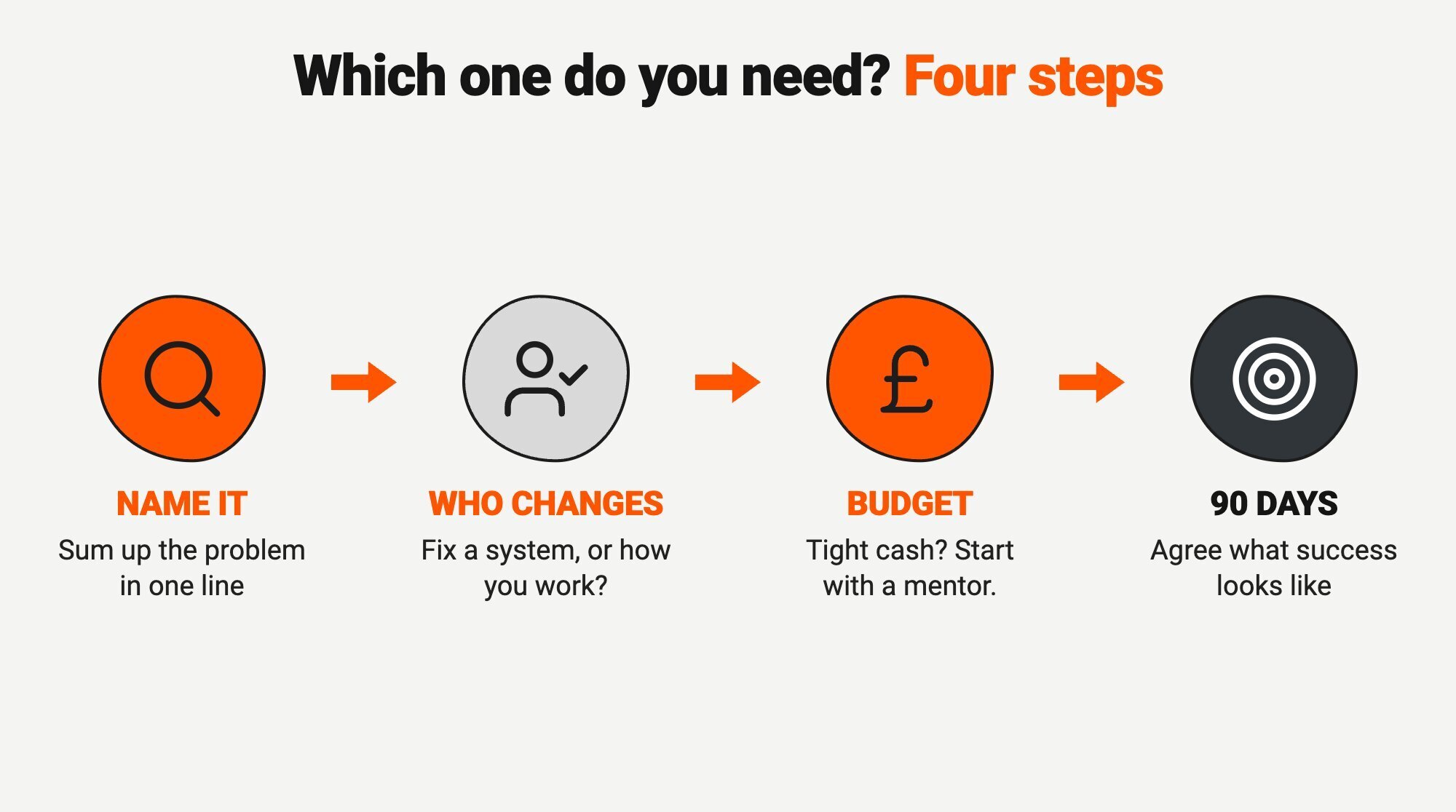
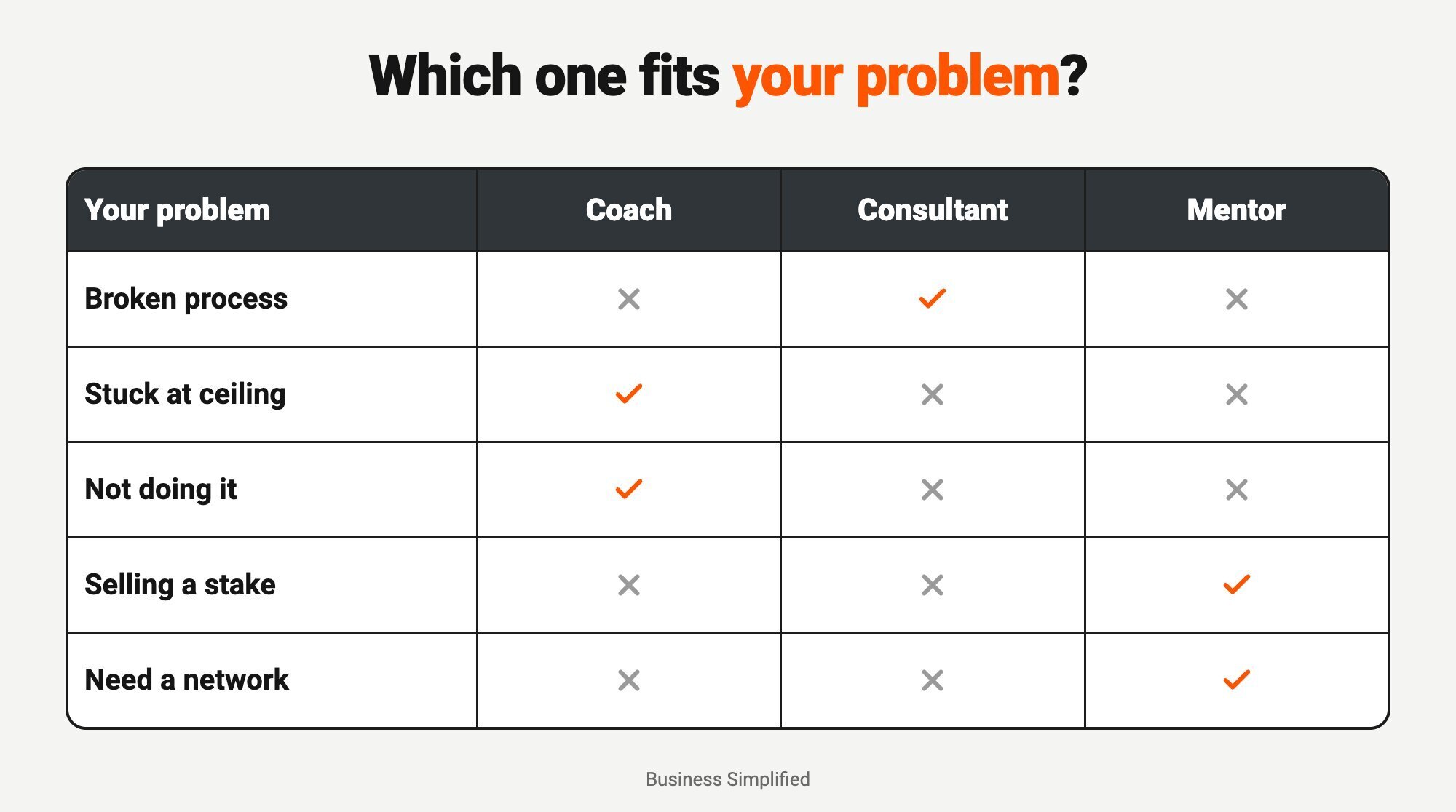
- Name the problem in one sentence. "Our quoting process is broken" is a consultant problem. "I can't stop being the bottleneck" is a coaching problem. "Should I sell a stake to a partner?" is a mentor problem.
- Ask who needs to change. If it's a system, buy expertise. If it's you, buy coaching.
- Check the budget honestly. If cash is tight, start with a mentor or a funded programme before you commit to a long paid contract.
- Agree what success looks like in 90 days. Whoever you pick should be able to tell you.
The verdict: business coach vs consultant vs mentor
Choose a consultant if you have a specific, technical problem with a clear end point, you don't need to learn the skill yourself, and you've got the budget to pay for someone else's time.
Choose a business coach if you're stuck at a ceiling, the business still runs through you, and you're willing to do the work between sessions. Don't choose a coach if you want someone to do it for you. I've written a whole piece on when you should NOT hire a business coach, and I'd rather you read that than waste money.
Choose a mentor if you need perspective on big decisions, you've found someone who's genuinely been where you're going, and you're happy to supply your own accountability.
And yes, you can use more than one. A mentor for the big calls, a consultant for a specific project, and a coach to make sure you actually change. Just don't hire all three at once and call it a strategy. For more head to head comparisons like this, see the rest of our Head to Head posts.
Frequently asked questions
What is the difference between a coach and a consultant?
A consultant tells you what to do and often does it for you. A coach helps you work out what to do and holds you accountable for doing it. Consultants fix problems; coaches build your ability to fix them yourself.
Is a mentor free?
Often, yes. Many mentors help informally because someone once helped them. Some charge, and some mentoring comes bundled into programmes like Help to Grow: Management. Free doesn't mean structured, so set expectations early.
Which is best for a £1m business?
It depends on what's stopping you. If the business still depends on you to win work, a coach is usually the best fit. If you have a specific technical gap, hire a consultant. If you face a big strategic decision, find a mentor who's made it before.
Can one person be all three?
Sometimes. Good advisors switch between coaching, advising and sharing experience. Just be clear about which hat they're wearing, because "do it this way" and "what do you think?" are very different conversations.
Which costs more?
Mentors are usually the cheapest, often free. Coaching and consulting vary widely. One UK coach's pricing guide puts coaching at £100 to £500 an hour or £3,000 to £15,000 for a 3 to 6 month package. Consultants are usually priced per day or per project, so get quotes.
Download The Growth Engine
Before you settle business coach vs consultant vs mentor and pay anyone to help, find out which growth ceiling you're actually stuck at. The Growth Engine shares what 186 UK business owners told us, plus the Market, Message and Machine framework and how UK SMEs grow from £100k to £5m.

Hi, we are Business Simplified
Growth shouldn’t depend on you chasing every lead. Business Simplified uses real data to fix your pipeline, increase leads and improve sales, so you can lead your business instead of being trapped running it.
Get Our Growth Engine White Paper
We surveyed 186 UK businesses to find out what growth strategies actually work
We published those findings in our "Growth Engine" whitepaper. You can get a copy here.