Download my Whitepaper here:
By clicking submit, you agree to receive promotional emails and weekly content from Company.

HubSpot Starter Review: Is It Enough for a UK Small Business?
Wednesday, November 04, 2026

HubSpot Starter is the paid plan most small businesses look at first. This is my honest HubSpot Starter review as a founder who pays for HubSpot, uses it every week, and earns nothing if you sign up.
You've got leads in your inbox, quotes in a spreadsheet, follow-ups on sticky notes and a nagging feeling that something slipped through the cracks last month. It probably did.
So you start looking at CRMs. Every review you find is written by a HubSpot partner who wants to sell you an onboarding package, or by an American blog comparing 47 tools you'll never use. Neither tells you whether HubSpot Starter is actually enough for a UK business turning over £300k with three people in the office.
We use HubSpot at SPOR. My one line summary? Brilliant, but not cheap. In this blog I'll cover who HubSpot Starter is for, what it costs in the UK, the honest pros and cons, who should not touch it, and my verdict on whether it's enough for a small business like yours.
HubSpot Starter review: the short version
If you only read one section, read this one.
- What it is: the entry level paid tier of HubSpot. A proper CRM with email marketing, forms, simple automation, a meetings link and sales pipelines bolted on.
- Who it suits: founder-led UK businesses with a small team who need one place for contacts, deals and follow-ups, and who want to start sending decent email to their list.
- What it costs: one UK HubSpot partner lists the Starter Customer Platform at £18 a month per seat, billed annually, excluding VAT. Check current pricing before you commit.
- The catch: HubSpot is designed to grow with you, which also means it's designed to grow its invoice with you. Starter is the front door, not the whole house.
My verdict, up front: for most UK small businesses between £100k and £1m, HubSpot Starter is enough. The question isn't whether the software can cope. It's whether you'll actually use it.
Who HubSpot Starter is for
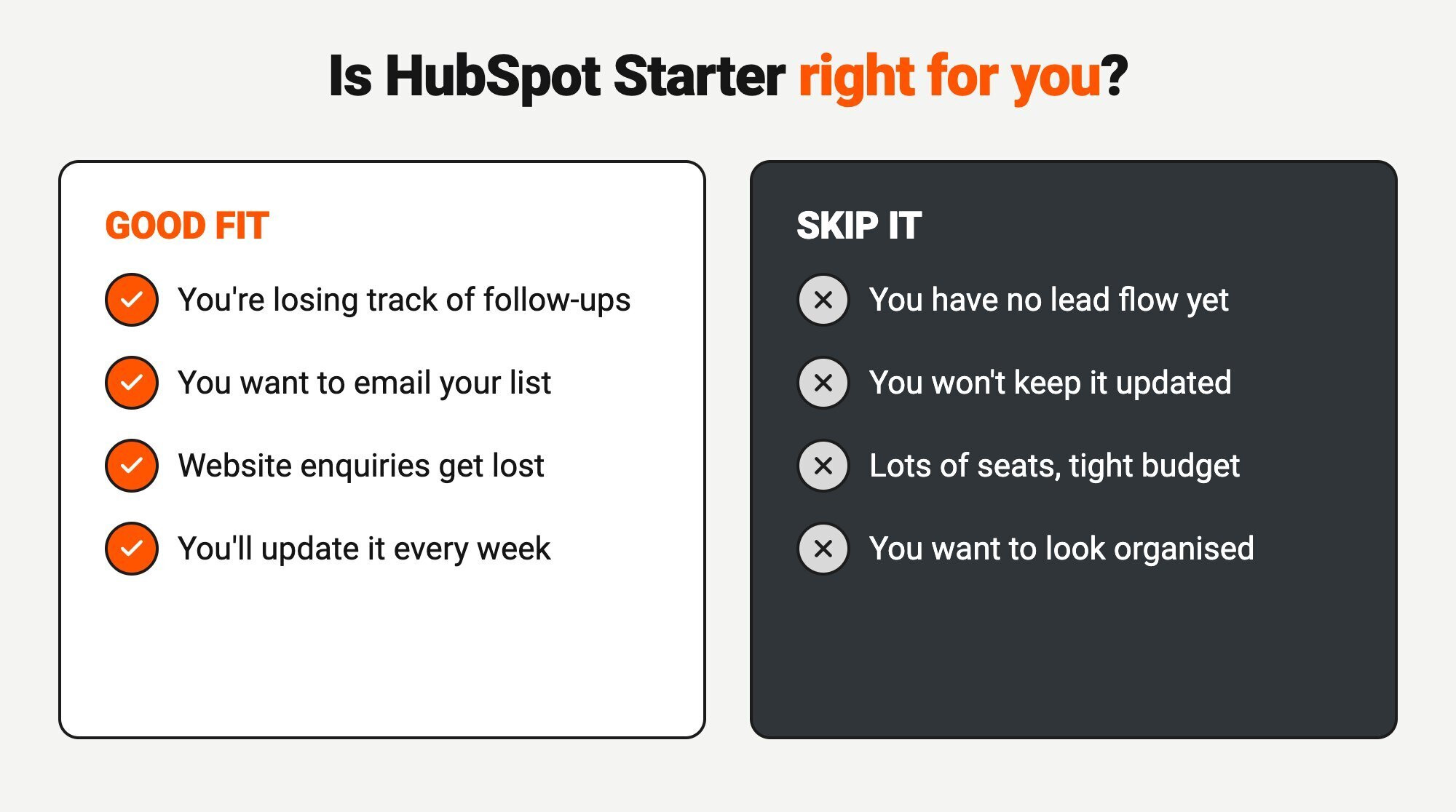
HubSpot Starter makes the most sense if you recognise yourself in at least two of these:
- You (or one or two people) handle sales, and you've lost track of who you've quoted and when.
- You've got a list of past clients and enquiries you never email because it lives in five different places.
- You want enquiries from your website to land somewhere sensible, not just in your inbox.
- You spend too long playing diary tennis to book discovery calls.
- You're planning to grow the team and want the basics in place before you hire.
That last point matters. If you're thinking about bringing in a salesperson (and you should read the real cost of hiring a salesperson in the UK before you do), a CRM isn't optional. You can't manage a pipeline you can't see.
HubSpot Starter price in the UK
Here's what I can tell you with a source behind it. UK HubSpot partner SpotDev lists the Starter Customer Platform at £18 a month per seat, billed annually, excluding VAT (checked July 2026). HubSpot changes its packaging and pricing regularly, so check current pricing on the official HubSpot pricing page before you sign anything.
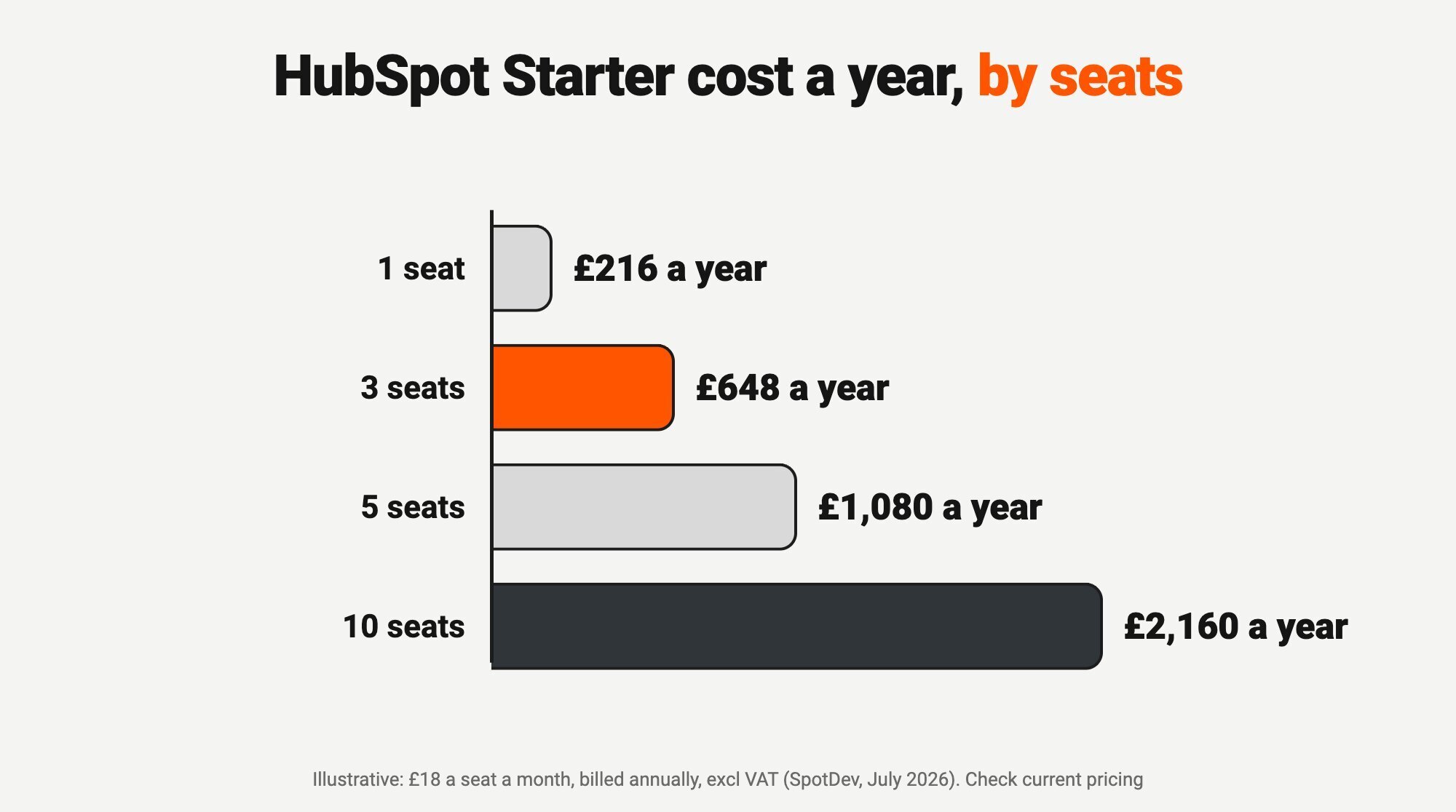
Let's do some quick maths so you know what you're walking into. Three seats at £18 a month, billed annually, comes to £648 a year before VAT (illustrative, based on that £18 figure). For a business turning over £300k, that's a rounding error compared to one lost deal.
Where people get caught out isn't Starter. It's what comes next. The jump from Starter to Professional is significant, and it's easy to talk yourself into it because a feature looks shiny. Budget for Starter. Treat Professional as a decision you make later, with evidence, not on a sales call.
If you're working out where your CRM sits within your overall spend, my post on how much a small business should spend on marketing will help you put it in context.
What you actually get with HubSpot Starter
I'm not going to list every feature and limit, partly because HubSpot changes them often and partly because most reviews that do are out of date within a quarter. At a level that's safely true, Starter gives you:
- A proper CRM: contacts, companies and deals in one place, with history attached.
- Sales pipelines: so you can see every open deal and what stage it's at.
- Email marketing: send newsletters and campaigns to your contacts from the same system.
- Forms: capture enquiries from your website straight into the CRM.
- Simple automation: basic follow-ups and tasks so things don't rely on your memory.
- A meetings link: people book time in your diary without the back and forth.
For specific limits (contacts, emails, automation depth), check HubSpot's own pricing page. Don't rely on a blog, including this one.
A CRM won't fix a growth problem on its own
The Growth Engine is our survey of 186 UK business owners turning over £100k to £5m. It shows where businesses stall and how the Market, Message and Machine framework gets them moving, so your CRM has something to run.
HubSpot Starter pros
It's genuinely easy to start
Most of the team will get the hang of logging a deal or a note without a training day. That matters, because a CRM nobody updates is just an expensive address book.
Everything lives in one place
Contacts, deals, emails, forms and meetings sitting in the same system means you stop asking "who spoke to them last?" across the office.
It grows with you
If the business takes off, you're not ripping out your CRM in two years. You add seats or move up a tier. That's a real advantage over cheaper tools you'll outgrow.
The ecosystem is huge
There are plenty of integrations, tutorials and UK partners around. When you get stuck, someone has usually written about it.
HubSpot Starter cons
It's not cheap once you grow
Starter itself is reasonable. But every extra seat costs, and the next tier up is a big step. "Brilliant but not cheap" is the most honest thing I can say about HubSpot overall.
The upsell is constant
You'll regularly see features you can't use without upgrading. It's a clever business model. It's also mildly annoying when you just want to get on with your day.
Software doesn't create discipline
This is the big one. Starter can hold your pipeline, but it can't make you follow up. In The Growth Engine research, 77% of UK owners said they still personally win most new business (Business Simplified survey of 186 UK business owners, 2026). If that's you, the CRM is only as good as the hour a week you give it.
Setup takes thought
You can be up and running quickly, but getting pipelines, properties and automations right takes planning. Rushed setup creates messy data, and messy data kills trust in the system.
HubSpot free vs Starter vs Professional: when to upgrade
Here's how I'd think about the HubSpot free vs Starter decision, and when Starter vs Professional becomes a real question.
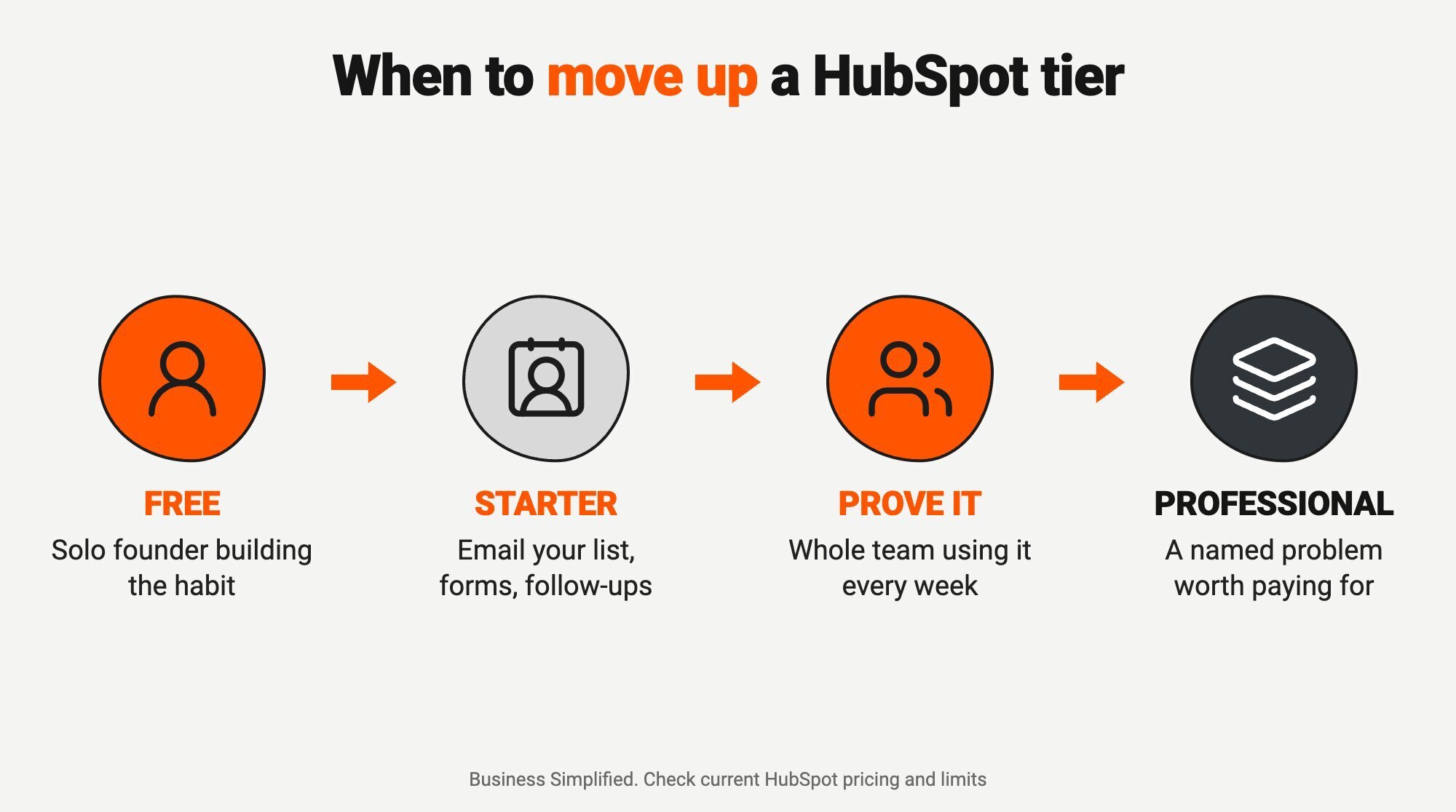
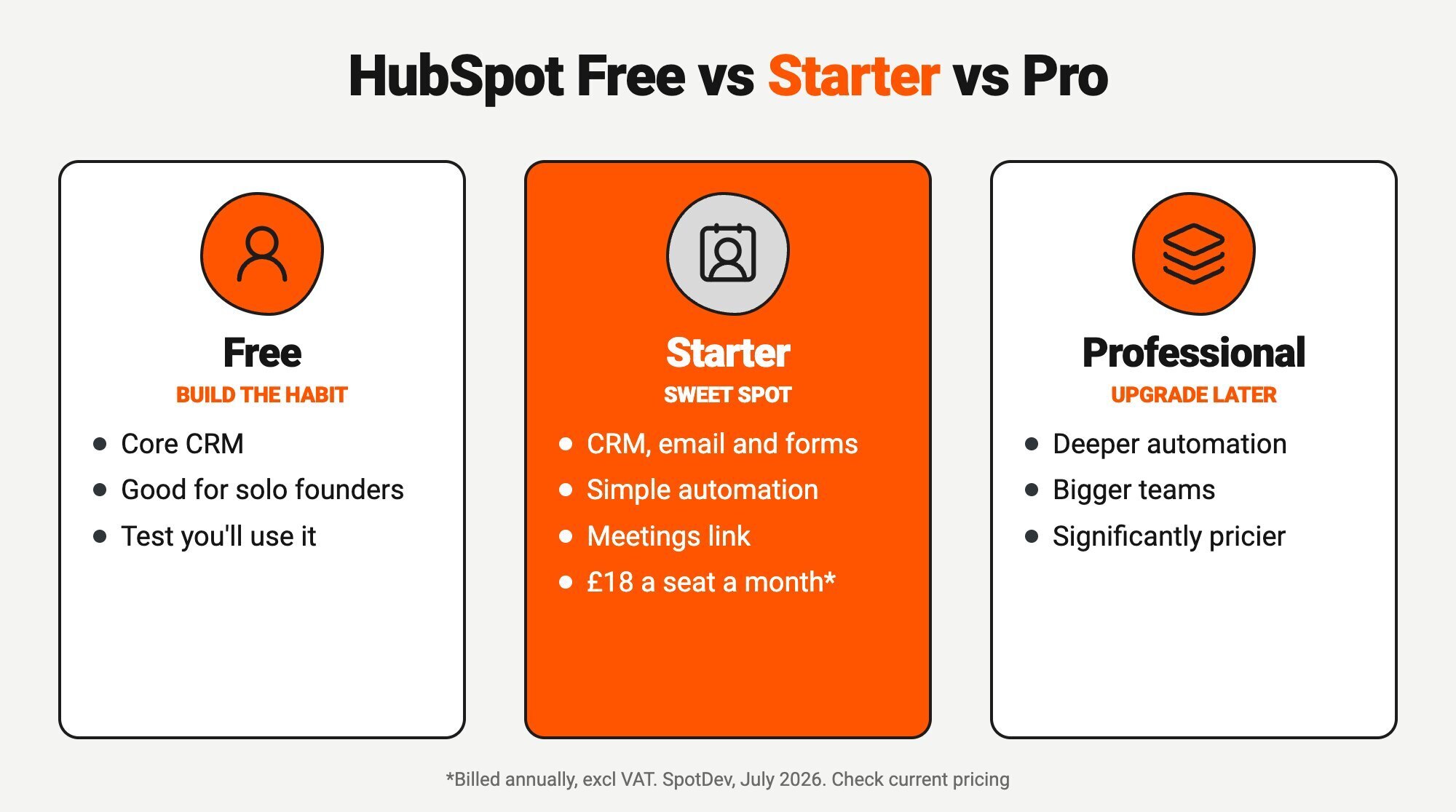
Stay on free if you're a solo founder testing whether you'll actually use a CRM at all. Build the habit first. If you won't log deals on a free tool, you won't log them on a paid one.
Move to Starter when you're sending email to your list, capturing enquiries from your website and want simple follow-ups running without you. For most founder-led businesses under £1m, this is where you'll sit for a good while.
Consider Professional only when you've got a clear, specific problem Starter can't solve, a team that's using the system properly, and a number that shows the upgrade pays for itself. If you can't name the problem in one sentence, you're not ready.
If you're still choosing between HubSpot and the alternatives, I've compared them in the best CRM for a small UK business. And if you're wondering how HubSpot stacks up against an all in one funnel tool, read my ClickFunnels 2.0 review, which is what I run Business Simplified on.
Who should NOT use HubSpot Starter
Being honest about who it's wrong for is the point of this category. Skip HubSpot Starter if:
- You have no lead flow to manage. A CRM organises leads. It doesn't create them. Fix that first with a lead generation process.
- You won't update it. If you know you'll stop logging deals after week three, save your money.
- You need lots of seats on a tight budget. Per seat pricing adds up fast with a bigger sales team.
- You're buying it to look organised. Software is not a strategy. I've watched businesses spend months configuring a CRM to avoid picking up the phone.
My verdict: is HubSpot Starter enough for a UK small business?
Yes, for most. My HubSpot Starter review comes down to this: it's a well built, easy to use CRM with enough email, forms and automation to run a founder-led business turning over £100k to £1m. You'll outgrow the free plan quickly and you probably won't need Professional for a while.
But I'll say it again because it's the thing nobody selling HubSpot will tell you. The tool is the easy bit. What matters is the system around it: who you target, what you say, and the machine that brings leads in without relying on you. That's exactly what I wrote about in building a lead generation machine that runs without you.
Get that right and HubSpot Starter will feel like a bargain. Get it wrong and it'll feel like a monthly reminder of the follow-ups you didn't do. For more honest reviews like this one, browse the Tools Tested category.
Frequently asked questions
How much is HubSpot Starter in the UK?
One UK partner lists the Starter Customer Platform at £18 a month per seat, billed annually, excluding VAT (checked July 2026). Pricing changes, so check the official HubSpot pricing page before you buy.
Is the free HubSpot CRM enough?
For a solo founder building the habit of logging contacts and deals, often yes. Once you want email marketing to your list, website forms and simple follow-up automation in one place, Starter is usually the better fit.
When should you upgrade to HubSpot Professional?
Only when your team is using Starter properly and you can name a specific problem it can't solve, with numbers showing the upgrade pays for itself. Not because a feature looks nice on a demo.
What are the limits of HubSpot Starter?
HubSpot changes its limits regularly, so check the current details on its pricing page rather than trusting any blog. In practice, the bigger limit is usually your team's discipline, not the software.
Is HubSpot worth it for 1 to 5 users?
In my opinion, yes, if you'll use it every week. At that size Starter is affordable, easy to learn and won't need replacing as you grow. If you won't keep it updated, no CRM is worth it.
Download The Growth Engine
86% of UK owners we surveyed have stalled at one of three growth ceilings. The Growth Engine shows you which one you're at and how to build the Market, Message and Machine that gets you past it, so your CRM is full of the right leads.

Hi, we are Business Simplified
Growth shouldn’t depend on you chasing every lead. Business Simplified uses real data to fix your pipeline, increase leads and improve sales, so you can lead your business instead of being trapped running it.
Get Our Growth Engine White Paper
We surveyed 186 UK businesses to find out what growth strategies actually work
We published those findings in our "Growth Engine" whitepaper. You can get a copy here.